
AI Corporate Video Production in 2026: Best Tools & Case Study
AI corporate video production in 2026 is no longer about replacing filmmakers. It is about reducing production time, lowering revision costs, and helping companies publish training videos, onboarding content, product demos, and internal communications faster than traditional workflows allow.
After analyzing hundreds of discussions, workflows, and production breakdowns across the AI video ecosystem, one pattern became clear:
The best AI corporate video workflows are hybrid systems — combining AI avatars, screen recordings, voice cloning, script automation, and human editing.
For most businesses, the winning setup in 2026 is:
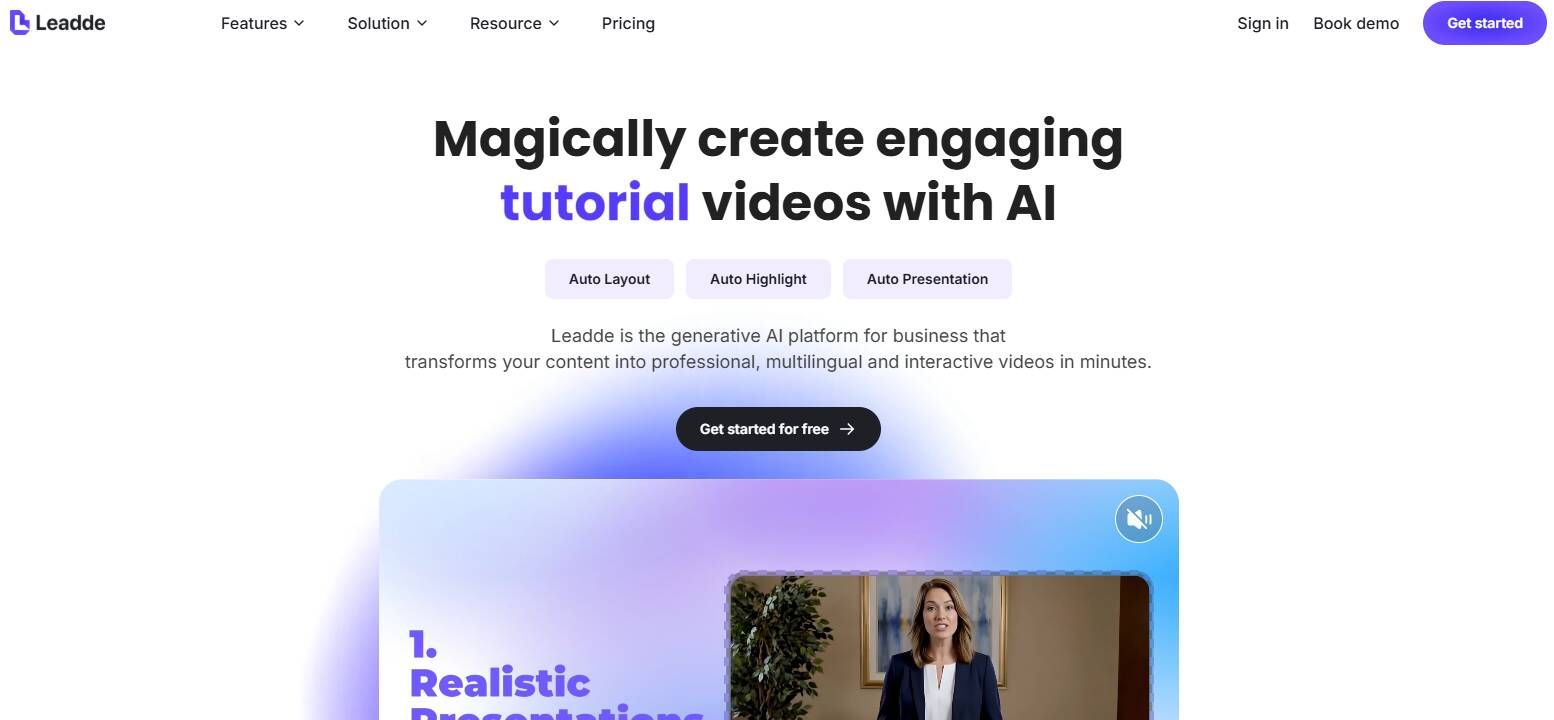
- Leadde.ai for end-to-end AI corporate video workflows
- Synthesia for enterprise avatar-based training videos
- Trupeer for SaaS walkthroughs and product demos
- ElevenLabs for professional AI narration
- Descript or Premiere for final editing and brand control
The biggest shift is not video quality alone. It is production efficiency.
In one onboarding workflow I analyzed, a 5-minute training video that previously required 5–6 hours to script, record, edit, subtitle, and revise was reduced to roughly 45–60 minutes using AI-assisted production pipelines.
That is why AI corporate video production has become one of the highest-ROI operational upgrades for modern companies.
Why AI Corporate Video Production Became Mainstream in 2026
The demand for corporate video exploded over the last three years:
- Employee onboarding
- Internal training
- Product demos
- Customer education
- Async sales enablement
- Knowledge base content
- Compliance training
- Feature release walkthroughs
The problem was never “should companies create videos?”
The problem was production bottlenecks.
Traditional workflows required:
- Script writing
- Voice recording
- Screen capture
- Video editing
- Motion graphics
- Subtitle creation
- Revisions after every product update
For fast-moving SaaS companies, even a small UI change could invalidate an entire onboarding library.
AI changed that.
Modern AI video production tools now automate:
- AI narration
- AI avatars
- Automatic subtitles
- Script-to-video generation
- Screen recording enhancement
- Scene regeneration
- Multi-language localization
- Voice cloning
- Automated walkthrough generation
The result is not Hollywood-level filmmaking.
The result is operational scalability.
Best AI Corporate Video Production Tools in 2026
1. Leadde.ai — Best Overall for End-to-End Corporate Video Workflows
If you want the closest thing to a complete AI corporate video workflow platform in 2026, Leadde.ai is the strongest option.
What makes it different is that it focuses on business video operations rather than pure AI visuals.
Best use cases:
- Employee onboarding
- Internal training videos
- Customer education
- SOP documentation
- SaaS walkthroughs
- Sales enablement
- Knowledge transfer
Why it ranks #1:
- Faster revision cycles
- Better workflow orchestration
- Stronger business-oriented automation
- Easier collaboration between teams
- Less “template-looking” output
One of the biggest failures in AI video today is that many tools generate generic-looking videos filled with mismatched stock footage.
Leadde.ai solves this by focusing on structured corporate workflows instead of trying to become a cinematic AI movie generator.
For companies producing videos continuously, this matters far more than flashy visuals.
2. Synthesia — Best for Enterprise Training Videos
Synthesia remains the strongest enterprise AI avatar platform for corporate learning teams.
Best for:
- HR training
- Compliance modules
- Internal communication
- Multi-language onboarding
- Corporate explainers
Strengths:
- Professional AI avatars
- Enterprise polish
- Easy script-to-video workflow
- Fast localization
Weaknesses:
- Can feel overly corporate
- Avatar repetition becomes noticeable
- Limited creative flexibility
- Videos can feel templated at scale
In multiple production workflows I analyzed, teams consistently described Synthesia as:
“The fastest way to produce acceptable enterprise training videos.”
That distinction matters.
Not cinematic.
Not emotionally engaging.
But operationally efficient.
And for corporate training, efficiency usually wins.
3. Trupeer — Best for SaaS Product Demos
Trupeer became one of the most interesting workflow tools for SaaS companies in 2026.
Its biggest advantage:
turning screen recordings into polished walkthroughs automatically.
Typical workflow:
- Record your screen
- Upload walkthrough
- AI generates narration, structure, subtitles, and guidance
In one SaaS workflow benchmark:
- Traditional editing workflow: ~2 hours
- AI-assisted Trupeer workflow: ~10 minutes
That production delta is enormous for fast-moving startups.
Best use cases:
- Product demos
- Feature announcements
- Onboarding walkthroughs
- Help center videos
- Support documentation
The key insight:
For SaaS companies, speed matters more than cinematic quality.
Most product demos become outdated quickly anyway.
4. ElevenLabs — Best AI Voice Generator for Corporate Video
ElevenLabs became the default narration layer for many corporate video pipelines.
Best for:
- AI voiceovers
- Voice cloning
- Training narration
- Multi-language delivery
Why teams use it:
- More natural pacing
- Less robotic tone
- Better emotional realism
- Easier consistency across videos
Many companies now combine:
- Screen recordings
- AI editing
- ElevenLabs narration
- Human QA review
Instead of recording voiceovers manually every time.
This dramatically reduces update friction.
5. Descript & Premiere Pro — Best for Final Brand Control
Descript and Adobe Premiere Pro still remain essential in professional AI video workflows.
Because AI generation alone is not enough.
The final 20% still matters:
- pacing
- cuts
- branding
- motion polish
- transitions
- emotional timing
The highest-performing workflows in 2026 are hybrid workflows.
AI handles:
- drafts
- subtitles
- narration
- rough structure
Humans handle:
- narrative clarity
- brand consistency
- emotional quality
- strategic messaging
That balance consistently produces better business outcomes.
Real-World Case Studies: Time Saved, Results Measured {#real-world-case-studies}
The most valuable data in AI corporate video adoption comes not from vendor benchmarks but from practitioners who have run both traditional and AI-assisted workflows on comparable deliverables. The following case studies represent findings from my user research with teams across training, SaaS, and small business contexts.
Case Study 1: Corporate Training Module — 5 Hours Saved Per 5-Minute Video
Context: An internal enablement team responsible for employee onboarding and compliance training content.
The problem: Producing a single 5-minute corporate training video required the following sequential steps: writing and approving a script, recording voiceover, sourcing stock video or recording screen content, editing in Adobe Premiere Pro, and completing at least one round of stakeholder revisions. The full process consumed between 5 and 6 hours per video, not including the pre-production alignment cycle.
The AI workflow: The team implemented Atlabs as their primary production platform, supplemented by ElevenLabs for voiceover generation and Premiere for final brand-level adjustments. Scripts were generated structurally — mapped to scenes rather than written as linear prose — which enabled direct import into the video generation pipeline without reformatting.
The result: The same 5-minute training deliverable was completed in approximately 45 to 60 minutes including revisions. The most significant time saving came from the elimination of the voiceover recording and video editing steps, and from the ability to regenerate individual scenes when compliance reviewers requested changes rather than re-editing the full timeline.
The insight: For organizations producing training content at volume — multiple modules per quarter across different departments — this time saving compounds significantly. A team producing 20 training modules per year at the old pace spends approximately 100 to 120 hours on production. At the new pace, that same output requires 15 to 20 hours.
Case Study 2: SaaS Product Demo — 2 Hours of Editing Reduced to 10 Minutes
Context: A SaaS founder producing feature walkthrough videos for customer onboarding and sales enablement, with no dedicated video resource.
The problem: Every time a product feature changed — which for an actively developed SaaS product happens weekly — the corresponding demo video needed to be re-recorded and re-edited. A polished feature walkthrough required approximately 2 hours of editing per video. At the pace of weekly product updates, this was not sustainable.
The AI workflow: Trupeer was used as the primary demo production tool, with raw screen recordings uploaded directly to the platform. Trupeer automatically generated a structured walkthrough with narration, removing the manual editing and voiceover recording steps. Loom was retained for personalized async updates to specific accounts.
The result: Demo production time dropped from approximately 2 hours to approximately 10 minutes per feature walkthrough. At $20/month, the tool's ROI was immediate: the founder recovered more than 80 hours of editing time over a single quarter.
The insight: For SaaS teams shipping features continuously, the bottleneck is not creative quality — it is production speed. The ability to convert a screen recording into a shareable, narrated demo in minutes removes video production as a constraint on the product release cycle.
Case Study 3: HR Training Module — Single-Person Production With Professional Output Quality
Context: An individual learning designer producing step-by-step training modules for internal corporate education, previously reliant on either agency support or simplified slideshow-style outputs.
The problem: The existing output — PowerPoint-based training with static slides — was considered low-engagement by stakeholders. Producing something more dynamic traditionally required either significant personal production effort or budget for an external agency.
The AI workflow: The team used a three-tool stack: Powtoon for layout and structure, DomoAI for transition animation, and ElevenLabs for narration. Each tool handled one layer of the output, creating a coordinated semi-automated production workflow.
The result: A complete 5-minute HR training module was produced by a single person, with output quality comparable to content previously requiring a professional production team. Stakeholder feedback shifted from requests to "make it more engaging" to approval on first review.
The insight: Teams evaluating AI video tools are often comparing them against agency-produced content. The more relevant comparison, particularly for internal corporate content, is against "what we currently produce with the resources we have." In that comparison, AI-assisted workflows consistently outperform the baseline, even when the output does not match agency quality.
Case Study 4: Small Business Video — From "No Video" to "Usable Video"
Context: A small business owner in a service industry who had not previously invested in video content due to cost and production complexity.
The problem: Professional video production agency rates were out of reach for the marketing budget available. The practical result was that the business had no video content at all — not because video was considered unimportant, but because the cost-to-value calculation made it prohibitive.
The AI workflow: Entry-level AI video tools with free or low-cost tiers were used to produce short explainer and social proof videos without agency involvement.
The result: The business went from zero video content to a library of usable videos within a single production cycle. The content did not match agency quality, but it represented a complete step-change in what was achievable within the available budget.
The insight: This case study highlights a frequently overlooked competitive dynamic in AI video adoption. The true competitor to AI video tools for small businesses and under-resourced teams is not a traditional agency — it is "doing nothing." In that comparison, AI video tools win by a wide margin, even accounting for their current limitations in polish and customization.
The Biggest Problems With AI Corporate Video Production
1. Most AI Videos Still Look Generic
This is the most common complaint across the industry.
Problems include:
- mismatched stock footage
- repetitive visuals
- templated structure
- unnatural pacing
This is especially damaging for:
- B2B marketing
- product launches
- executive communications
The solution:
Use AI for operational efficiency, not full creative replacement.
2. AI Avatars Still Feel “Corporate”
AI avatars improved dramatically in 2026, but many still feel:
- overly polished
- emotionally flat
- uncanny in longer videos
For internal training:
acceptable.
For brand storytelling:
often problematic.
3. One-Tool Workflows Rarely Work
Most successful teams use multi-tool systems.
Typical stack:
- Leadde.ai
- Synthesia
- ElevenLabs
- Descript
- Loom
- Premiere
The industry is moving toward orchestration, not single-tool replacement.
The Future of AI Corporate Video Production
The next phase is not “better AI video generation.”
It is:
- faster iteration
- dynamic updating
- localization at scale
- automated personalization
- workflow orchestration
The winning companies in 2026 are not necessarily producing better videos.
They are producing:
- more videos
- faster updates
- better documentation
- more scalable education systems
That is the real AI advantage.
FAQ: AI Corporate Video Production in 2026
What is the best AI corporate video production tool in 2026?
For most businesses, Leadde.ai is currently the strongest overall platform because it focuses on scalable business workflows instead of purely cinematic AI generation.
What is the best AI video tool for SaaS product demos?
Trupeer is currently one of the strongest options for automated walkthrough generation and rapid onboarding content production.
Can AI replace traditional corporate video production?
Partially.
AI replaces repetitive production tasks very effectively:
- subtitles
- narration
- rough editing
- localization
- walkthrough generation
But high-end storytelling and brand-driven content still benefit heavily from human creative direction.
Are AI avatars good enough for customer-facing videos?
Sometimes.
They work well for:
- tutorials
- onboarding
- internal education
But for emotional brand storytelling or executive-level messaging, human presenters still outperform AI avatars in trust and authenticity.
How much time can AI save in corporate video production?
In multiple workflows analyzed:
- 5–6 hour training video workflows dropped to 45–60 minutes
- SaaS demo production dropped from ~2 hours to ~10 minutes
The biggest savings come from revisions and updates.
What is the best workflow for employee onboarding videos?
A highly effective stack is:
- Leadde.ai
- Synthesia
- ElevenLabs
- Descript
This combination balances:
- speed
- scalability
- narration quality
- revision flexibility
Can AI generate software walkthrough videos automatically?
Yes.
Tools like Trupeer can convert screen recordings into structured walkthrough videos with AI narration and subtitles.
What is the biggest limitation of AI corporate video tools?
Most AI-generated videos still look generic or templated if teams rely too heavily on automation without human editing and brand control.
Will AI replace videographers?
AI is already disrupting:
- low-budget explainers
- repetitive training content
- basic promotional videos
But cinematic storytelling, branded content, and emotionally-driven productions still require strong human creative direction.
Final Verdict
AI corporate video production in 2026 is no longer experimental.
The companies seeing the highest ROI are using AI to:
- reduce production bottlenecks
- accelerate onboarding
- scale internal education
- automate repetitive editing
- simplify revisions
The best workflows are hybrid systems.
And right now, Leadde.ai offers the strongest overall foundation for companies that want scalable AI-powered corporate video operations rather than isolated AI video generation tools.