
A Modern Guide to Creating Professional, Scalable Commercial Videos

Commercial videos perform best when they are built around a clear message, purposeful pacing, and a structure that guides viewers smoothly from attention to action. Yet most commercial videos fall short not because of limited budgets or creative ideas, but because they lack focus—trying to explain too much, too fast, without a defined flow.
Creating a professional commercial video is less about cinematic effects and more about following a repeatable, conversion-driven process. Traditional production workflows—often built around filming, editing, and one-off deliverables—struggle to meet this need at scale.
With an AI commercial video creator like Leadde, teams can create video marketing content on a budget by turning scripts, product outlines, or marketing materials into structured, high-quality commercial videos in minutes—complete with clear scenes, consistent pacing, and brand-ready visuals that are easy to scale and reuse.

What Is a Commercial Video?
A commercial video is a type of video created specifically to promote a product, service, or offering with a clear business objective. To truly grasp the impact, one must understand what is video marketing and why it matters in today's digital economy. Unlike brand films, commercial videos are designed to communicate value quickly and guide viewers toward a specific action.
What sets commercial videos apart is their intent and structure. Every element—from the opening hook to the pacing, visuals, and call to action—is optimized for performance rather than expression. The goal is not to entertain or inform broadly, but to persuade efficiently within a short viewing window.
Commercial videos are commonly used across a range of high-impact business scenarios, including product marketing campaigns and landing pages. Many teams are even discovering how to create a video sales letter or pitch deck using these same commercial principles to close deals faster.
What Makes a Commercial Video Professional?
A professional commercial video isn’t defined by cinematic visuals or expensive production—it’s defined by how clearly and efficiently it drives a business outcome. Whether the goal is generating leads, increasing conversions, or supporting sales, professional commercial videos follow consistent standards that prioritize focus, clarity, and performance over creative excess. Before learning how to make a commercial video, it’s essential to understand what qualifies one as professional.
Clear commercial goal (conversion, awareness, or action)
Every professional commercial video is built around a single, measurable objective. Viewers should never be left guessing what to do next—whether that action is clicking, signing up, purchasing, or continuing to learn. Clear goals keep messaging tight and prevent videos from trying to serve too many purposes at once.
Strong opening hook in the first 3–5 seconds
Professional commercial videos earn attention immediately. The opening seconds must establish relevance, address a problem, or promise a clear benefit. A strong hook reduces early drop-off and sets expectations for what the viewer will gain by watching.
Message clarity over visual complexity
Effective commercial videos favor clarity over decoration. Clean visuals, concise language, and purposeful pacing outperform overdesigned animations or feature-heavy explanations. If the core message isn’t instantly understandable, production quality won’t compensate for confusion.
Consistent branding and controlled pacing
Determining how long a marketing video should be is crucial for maintaining viewer engagement without wasting seconds. Professional videos maintain visual and tonal consistency—logos, colors, typography, and rhythm all support brand recognition and trust. Pacing is deliberate, with no wasted seconds or unnecessary transitions, ensuring the message feels confident and intentional rather than rushed or scattered.
The Commercial Video Creation Process (Step by Step)
Creating a professional commercial video works best when the process is structured, repeatable, and optimized for speed and clarity. High-performing teams don’t treat commercial video production as a one-off creative task—they follow a clear workflow that allows ideas, scripts, visuals, and formats to scale across campaigns. Below is a practical, step-by-step commercial video creation process, with examples of how an AI commercial video creator like Leadde can support each stage.
Step 1: Define the Goal and Core Message
Every effective commercial video starts with a single, focused objective—such as driving sign-ups, showcasing a product benefit, or supporting a sales conversation. At this stage, the goal is to clarify what the viewer should understand or do next. Many successful teams utilize a PPT to video workflow to turn existing presentations into high-converting commercial assets.
In practice, this often means starting from an existing script, product outline, or marketing document rather than a blank page. Many teams begin by uploading a draft script or structured outline, which helps keep the message aligned with business intent from the start.
Step 2: Pre-Production – Plan Your Commercial Video
Pre-production sets the foundation for clarity and pacing. Instead of improvising scenes, professional commercial videos are planned in modular sections that guide viewers from value proposition to call to action.
Whether you are creating a promotional spot or learning how to make a recruiting video, a structured outline is your best tool for ensuring the content remains purpose-driven.
- Script focused on a clear value proposition Whether written manually or generated from an outline, the script should prioritize what problem is solved and why it matters.
- Structured outline for commercial pacing Breaking content into short, purpose-driven scenes makes the video easier to follow and adapt later.
- Shot or scene list aligned with a single CTA Each section should reinforce the same action, avoiding mixed messages.
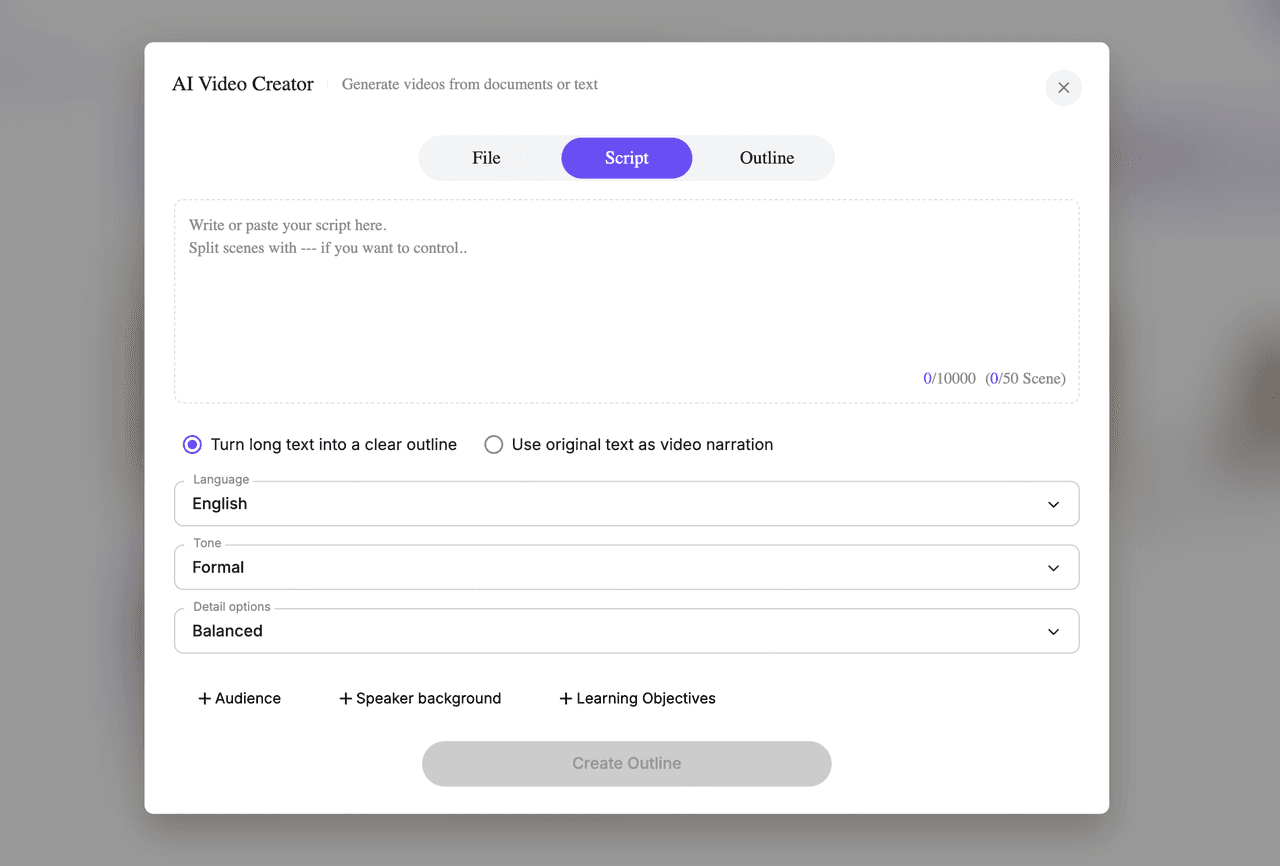
Key principle: Commercial videos succeed when clarity matters more than creativity. A structured outline almost always outperforms free-form storytelling in commercial contexts.
Step 3: Production – Assemble the Video Content
Unlike traditional shoots, many commercial videos today are assembled digitally rather than filmed end-to-end. This stage focuses on building scenes, narration, and visuals that support the message without unnecessary complexity.
If your campaign is international, this is the time to consider how to tailor marketing videos for different regions and languages to ensure the message resonates globally.
- Language and tone selection Choosing the right language and tone—formal, persuasive, friendly, or storytelling—ensures the video matches its audience and platform.
- Scene-by-scene structure Each scene should carry one idea, paired with visuals that reinforce the narration rather than distract from it.
- Consistent visual presentation Templates help maintain brand consistency across colors, layouts, and transitions without manual design effort.
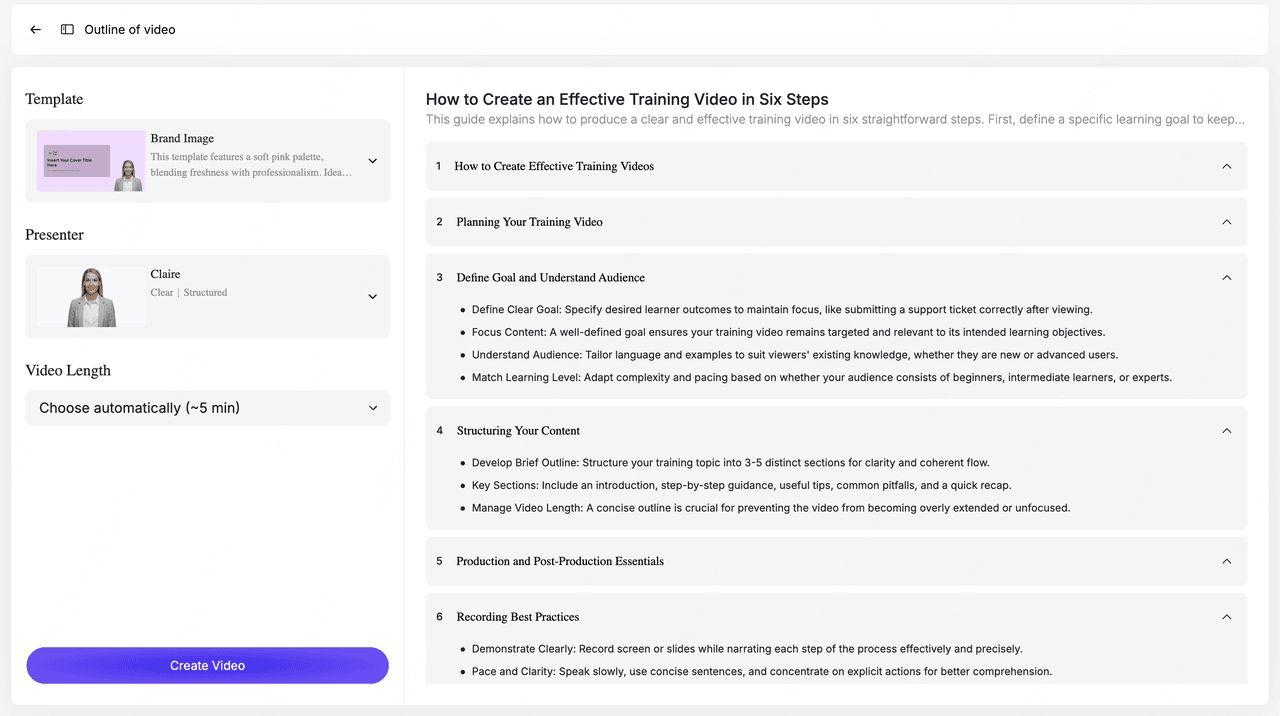
Traditional filming workflows require coordination across equipment, locations, crews, and post-production timelines, which makes iteration slow and costs high—especially when videos need frequent updates. At this stage, AI-driven workflows allow teams to assemble professional-looking commercial videos without managing cameras, lighting setups, or multiple production tools.
Step 4: Post-Production – Edit for Conversion
Post-production is where a commercial video becomes a performance asset. The focus here is speed, consistency, and optimization—not visual excess.
- Tight pacing Scenes are trimmed aggressively to keep attention and maintain momentum.
- Brand-safe elements Logos, typography, and color systems are applied consistently across scenes.
- Captions for silent viewing Subtitles improve accessibility and dramatically increase engagement on social feeds.
- Platform-specific formats Aspect ratios, duration, and pacing are adjusted depending on where the video will be used.

In traditional commercial video production, even small changes—such as updating messaging, adjusting pacing, or localizing content—often require revisiting editing timelines and production costs. This is where a commercial video creator like Leadde becomes especially valuable—automating scene structure, pacing, narration, and formatting so teams can iterate quickly without starting over.
Traditional Production vs Modern Commercial Video Workflows
| Aspect | Traditional Production | Modern AI Workflow |
| Production time | Days to weeks | Minutes to hours |
| Cost per update | High | Minimal |
| Iteration speed | Slow | Fast |
| Scalability | Low | High |
| Best use case | One-off campaigns | Ongoing commercial needs |
Step 5: Review, Refine, and Generate
Before publishing, professional workflows include a short review phase. Previewing the video allows teams to check timing, clarity, layout, and narration before generating the final version.

Small adjustments—such as changing scene order, refining phrasing, or selecting a different visual style—can be made quickly before exporting the finished commercial video with a title and description ready for distribution.
Step 6: Distribution – Where Commercial Videos Perform Best
Once generated, commercial videos should be deployed where they support specific business outcomes:
- Websites and landing pages for conversion-focused experiences
- Paid ads and social platforms for awareness and acquisition
- Email campaigns and sales decks to support nurturing and closing
Organizing distribution by use case connects video creation directly to performance, which Google strongly favors in how-to content.
Choosing the Right Commercial Video Creator
As commercial video becomes a repeatable part of modern marketing workflows. For example, HR departments often look for fresh recruitment video ideas to keep their pipeline full; choosing the right commercial video creator is no longer just a tooling decision—it’s a scalability decision. The best tools don’t simply help you make a single video; they support consistent quality, faster turnaround, and long-term reuse across campaigns and channels.
What to look for in a commercial video creator
A strong commercial video creator should align with how commercial videos are actually produced and used. Instead of focusing solely on visual effects or editing controls, look for tools that support structure, clarity, and iteration.
Key factors to consider include:
- Speed and efficiency Commercial videos often need to be produced, updated, and localized quickly. A creator that reduces manual steps—such as scripting, scene setup, and formatting—can dramatically shorten production cycles.
- Built-in structure and pacing Tools that guide videos into clear scenes with controlled pacing help ensure consistent quality, especially when producing multiple videos over time.
- Brand consistency by default Logos, colors, typography, and layout should remain consistent without requiring designers to recreate them for every new video.
- Flexibility across use cases A commercial video creator should support product marketing, ads, landing pages, and sales enablement without forcing teams to rebuild workflows from scratch.
Speed, structure, and scalability for ongoing marketing
For teams producing commercial videos regularly, scalability matters more than one-off polish. The right commercial video creator makes it easy to turn scripts, outlines, or existing marketing materials into structured videos—while keeping messaging, pacing, and branding aligned across formats and platforms.
AI-powered tools like Leadde are designed with this workflow in mind. By generating scene-based videos from structured input and handling narration, layout, and formatting automatically, such platforms allow teams to scale commercial video production without adding complexity or production overhead.
Speed and Cost Over Time
When evaluating a commercial video creator, it’s important to consider not just upfront production quality, but long-term speed and cost. Traditional workflows often scale costs linearly—each new video or update adds time and expense. Modern AI-driven creators, by contrast, reduce marginal cost by reusing structure, templates, and content logic, allowing teams to produce and update commercial videos faster without increasing production overhead.
FAQ – Commercial Video Creation
Is traditional commercial video production still worth it?
Traditional commercial video production can still be valuable for high-budget, cinematic campaigns. However, for ongoing marketing needs that require speed, updates, localization, and cost control, AI-driven commercial video workflows are often more practical and scalable.
What is the ideal length of a commercial video?
The ideal length of a commercial video depends on its goal and placement, but most high-performing commercial videos fall between 15 and 90 seconds. Shorter videos work best for paid ads and social feeds, while slightly longer formats are effective on landing pages or product pages—provided the message stays focused and action-driven.
How much does a commercial video cost?
Commercial video costs vary widely based on production method, frequency, and complexity. Traditional studio-based production can range from thousands to tens of thousands of dollars per video, while modern workflows using AI or template-based tools significantly reduce costs—especially for teams creating videos regularly or updating content often.
Can AI tools create professional commercial videos?
Yes—when used correctly, AI tools can produce professional, commercial-ready videos. AI-driven commercial video creators streamline scripting, scene structure, pacing, narration, and formatting, making it easier to maintain consistency and speed without sacrificing clarity. The key is using AI to support a structured process, not to replace strategic thinking.
What’s the difference between a commercial video and an ad?
A commercial video is a broader category of business-focused video content designed to promote a product or service with a clear objective. An ad is a specific distribution format—usually paid and platform-specific. In practice, the same commercial video may be adapted into multiple ads, landing page videos, or sales assets depending on where it’s used.
Conclusion
Professional commercial videos are built on structure and clarity—not complexity or production excess. In practice, the right process consistently matters more than budget when it comes to creating videos that perform. With a clear, repeatable workflow, commercial videos become scalable assets that support marketing, sales, and growth over time.