
Commercial Video Creator: What It Is, Why It Matters, and How to Use One in 2026

Commercial video creators have fundamentally changed how audiences interact with brands. Viewers are no longer drawn to static images or long blocks of promotional text. Instead, they expect clear, visual storytelling that communicates value quickly and effectively.
Video has become the preferred way for people to understand products and services online. Across digital channels, audiences consistently engage more with video than with text-based content, making commercial video one of the most effective formats for capturing attention and driving action.
This shift is closely tied to how content is consumed today. Short-form videos dominate social platforms, mobile feeds, and streaming environments, where businesses have only seconds to communicate their message. As a result, commercial videos must be concise, structured, and optimized for speed and clarity.
At the same time, the way commercial videos are produced has evolved. Businesses no longer need expensive studios, complex editing workflows, or long production cycles to create professional campaigns. Modern commercial video creators allow teams to turn scripts, product details, or existing materials into polished videos in minutes rather than weeks.
With AI video creation tools like Leadde, teams can generate commercial videos faster by transforming structured input into complete scenes—combining narration, visuals, pacing, and branding into a clear, ready-to-publish format. This reflects a broader shift in advertising: from manual production to scalable, system-driven video creation.

In this guide, we explore what commercial videos are, why they matter in modern marketing, and how businesses can use commercial video creators to produce high-quality content efficiently and at scale.
What Is a Commercial Video and Why Does It Matter in 2026?
A commercial video is a video created to promote a product, service, or brand with the goal of driving awareness, engagement, or conversion. Unlike purely informational or entertainment content, commercial videos are designed to communicate value quickly and encourage viewers to take a specific action.
As audiences consume more video across platforms, commercial video has become a core marketing asset—not because it is visually appealing, but because it delivers messages more clearly and memorably than static formats.
Understanding what commercial video is sets the foundation for evaluating how it is created, scaled, and optimized—especially as commercial video creators reshape the production process.
Why Do Commercial Videos Outperform Static Ads in Marketing?
Commercial video has become essential in modern marketing because it communicates information faster and more effectively than static formats. Unlike image or text-based ads, commercial videos combine visuals, motion, narration, and sound to guide viewers through a clear message in a short amount of time.
In high-competition digital environments, static ads require users to stop, read, and interpret the message themselves. Commercial videos reduce this friction by combining visuals, motion, narration, and sound into a structured format that guides viewers through the message quickly.
This lower cognitive effort makes video content easier to remember and more likely to drive action. At the same time, major platforms actively prioritize video because it keeps users engaged longer, giving commercial video a natural advantage in reach and distribution compared to static formats.
Across the marketing funnel, commercial video plays multiple roles. Short-form videos are used in social ads to capture attention quickly, while longer videos on websites and landing pages help explain products, build trust, and improve conversion rates. In brand marketing, commercial video communicates tone and differentiation more effectively than static assets.
For these reasons, commercial video is no longer just a creative option—it is a core performance tool in modern marketing strategies.
How a Commercial Video Creator Simplifies Video Production
A commercial video creator is a tool designed to help businesses produce professional commercial videos through structured, software-driven workflows. These tools focus on simplifying how videos are built, edited, and adapted, making commercial video creation more efficient and repeatable.
Traditional commercial video production involves scripting, filming, editing, revisions, and coordination across teams. This makes video slow to produce and difficult to update. Even minor changes often require re-editing or re-shooting, delaying campaigns and increasing costs.
Online commercial video creators simplify this process by replacing manual production steps with templates, predefined scenes, and guided editing interfaces. Teams focus on message structure and visual flow rather than technical execution, allowing videos to be created and updated quickly without restarting the entire process.
One of the biggest advantages of a commercial video creator is accessibility. Non-professional teams can produce commercial-grade videos without advanced editing skills. By reducing technical complexity, these tools make it possible to scale video production, maintain brand consistency, and adapt content for multiple platforms.
By turning video creation into a repeatable workflow instead of a one-off project, commercial video creators make professional commercial video production faster, more flexible, and accessible for teams of any size.
Why Templates Matter in Commercial Video Creation
Templates play a critical role in commercial video creation because they are built around patterns that already perform well. Instead of starting from a blank canvas, templates provide a proven structure that helps businesses communicate value quickly, clearly, and consistently—key factors for driving engagement and conversion.
Why Commercial Video Templates Improve Conversion
Commercial video templates are designed around proven conversion patterns. They guide viewers through a clear sequence—capturing attention, presenting value, and leading to a call to action—without unnecessary distractions. This structure reduces cognitive load and helps audiences understand the message quickly.
Templates also optimize pacing, text placement, and scene length for short-form and scroll-based environments. Because these layouts are tested across platforms and campaigns, they increase the chances that commercial videos hold attention and perform well.
Consistency and Faster Iteration With Templates
Templates improve efficiency by enforcing consistent branding and structure across videos, even when created by different team members. This consistency strengthens brand recognition as video output scales.
By reducing manual design decisions, templates also minimize trial and error. Teams can focus on refining messaging and testing variations, making updates faster without rebuilding videos from scratch.
Templates for Different Commercial Video Use Cases
Effective commercial video creators offer templates tailored to different business goals.
- Ad templates are optimized for short-form formats, fast hooks, and strong calls to action, making them ideal for social and paid advertising.
- Brand templates focus on tone, storytelling, and visual identity to communicate values, mission, and differentiation.
- Product templates are designed to highlight features, workflows, or benefits clearly, helping audiences understand how a product works and why it matters.
By using the right template for each scenario, businesses can align video structure with intent—improving clarity, efficiency, and results across channels.
Key Editing Features Every Commercial Video Creator Should Offer
An effective commercial video creator is defined not only by how quickly it generates videos, but by how well it supports editing control and distribution requirements. The right set of editing features ensures that commercial videos remain clear, professional, and adaptable across platforms.
Timeline-Based Editing for Structure and Flow
Timeline editing is essential for controlling the structure and pacing of a commercial video. It allows creators to arrange scenes, adjust timing, and fine-tune transitions between visuals. A clear timeline helps ensure that key messages are delivered in the right order and that videos maintain a natural rhythm—especially important in short-form formats.
Animated Text for Clarity and Emphasis
Text animation plays a central role in commercial videos by reinforcing key messages without overwhelming the viewer. Well-designed text motion highlights value propositions, features, and calls to action while maintaining visual interest. For sound-off viewing environments, animated text ensures that core information remains accessible.
Audio–Visual Synchronization for Professional Quality
Precise audio and visual synchronization is critical for professional commercial videos. Background music, voiceovers, and sound effects should align naturally with visual transitions and on-screen text. Proper sync improves clarity, reinforces emotional tone, and prevents distractions that can reduce message effectiveness.
Multi-Format Export for Cross-Platform Distribution
Modern commercial video creators must support exporting videos in multiple aspect ratios and resolutions. Platforms like TikTok, YouTube, and Instagram each require different formats, and content often needs to be adapted without re-editing from scratch. Flexible export options make it easier to repurpose videos across channels while preserving quality and layout.
Step-by-Step: How to Create a Commercial Video
Creating a commercial video no longer requires a complex production pipeline or a large creative team. High-performing teams typically follow a lightweight, structured workflow that keeps the focus on the message while making updates fast and scalable. Below is one practical step-by-step approach used in modern AI-powered commercial video creators such as Leadde—not as a rigid formula, but as a reusable framework.
Step 1: Define the role of narration in your commercial video
Before choosing visuals or generating scenes, clarify what role narration plays in the video. In commercial videos, on-screen narration or an AI presenter usually serves one of three purposes:
- Explainer – clearly communicates key features, benefits, or offers
- Guide – introduces sections and transitions between ideas
- Support role – provides context while visuals deliver most of the information
For most commercial videos, narration works best as a guide or explainer rather than the centerpiece. The goal is to support clarity and flow—not to distract from the product or message.

Step 2: Choose a visual and delivery style that fits the brand
Once the narration role is clear, select a visual and delivery style that aligns with your brand and audience. In AI video workflows like Leadde’s, teams typically choose styles based on use case rather than novelty:
- Clean, professional presentation styles for B2B or SaaS products
- Slightly simplified or stylized visuals for fast comprehension and longer viewing
Two principles matter more than visual complexity:
- Clarity over personality
- Brand alignment over visual experimentation
A neutral, consistent delivery helps viewers focus on the message and visuals rather than the presenter itself.
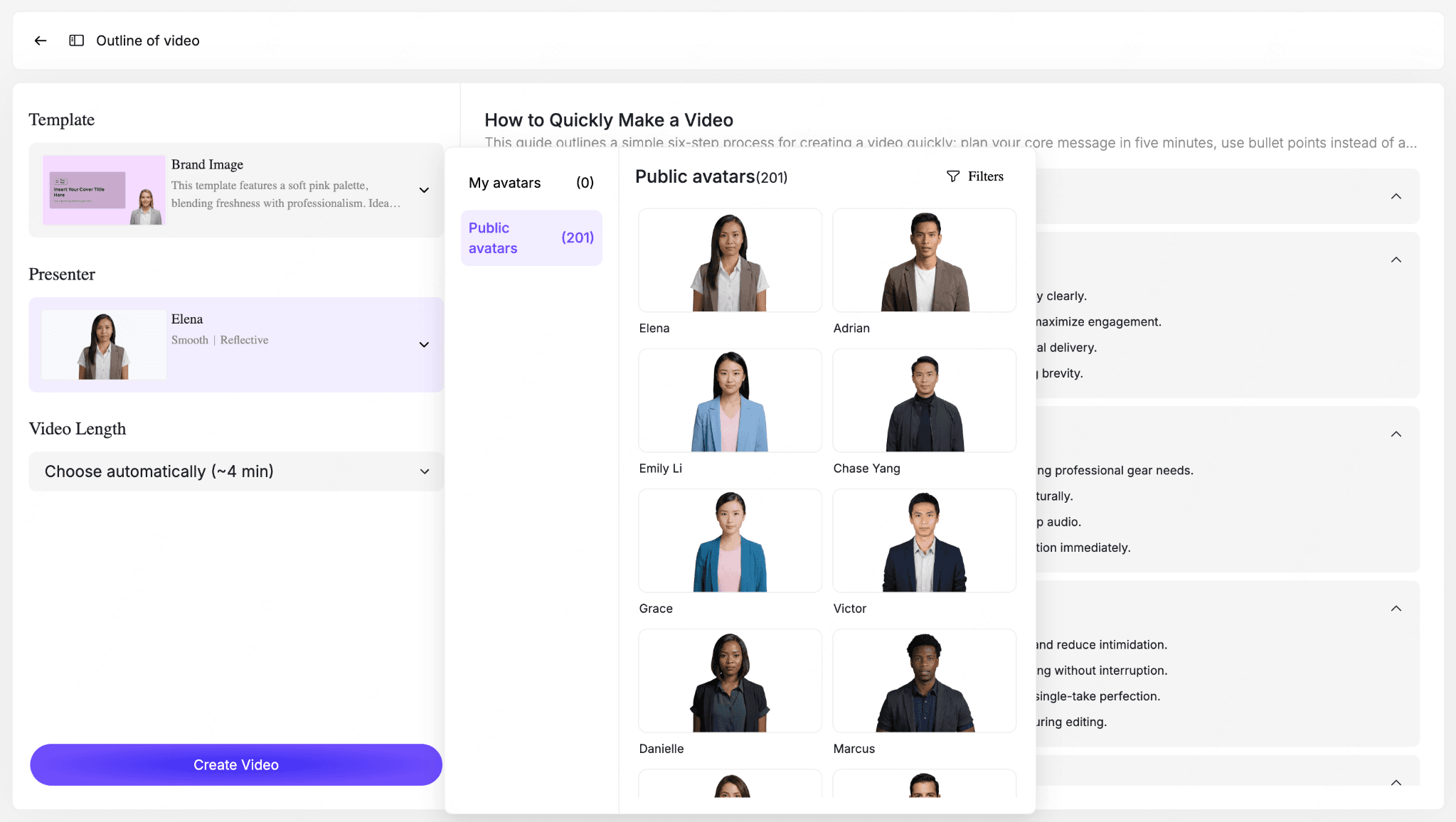
Step 3: Generate or customize your AI presenter and narration
Instead of building everything from scratch, many teams start with a reusable AI presenter or narration template and customize it for commercial use. Common adjustments include:
- Delivery tone – calm, professional, and easy to follow
- Voice pacing – matched to on-screen transitions
- Consistency – uniform style across videos and campaigns
In tools like Leadde, users can select from a public presenter library or create a custom presenter, then fine-tune narration to match brand and campaign needs. The objective is not uniqueness, but repeatability and clarity across commercial videos.

Step 4: Integrate narration with product visuals and structure
Effective commercial videos do not rely on narration alone. The presenter or voice should be integrated with structured visuals, such as:
- Screen recordings or product visuals
- Slides or modular scene layouts
- UI highlights, callouts, or diagrams for complex ideas
In practice, this often means locking the narration structure first, then building modular scenes where narration introduces each section while visuals deliver the details. This approach makes commercial videos:
- Easier to update when messaging changes
- Easier to localize for different markets
- Easier to reuse across ads, websites, onboarding, and sales materials

Step 5: Review, refine, and export for multiple platforms
Once scenes are assembled, teams review pacing, clarity, and calls to action before exporting. Modern commercial video creators allow the same structure to be reused across multiple formats and platforms—reducing rework while maintaining consistency.

By following this structured workflow, teams can move from idea to finished commercial video quickly, without sacrificing quality or control.
How Is AI Changing Commercial Video Production?
AI and automation are transforming commercial video production by streamlining workflows that were once manual and time-intensive. Instead of managing each video as a separate project, modern tools use structured input—such as scripts or product information—to generate organized scenes and layouts automatically.
By automating tasks like scene sequencing, pacing adjustments, subtitle generation, and layout optimization, AI reduces repetitive work and shortens production cycles. Teams can focus on defining goals and refining messaging while execution details are handled programmatically.
Automation also brings consistency at scale. Branding, tone, and structure remain aligned across videos, even when content is produced frequently or by different contributors. This makes it easier to update messaging, test variations, and adapt videos for new platforms without rebuilding everything from scratch.
Rather than replacing creative decisions, AI shifts effort away from mechanical editing toward strategy and optimization. As demand for commercial video continues to grow, automation enables teams to maintain quality while producing content efficiently and at scale.
What Makes a Commercial Video Convert?
High-performing commercial videos are not defined by visuals alone. They succeed because they combine clear structure, focused messaging, and deliberate calls to action—all aligned with how audiences consume video across platforms.
Visual Structure: Guide the Viewer, Don’t Overwhelm
Effective commercial videos follow a clear visual hierarchy. Each scene serves a specific purpose, guiding viewers from initial attention to core value and next steps. Clean layouts, predictable transitions, and intentional pacing make it easier for audiences to follow the message without distraction.
Strong visual structure is especially important in short-form videos, where clarity matters more than complexity. When visuals compete for attention or change too rapidly, viewers are more likely to drop off before the message lands.
Information Density: Say More With Less
Commercial videos perform best when they respect limited attention spans. Rather than packing too many ideas into a single video, high-converting videos focus on one key message or benefit at a time. Concise text, clear visuals, and minimal on-screen elements help audiences understand the value quickly.
Reducing information density improves both engagement and recall. Viewers are more likely to remember and act on a simple message than a video that tries to explain everything at once.
Clear and Intentional Calls to Action (CTA)
A strong CTA turns engagement into action. Whether the goal is to learn more, sign up, or make a purchase, the next step should be obvious and easy to follow. Effective commercial videos introduce the CTA naturally, reinforcing it visually and verbally without disrupting the flow.
Timing and placement matter. CTAs work best when they appear after the value has been clearly communicated, rather than being rushed or buried at the end of the video.
Common Reasons Commercial Videos Fail
Many commercial videos underperform not because of poor visuals, but because of strategic misalignment. Common issues include unclear messaging, overcrowded scenes, weak structure, or missing CTAs. Others fail by prioritizing style over substance—focusing on effects while neglecting clarity and intent.
Successful commercial videos are designed with the viewer in mind. By emphasizing structure, simplicity, and purpose, businesses can create videos that not only attract attention but also drive meaningful results.
Cost-Effective Commercial Video Production at Scale
Cost has long been a barrier to consistent commercial video production. Traditional workflows often involve high upfront expenses, long timelines, and limited flexibility—making it difficult for businesses to produce videos regularly or adapt content as campaigns evolve.
Traditional Production Costs vs. Creator-Based Tools
Traditional commercial video production typically requires professional crews, studio time, post-production resources, and multiple revision cycles. These costs add up quickly, especially when videos need frequent updates or must be adapted for different platforms. As a result, video often becomes a one-off project rather than a scalable marketing asset.
Commercial video creator tools change this cost structure. By replacing manual production steps with software-driven workflows, they significantly reduce both production time and ongoing maintenance costs. Videos can be created, edited, and repurposed without repeating the entire process—making it practical to produce content continuously rather than occasionally.
Why Lower Cost Does Not Mean Lower Quality
Lower production costs do not inherently lead to lower quality. In many cases, efficiency improves quality by enabling better iteration and optimization. When videos are easier to update, teams can refine messaging, test variations, and respond to performance data instead of settling for a single, static version.
Quality in commercial video is defined less by production complexity and more by clarity, structure, and relevance. Well-designed templates, consistent branding, and thoughtful pacing often outperform expensive productions that lack focus or adaptability. Modern tools make it possible to maintain professional standards while scaling output—without sacrificing visual consistency or effectiveness.
At scale, cost-effective video production is not about cutting corners. It is about building a sustainable system that allows businesses to produce, refine, and distribute commercial videos efficiently. This shift enables video to function as a long-term growth channel rather than a high-risk, high-cost investment.
FAQs: Commercial Video & Commercial Video Creators
What is a commercial video?
A commercial video is a video created to promote a product, service, or brand with the goal of driving awareness, engagement, or conversion. Unlike entertainment or purely informational videos, commercial videos are designed to communicate value quickly and encourage viewers to take a specific action.
What is a commercial video creator?
A commercial video creator is a tool that helps businesses produce professional commercial videos without traditional production workflows. These tools typically provide templates, guided editing, and export options that simplify video creation for teams without advanced editing skills.
Can I create a commercial video without experience?
Yes. Modern commercial video creators are built for non-professional users. By using templates, drag-and-drop editors, and guided workflows, teams can create effective commercial videos without prior video production experience.
Are free commercial video creators worth it?
Free commercial video creators can be useful for testing ideas, experimenting with formats, or creating simple videos. However, they often come with limitations such as watermarks, restricted templates, or lower export quality. For businesses producing commercial videos at scale, paid tools usually offer greater flexibility and consistency.
Conclusion: Building Scalable Commercial Videos in 2026
Commercial video remains one of the most effective ways for businesses to communicate value, capture attention, and drive action. Today, success is less about production scale or budget, and more about clarity, relevance, and consistency across channels.
In 2026, scalable commercial video production depends on systems rather than one-off assets. Teams that align the right tools, efficient workflows, and clear objectives can create, update, and distribute videos at speed—turning video into a sustainable growth channel instead of a high-effort creative task.
Modern commercial video creators support this shift by reducing production friction and enabling faster iteration. When combined with strong structure, focused messaging, and clear calls to action, they allow teams of any size to compete effectively in video-driven markets.