
Corporate Video Production for Business: A Complete Guide to Strategy, Process, and Scale

Corporate video plays a central role in how modern businesses communicate, market, and train at scale. From brand storytelling and sales enablement to internal communication and employee training, video helps organizations deliver consistent messages across teams, channels, and regions.
Today, corporate video is no longer just about production quality—it’s a practical business tool. As video demand grows, many businesses begin to re-evaluate how corporate video production fits into their long-term workflows. Tools like AI-powered video platforms such as Leadde allow teams to transform existing scripts, documents, or presentations into structured corporate videos in minutes, making video production faster and easier to scale.

This guide explains what corporate video is, how the production process works, what it typically costs, and how businesses can build an efficient, scalable corporate video strategy.
What Is Corporate Video?
A corporate video is a type of video content created by a business or organization to communicate messages related to its operations, products, services, or values. Unlike advertisements or entertainment-focused videos, corporate videos are designed primarily to inform, explain, or align—not to entertain or sell aggressively.
Corporate videos are created for business audiences, which can include customers, employees, partners, stakeholders, or potential hires. The focus is on clarity, consistency, and relevance rather than storytelling for entertainment or emotional impact alone.
In practice, corporate video serves multiple business purposes. Companies use corporate videos to:
- Communicate brand positioning and company values
- Support sales and product understanding
- Share internal updates and leadership messages
- Train employees and standardize knowledge across teams
What distinguishes corporate video from other video formats is its role within a broader business workflow. These videos are often reused, updated, localized, and distributed across different channels over time. As a result, corporate video production for business prioritizes structure, accuracy, and scalability as much as visual quality.
Corporate Video Production for Business: Core Use Cases
Corporate video production for business supports a wide range of organizational goals. Rather than being defined by video format or style, corporate videos are best understood by the business outcomes they are designed to support. Below are the most common and high-impact use cases where corporate video plays a critical role.
Brand & Company Overview Videos
Businesses use corporate videos to clearly communicate who they are, what they do, and how they create value. Brand and company overview videos help align external audiences—such as potential customers, partners, and investors—around a company’s mission, positioning, and credibility.
Unlike traditional advertising, these videos focus on explanation and clarity rather than persuasion. They are often used on company websites, pitch decks, and landing pages to establish trust and provide a consistent first impression.
Product & Service Explanation Videos
Corporate video is one of the most effective ways to explain complex products or services. Product and service explanation videos break down features, workflows, and benefits in a structured, visual format that is easier to understand than text alone.
For many businesses, these videos reduce friction in the buyer journey by helping prospects quickly grasp how a solution works and whether it fits their needs. They are commonly used across websites, onboarding flows, and customer support resources.
Sales Enablement & Funnel Videos
Sales teams rely on corporate video to support conversations throughout the sales funnel. From introductory videos to tailored walkthroughs and follow-up explanations, video helps sales teams deliver consistent messaging while addressing common questions and objections.
Because these videos can be reused across deals and accounts, corporate video production for business enables sales organizations to scale knowledge without requiring repeated live explanations.
Internal Communication & Leadership Messages
Corporate video plays an increasingly important role in internal communication—especially for distributed or global teams. Leadership messages, company updates, and strategic announcements are often more effective when delivered via video, where tone and context are easier to convey.
These videos help maintain alignment, reinforce priorities, and ensure that key messages are delivered consistently across the organization.
Recruitment & Employer Branding
Corporate video is also widely used to support hiring and employer branding efforts. Recruitment videos give candidates insight into company culture, values, and team dynamics in ways that job descriptions cannot.
These videos help businesses attract candidates who are aligned with their culture while setting clearer expectations about the organization and roles.
Why These Use Cases Matter for Business
Across all of these scenarios, corporate video production for business serves a common purpose: to deliver clear, consistent information at scale. The most effective corporate videos are not defined by production style, but by how well they support real business needs—whether that’s building trust, enabling sales, aligning teams, or transferring knowledge efficiently.
When Should a Business Invest in Corporate Video Production?
There is no single “right time” to invest in corporate video production, but certain business moments make video significantly more valuable.
Below are some of the most common situations where investing in corporate video production for business delivers strong returns.
Launching a New Brand or Product
When a business introduces a new brand, product, or service, clarity is critical. Corporate video helps explain positioning, value propositions, and differentiation in a concise and engaging format.
For new launches, video provides a shared narrative that aligns marketing, sales, and internal teams—ensuring consistent messaging across websites, campaigns, and presentations from day one.
Entering a Growth or Expansion Phase
As businesses scale, communication challenges increase. New hires, new markets, and expanded product lines often introduce complexity that’s difficult to manage through written documentation alone.
Corporate video production supports growth by turning core explanations, processes, and messaging into reusable assets. This allows businesses to onboard faster, train consistently, and reduce reliance on repeated live explanations.
Updating a Website or Refining Brand Positioning
Website redesigns, rebranding efforts, or positioning updates are ideal moments to reassess how information is communicated. Corporate videos—such as company overview or product explanation videos—help translate updated messaging into clear, accessible content for visitors.
In many cases, video improves user understanding while reducing bounce rates and shortening time-to-value for prospects evaluating a business online.
Managing Complex Internal Communication
As organizations become more distributed, internal communication grows more complex. Remote and global teams rely on asynchronous communication, where nuance and context can be lost in written messages.
Corporate video enables leadership teams to communicate priorities, changes, and strategic direction with greater clarity and consistency. Video-based communication is especially effective for company-wide updates, organizational changes, and cross-functional alignment.
Investing with Intention
Across these scenarios, the value of corporate video production for business comes from its ability to simplify complexity and scale communication. Businesses see the strongest impact when video is treated not as a one-off project, but as a strategic investment aligned with specific business needs and moments of change.
How Businesses Should Think About the Cost of Corporate Video Production
The cost of corporate video production can vary widely, and there is no single “standard price” that applies to every business. What matters more than exact numbers is understanding what drives cost and how different production approaches align with business needs over time.
For most organizations, the biggest mistake is viewing cost only as the price of making one video. In reality, corporate video production for business should be evaluated based on how videos are created, updated, reused, and scaled across the organization.
Cost Ranges Depend on the Production Approach
Different production models come with different cost structures, trade-offs, and long-term implications.
In-house production Businesses that build internal video teams gain control and faster turnaround but take on ongoing costs such as salaries, equipment, software, and training. This model can work well for companies with consistent, high-volume video needs, but requires upfront investment and operational oversight.
Freelancers Freelancers offer flexibility and lower commitment for individual projects. Costs typically depend on scope, experience, and timeline. While this model reduces overhead, coordination and consistency can become challenging as video needs grow or diversify.
Agencies Agencies provide end-to-end services, including creative direction, production, and post-production. This approach often delivers high production value but is usually better suited for flagship or external-facing videos rather than frequent updates or internal use.
Hybrid or AI-assisted workflows Many businesses adopt hybrid approaches that combine internal teams, external support, and automation. This model focuses on efficiency and scalability, especially when producing multiple videos or updating content regularly.
Each approach can be effective—the key is matching the model to how video is used within the business, not just how it looks.
Business Variables That Have the Biggest Cost Impact
Beyond who produces the video, several business factors significantly influence overall cost.
Reusability and lifespan Videos designed for long-term use or modular updates generally deliver better value than one-off productions. A video that can be reused across teams or adjusted as information changes lowers total cost over time.
Update frequency Businesses that frequently update products, processes, or messaging need videos that are easy to revise. Production methods that require reshoots or heavy coordination can become costly when updates are frequent.
Localization and language needs Global organizations often require videos in multiple languages. Translation, re-recording, and localization can quickly multiply costs if not planned for early.
Distribution scope A single internal training video and a multi-channel, customer-facing campaign have very different cost considerations. Clarity about where and how videos will be used helps avoid over- or under-investing.
Cost Is a Strategy Question, Not Just a Budget Question
For businesses, the true cost of corporate video production is not defined by a single invoice—it is shaped by how video fits into broader workflows. Videos that save time for sales teams, reduce onboarding effort, or standardize communication often provide returns that outweigh production expenses.
Organizations see the greatest value when they:
- Align production methods with actual usage
- Plan for reuse and updates from the start
- Choose workflows that support growth rather than one-time output
When evaluated this way, corporate video production for business becomes less about minimizing cost and more about maximizing efficiency and long-term impact.
The Corporate Video Production Process (Step-by-Step)
Modern corporate video production for business follows a structured but lightweight process. While tools and outputs may vary, effective teams focus on clarity, consistency, and ease of updates—especially when videos are used across sales, training, and internal communication.
Below is a practical step-by-step view of how many businesses approach corporate video production today, including AI-assisted workflows that help reduce friction and support scale.
Step 1: Define the Purpose and Role of the Video
Before production begins, businesses need to clarify what the video is meant to do and how it fits into broader workflows.
Key questions include:
- Who is the audience—customers, employees, or partners?
- Is the video explaining, guiding, or reinforcing information?
- Will it be reused across teams or updated frequently?
In many corporate scenarios, videos act as explainers or guides rather than standalone storytelling pieces. Defining the role early helps keep production focused and prevents unnecessary complexity later.
Step 2: Plan the Structure and Delivery Style
Once the purpose is clear, teams decide how information will be delivered. For presenter-led corporate videos, this includes defining how on-screen presenters or avatars support the content rather than distract from it.
Effective teams prioritize:
- Neutral, professional delivery over strong personality
- Brand-aligned visuals over novelty
- Clear pacing that matches on-screen actions
In AI-assisted workflows such as those supported by Leadde, teams often select presenter styles that blend into the background while visuals—such as screens, slides, or diagrams—carry the core explanation.
Step 3: Create or Configure the Presenter Element
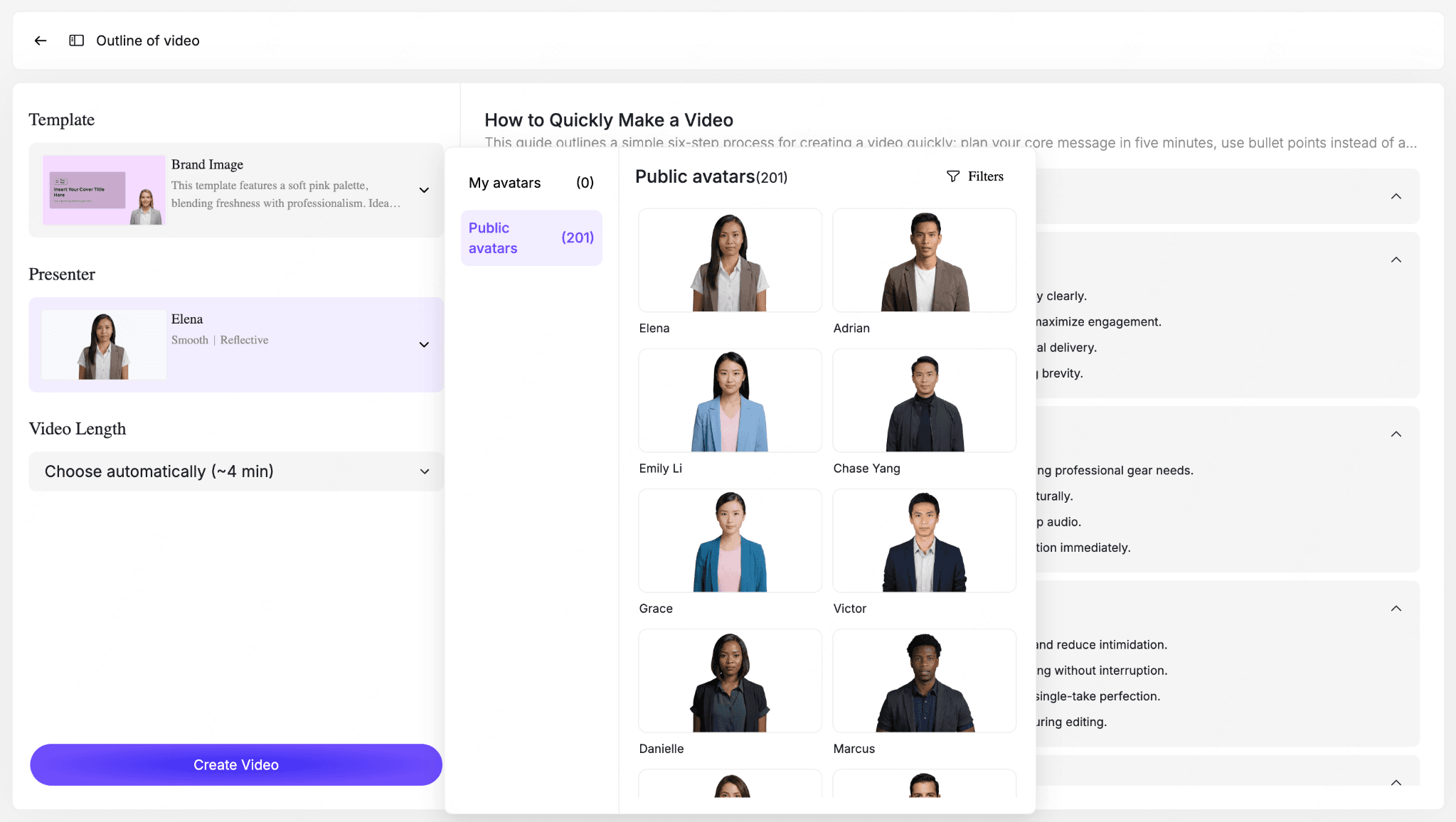
Instead of building every video from scratch, many businesses reuse standardized presenter elements to maintain consistency across content.
This step typically involves:
- Selecting a presenter or AI avatar from an existing library
- Adjusting appearance, voice, and pacing to match brand standards
- Ensuring delivery is clear and repeatable across videos
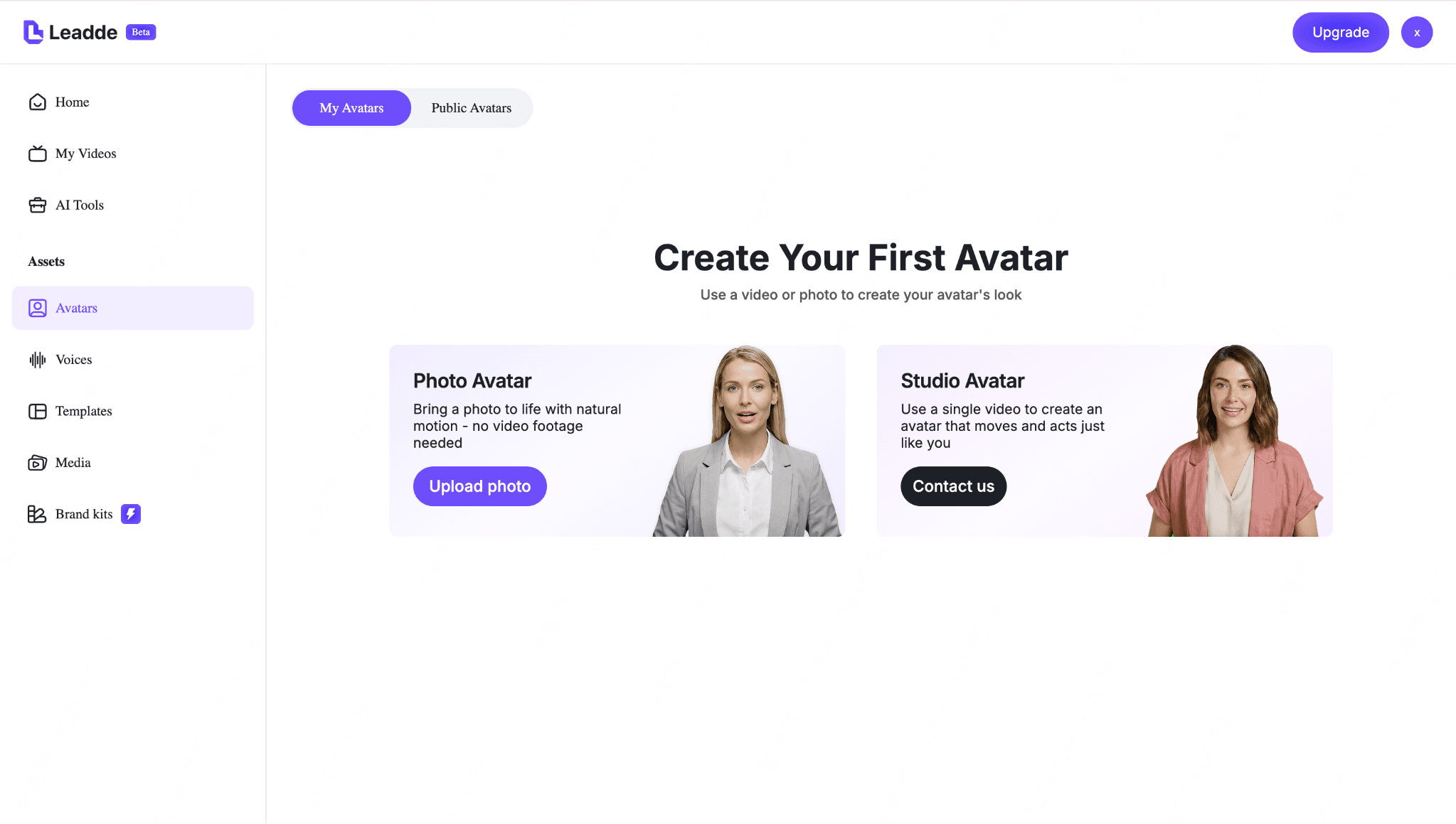
Teams can either customize their own AI avatars or use prebuilt options, fine-tuning delivery to fit different corporate use cases. The goal is not uniqueness, but clarity and consistency across all videos.
Step 4: Integrate Visuals and Core Content
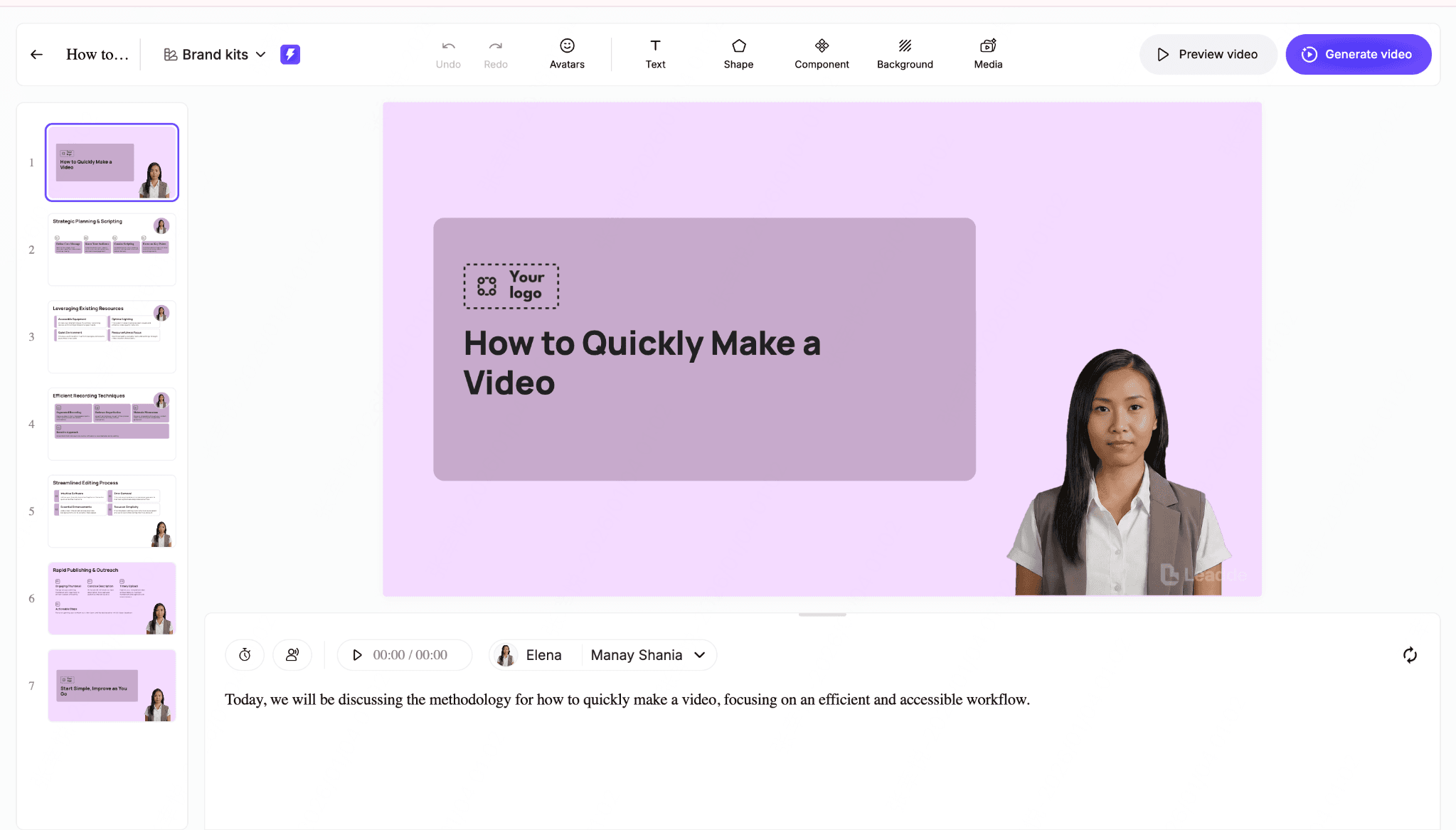
Corporate videos are most effective when presenters are integrated with clear visual structure. Rather than relying on a talking head alone, businesses combine presenters with:
- Screen recordings of products or tools
- Slides or UI highlights to guide attention
- Diagrams or callouts for complex processes
A common approach in AI video tools is to lock the presenter first, then build a modular outline where the presenter introduces sections while visuals carry the explanation. This structure makes videos easier to update, localize, and reuse across different business contexts.
Step 5: Review, Edit, and Prepare for Reuse
After the initial version is generated, teams review the video for clarity, pacing, and accuracy. In corporate environments, this step emphasizes practical considerations:
- Can information be updated without re-recording everything?
- Can the same structure support new versions or languages?
- Is the video easy to distribute internally or externally?
AI-assisted production workflows help streamline revisions by allowing teams to edit scripts, visuals, or narration without restarting the entire process.
Step 6: Generate and Deploy the Video Across Business Channels
Once finalized, corporate videos are exported and deployed across relevant channels—such as websites, sales materials, onboarding programs, or internal portals. Because these videos often support ongoing business processes, their value depends on how easily they can be maintained and adapted over time.
By following a structured, modular production process, businesses can turn video creation into a repeatable workflow rather than a one-off effort.
Why This Process Works for Business Use
This approach reflects a broader shift in corporate video production for business: from project-based creation to system-oriented workflows. By focusing on structure, consistency, and reusability—and by leveraging AI-assisted tools where appropriate—organizations can produce high-quality corporate videos that scale alongside their operations.
Scaling Corporate Video Production for Business
As businesses increase their use of video, the challenge quickly shifts from creating corporate videos to scaling them. While producing one or two high-quality videos is achievable for most teams, maintaining consistent, up-to-date video content across departments, regions, and use cases is far more difficult.
This is where many traditional corporate video production approaches begin to break down.
Why Scaling Is a Real Business Challenge
Corporate video production for business is rarely a one-time effort. Videos must support multiple teams, adapt to changing products or policies, and remain usable across channels. Without a scalable approach, keeping video content current and consistent quickly becomes a challenge.
The pressure to scale typically comes from:
- Growing, distributed teams
- Increasing demand for training and internal communication
- Frequent changes to products, processes, or messaging
- The need for consistent branding across regions
At scale, corporate video is less about creative output and more about operational efficiency.
Why Traditional Production Models Don’t Scale Well
Traditional video production workflows are designed for individual projects rather than ongoing business use. While effective for one-off campaigns or flagship videos, they introduce friction when applied repeatedly.
Common limitations include:
- High costs tied to reshoots and coordination
- Slow turnaround times for updates
- Limited flexibility for localization or role-specific content
- Inconsistent branding across teams or vendors
When updates are frequent or distribution is broad, these limitations become increasingly difficult and expensive to manage.
Common Problems Businesses Face When Scaling Corporate Video
As video usage grows, businesses often encounter similar challenges:
Uncontrolled costs Producing videos through traditional workflows can become expensive when content needs regular updates or variations.
Slow updates Simple changes—such as pricing, product features, or internal processes—may require reshoots or lengthy revisions.
Localization complexity Global teams often need the same video in multiple languages, increasing effort and cost.
Brand inconsistency Without shared standards, videos created across teams can drift in tone, structure, and visual identity.
Distribution and adoption friction Videos only create value if they are easy to distribute, access, and use—whether on websites, sales decks, learning platforms, or internal portals. Measuring success often comes down not to views alone, but to whether teams actually adopt and reuse the content.
Scalable Approaches to Corporate Video Production
To address these challenges, businesses increasingly adopt system-level solutions rather than project-based fixes.
Template-driven video creation Templates help standardize structure, branding, and pacing while allowing content to be updated without starting from scratch.
Standardized production workflows Clear guidelines for scripting, review, updates, and distribution reduce dependency on specific individuals or vendors.
Modular and reusable content Breaking videos into smaller, reusable components allows teams to update or localize content more efficiently.
Hybrid production models Many organizations combine internal teams, external creative support, and automation to balance quality with speed and scalability. AI-assisted video platforms can support this approach by turning existing documents, scripts, or presentations into structured corporate videos that are easy to update, distribute, and maintain across the business.
Measuring Success at Scale
At scale, the effectiveness of corporate video production for business is measured less by individual video performance and more by operational outcomes, such as:
- Faster onboarding and training completion
- Consistent messaging across sales and marketing teams
- Higher adoption of internal knowledge resources
- Reduced effort required to update and localize content
When video production is scalable, businesses spend less time managing content and more time using it to support real work.
From Projects to a Video System
The most successful organizations treat corporate video not as a series of isolated projects, but as an integrated communication system. By focusing on scalability—through structured workflows, reusable content, and hybrid production models—businesses can ensure their video strategy grows alongside their organization.
At that point, corporate video production for business becomes a long-term capability rather than a recurring bottleneck.
Build More Corporate Videos With the Resources You Already Have
For many businesses, the biggest barrier to corporate video production isn’t creativity—it’s time, coordination, and the effort required to keep videos updated as the organization grows.
Now that you understand what corporate video is, how corporate video production for business works, and why scalability matters, the next step is to move from one-off projects to a sustainable video system.
Modern workflows make this shift possible. By combining clear objectives, structured production processes, and scalable approaches, businesses can turn existing scripts, documents, and presentations into effective corporate videos without adding unnecessary complexity. AI-powered tools like Leadde can support this transition by helping teams produce, adapt, and maintain corporate video content more efficiently—so video becomes a practical, repeatable part of everyday business communication.