Corporate Promotional Video Production: Why Most Videos Fail to Deliver ROI
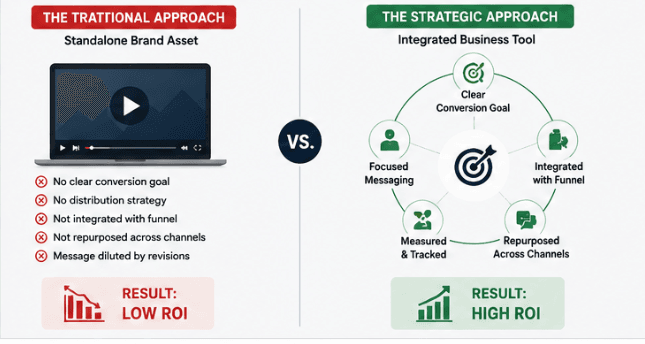
Most corporate promotional videos fail to deliver ROI because they are created as standalone “brand assets” instead of integrated business tools. In my research across corporate video production discussions, agency workflows, and B2B marketing case studies, the same problems appeared repeatedly: unclear goals, weak distribution strategies, endless stakeholder revisions, and no measurable connection to sales or lead generation.
The issue is rarely video quality alone.
A beautifully produced corporate video can still fail if:
- there is no clear conversion goal,
- the company lacks a marketing funnel,
- the video is not repurposed across channels,
- or internal stakeholders dilute the message during revisions.
The highest-performing corporate promotional video strategies are not built around cinematic visuals alone. They are built around measurable business outcomes such as trust building, lead nurturing, customer education, recruiting, and sales enablement.
This article breaks down the real reasons corporate videos underperform, using industry research, real production scenarios, workflow breakdowns, and operational insights from video producers and B2B marketers.
Teams looking to improve video ROI at scale are also increasingly using AI-powered workflow platforms like Leadde.ai to streamline lead generation, content distribution, and sales follow-up workflows around corporate video campaigns, helping transform videos from passive brand assets into measurable growth tools.
Why Corporate Promotional Video Production Often Fails
The biggest misconception in corporate promotional video production is the belief that producing a video automatically creates business results.
In practice, video production is only one part of a much larger system. Understanding the commercial video production process from script to final video clarifies where these bottlenecks actually happen.
A company may spend $10,000–$50,000 on a polished corporate video and still see little impact because the video was never connected to:
- a landing page,
- paid distribution,
- sales outreach,
- customer onboarding,
- or lead nurturing sequences.
In many production workflows I analyzed, businesses expected the video itself to “generate customers,” while lacking:
- attribution tracking,
- conversion funnels,
- email automation,
- campaign strategy,
- or measurable KPIs.
This creates a major ROI disconnect.
The most effective corporate promotional videos are usually tied to specific business functions, such as:
| Business Goal | Effective Video Type |
|---|---|
| Lead generation | Product explainer videos |
| Enterprise sales | Customer testimonial videos |
| Recruitment | Employer branding videos |
| Customer onboarding | Educational walkthrough videos |
| Investor trust | Brand narrative films |
| Retention | Customer success content |
When companies approach corporate video production as a strategic marketing asset instead of a one-time creative project, ROI becomes much easier to achieve. Exploring how to create video marketing content on a budget can also help align production goals with realistic financial constraints.
Corporate Promotional Video Production and the ROI Problem
One of the biggest findings from my research was that most businesses cannot clearly define what “ROI” actually means for video.
For some companies, ROI means:
- direct revenue,
- booked demos,
- qualified leads,
- or conversion rate improvements.
For others, it means:
- stronger brand perception,
- improved trust,
- better sales conversations,
- or shortened sales cycles.
This ambiguity causes major production problems from the start.
Why Businesses Struggle to Measure Video ROI
Most underperforming corporate video projects share these characteristics:
No Distribution Strategy
The video is uploaded to YouTube or embedded on a homepage without amplification.
No paid ads.
No email sequence.
No outbound integration.
As a result, even strong content receives little visibility.
No Funnel Integration
Many companies expect videos to drive conversions without integrating them into:
- landing pages,
- sales decks,
- webinars,
- CRM workflows,
- or lead nurturing systems.
In B2B environments especially, videos perform best when supporting long sales cycles rather than acting as isolated advertisements.
No Defined KPI Before Production
A surprising number of projects begin without answering basic questions like:
- What action should viewers take?
- Who is the audience?
- What stage of the funnel is this for?
- How will success be measured?
Without those answers, even excellent production quality becomes strategically ineffective.
Why Corporate Promotional Video Production Gets Stuck in Endless Revisions
One of the most expensive operational problems in corporate promotional video production is revision overload.
This issue appears repeatedly across agencies, freelancers, and in-house teams.
The pattern is predictable:
- Marketing approves the concept.
- Leadership joins later.
- Sales requests changes.
- Additional stakeholders appear.
- Messaging becomes diluted.
- Timelines expand.
- Budgets shrink.
The result is often a weaker final product than the original cut.
The Real Cost of Unlimited Revisions
Many businesses underestimate how much time is spent outside the actual shoot, often wondering how much does commercial video production cost without factoring in soft costs.
In practice, a “one-minute corporate video” may involve:
- strategy sessions,
- scripting,
- pre-production planning,
- scheduling,
- lighting setup,
- audio engineering,
- editing,
- color grading,
- motion graphics,
- stakeholder reviews,
- and multiple revision cycles.
Production itself is frequently only a fraction of the total workload.
Experienced production teams now protect profitability by:
- limiting revision rounds in contracts,
- establishing approval hierarchies,
- defining final-cut processes early,
- and charging additional fees for scope expansion.
Without those controls, revisions become the primary reason projects lose both creative clarity and financial efficiency.
Corporate Promotional Video Production Is Shifting From “One Video” to Content Systems
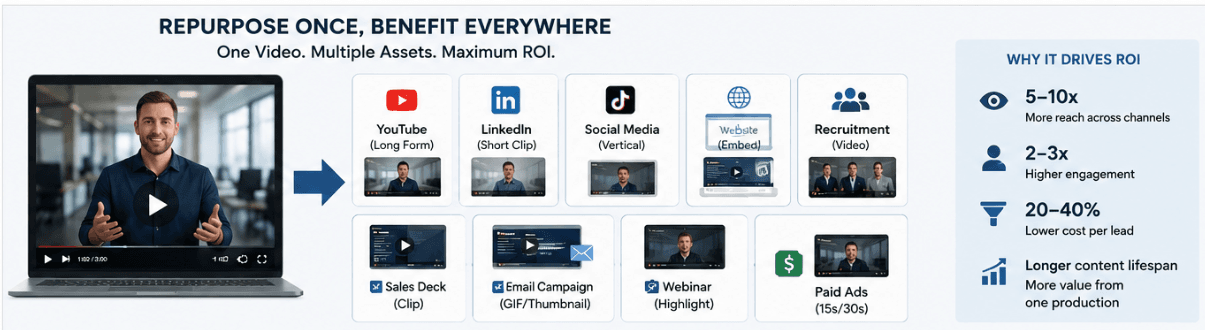
Another major shift in corporate promotional video production is the move away from single-use videos.
Today, businesses increasingly expect one production project to generate:
- YouTube content,
- LinkedIn edits,
- TikTok/Reels clips,
- trade show loops,
- recruitment assets,
- webinar snippets,
- customer onboarding videos,
- and paid ad creatives.
This is no longer optional.
Content repurposing has become one of the strongest ROI drivers in modern video strategy.
Why Repurposing Improves Video ROI
A single production day can now generate months of multi-platform content.
Instead of treating corporate promotional video production as a single deliverable, high-performing teams structure projects around modular content systems.
For example:
| Original Asset | Repurposed Outputs |
|---|---|
| 3-minute brand film | 10 short social clips |
| Customer interview | Sales testimonial snippets |
| Product demo | Onboarding content |
| Webinar recording | LinkedIn educational content |
| Executive interview | Thought leadership posts |
This dramatically improves cost efficiency per asset.
Companies that fail to repurpose content often experience poor ROI simply because the content lifespan is too short.
Real Corporate Promotional Video Production Case Studies
Case Study 1: B2B Video as a Customer Education System
One B2B marketing team shifted from relying primarily on written content to using:
- customer testimonials,
- product tutorials,
- webcast videos,
- and educational walkthroughs.
The goal was not immediate virality.
Instead, the strategy focused on:
- lead nurturing,
- customer trust,
- onboarding,
- and long-term education.
The team used video platforms such as Brainshark to distribute educational content internally and externally.
Before
- Heavy dependence on text-based marketing
- Limited customer engagement with technical information
- Sales teams repeatedly answering the same questions
After
- Video became a reusable educational asset
- Customers consumed information faster
- Sales conversations became more efficient
Key Insight
In B2B environments, corporate promotional video production often performs best as a trust-building and educational system rather than a pure advertising mechanism.
No measurable revenue data was publicly shared, but operational efficiency and content reuse were repeatedly emphasized.
Case Study 2: Using Free Spec Work to Enter Enterprise Markets
A small narrative advertising studio struggled to secure large enterprise clients.
To overcome the credibility gap, the founder created speculative campaigns for recognizable brands without being hired first.
The objective was to build:
- stronger case studies,
- agency credibility,
- and portfolio positioning.
Before
- Difficulty landing larger corporate accounts
- Limited proof of enterprise-level creative capability
After
- Improved positioning for agency partnerships
- Stronger perceived authority through polished case studies
Key Insight
In corporate promotional video production, portfolio credibility often matters more than technical skill alone.
Many mid-market and enterprise buyers choose vendors based on perceived business sophistication rather than cinematography quality.
No measurable revenue data was shared publicly.
Case Study 3: Moving From Small Projects to $10K–$20K Corporate Video Contracts
One independent videographer documented the challenge of moving from:
- $1K–$3K projects
to - $10K–$20K corporate production retainers.
At the time, the creator reported annual earnings of approximately $45,000, mostly from:
- corporate projects,
- and real estate video production.
Core Problem
The technical production quality was already strong.
The bottleneck was business positioning.
Specifically:
- proving ROI,
- communicating strategic value,
- attracting larger clients,
- and transitioning from freelancer to trusted business partner.
Key Insight
Many video professionals struggle not because they cannot produce quality work, but because they cannot connect video production to measurable business outcomes.
That distinction becomes critical in higher-budget corporate environments.
Why “Beautiful” Corporate Promotional Videos Often Underperform
One of the clearest patterns in my research was that businesses frequently prioritize aesthetics over business utility.
This usually leads to videos that look expensive but accomplish little.
Common symptoms include:
- cinematic drone shots with weak messaging,
- generic brand storytelling,
- vague mission statements,
- stock-style editing,
- and no clear audience action.
The problem is not creativity.
The problem is strategic disconnect.
High-Performing Corporate Videos Usually Focus on One Goal
The best-performing projects are often surprisingly simple.
Instead of trying to accomplish everything at once, they focus on one outcome:
- increase demo requests,
- improve recruiting,
- shorten sales cycles,
- educate customers,
- or build investor trust.
This clarity improves:
- scripting,
- pacing,
- CTA placement,
- editing decisions,
- and distribution strategy.
The more objectives a video tries to satisfy simultaneously, the weaker the final outcome usually becomes.
How to Improve ROI in Corporate Promotional Video Production
Based on the recurring patterns identified in my research, companies that consistently generate better video ROI tend to follow six principles.
1. Define Business Goals Before Production
Do not start with:
“We need a video.”
Start with:
“What business problem are we solving?”
2. Build Videos Into the Marketing Funnel
Video works best when integrated into:
- sales workflows,
- paid campaigns,
- onboarding systems,
- and lead nurturing sequences.
3. Plan Repurposing Before Filming
Capture extra formats, alternate cuts, vertical footage, and modular interviews during production.
This dramatically increases long-term content output.
4. Limit Stakeholder Chaos
Define:
- approval owners,
- revision limits,
- messaging priorities,
- and decision authority before production begins.
5. Focus on Audience Problems, Not Brand Vanity
The most effective corporate videos solve viewer uncertainty.
They answer questions like:
- Why should I trust this company?
- How does this solve my problem?
- Why is this different?
- What happens next?
6. Measure Outcomes Beyond Views
Views alone are often meaningless.
Better metrics include:
- qualified leads,
- watch time,
- conversion rates,
- onboarding completion,
- meeting bookings,
- and sales acceleration.
FAQ: Corporate Promotional Video Production
How do you measure ROI for corporate promotional video production?
ROI should be tied to business outcomes such as:
- lead generation,
- conversion rates,
- recruitment efficiency,
- onboarding effectiveness,
- or shortened sales cycles.
A video without distribution or funnel integration is difficult to measure meaningfully.
Why do corporate video projects often go over budget?
The most common causes are:
- unclear scope,
- too many stakeholders,
- unlimited revisions,
- poor planning,
- and changing objectives during production.
What is the ideal length for a corporate promotional video?
It depends on the objective.
- Brand overview videos are often 60–120 seconds.
- Product explainers may run longer.
- Social clips are usually under 30 seconds.
- Educational or onboarding videos can exceed 5 minutes if the content is valuable.
Why do clients underestimate video production costs?
Most clients only see the filming stage.
They often underestimate:
- scripting,
- planning,
- editing,
- revisions,
- motion graphics,
- sound design,
- and stakeholder management.
What makes a corporate promotional video successful?
Successful videos usually have:
- one clear objective,
- audience-focused messaging,
- strong distribution,
- funnel integration,
- and measurable business intent.
Should corporate videos focus on branding or sales?
The best projects usually combine both.
Strong branding builds trust.
Clear messaging drives action.
The balance depends on where the audience sits in the buyer journey.
Why are revisions such a major issue in corporate video production?
Because corporate projects often involve multiple departments with competing priorities.
Without clear approval structures, revisions can expand indefinitely and weaken the final message.
Can small video production companies compete for enterprise clients?
Yes, but positioning matters more than equipment.
Enterprise buyers usually prioritize:
- credibility,
- case studies,
- communication,
- reliability,
- and business understanding.
Why are companies repurposing corporate videos into multiple assets?
Because content reuse dramatically improves ROI.
One production project can support:
- social media,
- sales enablement,
- recruiting,
- onboarding,
- webinars,
- and paid advertising simultaneously.
Final Thoughts
Corporate promotional video production fails when companies treat video as decoration instead of infrastructure. It is essential to learn how to create a corporate promotional video with AI to avoid costly missteps and keep resources focused on ROI.
The highest-performing video strategies are deeply connected to:
- trust,
- education,
- sales enablement,
- customer experience,
- and long-term content systems.
The companies seeing the best ROI are no longer asking:
“How do we make a beautiful video?”
They are asking:
“How do we make video support measurable business outcomes?”