Event Video Production Guide: Process, Cost, Equipment & Tips
Event video production is the process of filming, editing, and producing video content from live events such as conferences, corporate meetings, product launches, and trade shows. It typically involves three stages—pre-production planning, on-site filming, and post-production editing—to create professional videos like event highlights, keynote recordings, and promotional recap videos that extend the impact of the event beyond the live audience.
Event videos are powerful, but traditional production can be slow and expensive—especially when teams need multiple versions for marketing, training, or global audiences. With tools like Leadde, you can turn event materials such as slides or scripts into professional business videos automatically, creating polished content in minutes while reducing production time and cost dramatically.

What Is Event Video Production? (Definition, Scope, and Business Value)
Event Video Production Explained
Event video production is the strategic process of capturing live events and transforming that footage into polished, high-value marketing assets. It goes far beyond simply setting up a camera at the back of a room.
In 2026, professional production involves comprehensive pre-planning, multi-camera live switching, professional audio engineering, and advanced post-production storytelling. The ultimate goal is to capture the atmosphere, deliver key messages, and drive ongoing business value long after the event concludes, much like understanding how explainer videos help businesses scale their core messaging.
Event Videography vs Event Video Production
While often used interchangeably, there is a distinct difference between these two terms. Event videography typically refers strictly to the act of operating a camera and recording the live action as it happens.
Conversely, event video production encompasses the entire end-to-end lifecycle. It includes strategy sessions, scripting, lighting design, crew management, and post-event content scaling (such as repurposing footage for social media and sales funnels).
Types of Events That Require Professional Video Production
Different gatherings require distinct production approaches to maximize ROI. As of 2026, the most common events requiring professional crews include:
- Corporate events: Annual general meetings, town halls, and shareholder presentations.
- Conferences and summits: Multi-day industry gatherings requiring multi-room recording and live streaming.
- Product launches: High-energy presentations where visual fidelity and dynamic lighting are critical.
- Trade shows and exhibitions: Capturing booth traffic, product demonstrations, and attendee testimonials.
- Internal training and company events: Team-building exercises and workshops meant for an internal LMS (Learning Management System).
Why Event Video Production Is Essential for Modern Marketing
Extending the Life of an Event Beyond the Event Day
Live events require massive financial investments, but their immediate impact is limited to the attendees in the room. Video production immortalizes the event, transforming a one-day gathering into an evergreen asset.
By capturing keynotes and highlight reels, businesses can market the event's success year-round. This extended lifespan dramatically increases the overall return on investment (ROI) of the original event budget.
Increasing Brand Visibility and Authority
High-quality video content signals industry leadership. When a company releases a masterfully edited conference recap or an insightful keynote speech, it builds instant credibility.
Sharing these polished videos across LinkedIn, YouTube, and company websites establishes the hosting brand as an authoritative voice. It proves to prospective clients and partners that your organization operates at the highest professional level.
Improving Engagement Across Marketing Channels
Modern marketing relies heavily on dynamic, visually engaging content. Text-based event recaps simply do not perform as well as video on modern algorithms.
Video clips generate significantly higher click-through rates in email newsletters and boast higher share rates on social media. Utilizing event video gives marketing teams a massive library of high-performing assets to fuel their ongoing campaigns.
Types of Event Videos Businesses Create
Event Highlight Videos (Recap Videos)
Also known as "sizzle reels," these are fast-paced, 1-to-2-minute videos that capture the absolute best moments of the event. They rely heavily on dynamic B-roll, upbeat music, and quick soundbites.
Highlight videos are primarily used for top-of-funnel marketing. They are the ultimate promotional tool to drive ticket sales and sponsorships for the following year's event.
Full Conference or Event Recordings
These are start-to-finish recordings of entire sessions or panel discussions. They require stable, multi-camera setups to keep the viewer engaged over a 45-to-60-minute duration.
Full recordings are usually gated behind an email capture form or placed inside an exclusive membership portal. They offer immense educational value to those who could not attend the event live.
Keynote and Speaker Videos
Similar to full recordings but highly focused on a single thought leader or VIP speaker. These videos often utilize picture-in-picture editing to show both the speaker and their presentation slides simultaneously.
Social Media Event Clips
These are bite-sized, 15-to-60-second micro-videos specifically formatted for platforms like TikTok, Instagram Reels, and LinkedIn Shorts. They usually feature one profound quote or exciting moment.
In 2026, producing vertical (9:16) social media clips is a mandatory deliverable for any modern event video production package.
Promotional Event Videos
Unlike recap videos that are made after the event, promotional videos are created before the next event begins. If you are familiar with what is an explainer video, promotional videos serve a similar educational and hype-building purpose by repurposing last year's footage mixed with new motion graphics to drive registrations.
The Complete Event Video Production Process
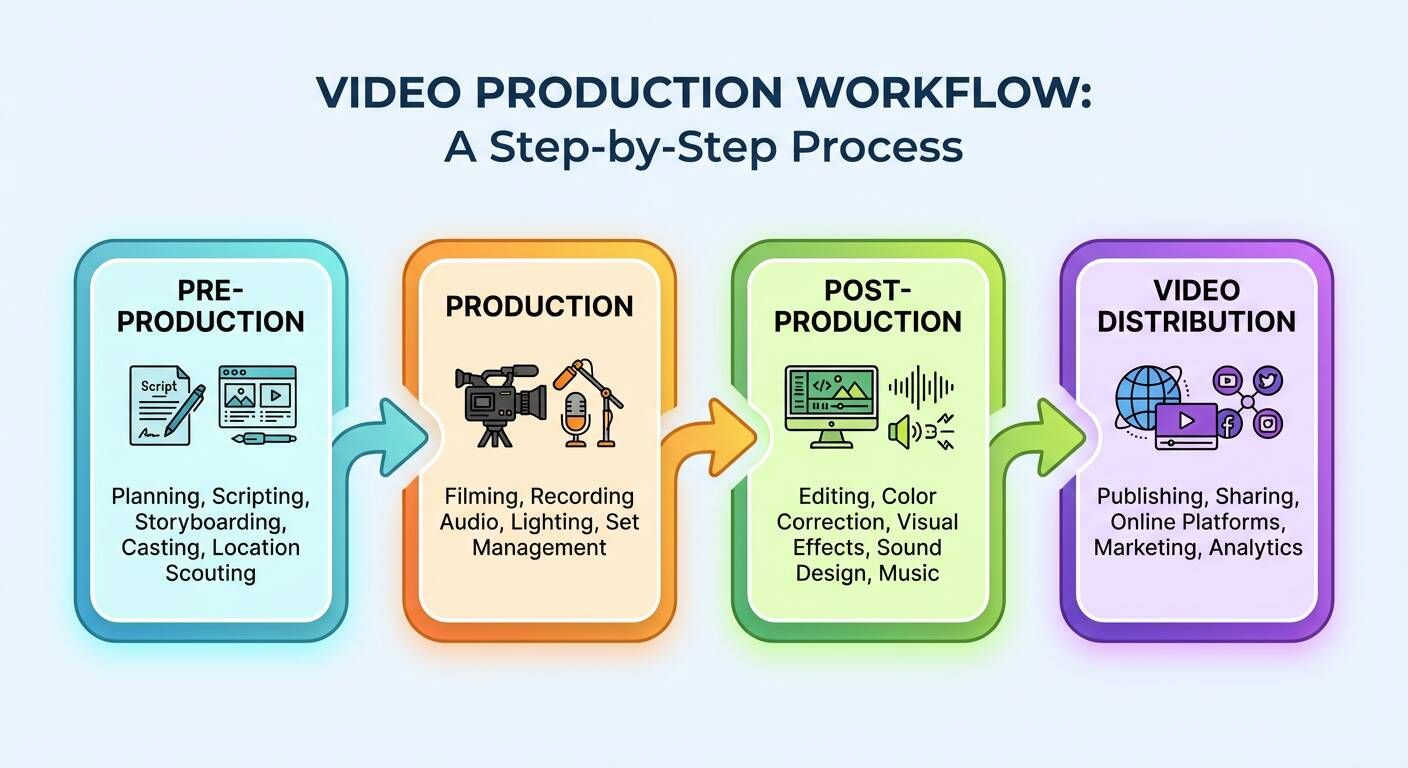
Pre-Production Planning (Strategy and Preparation)
The success of an event video is entirely dependent on the preparation phase. Arriving at a venue without a plan guarantees missed moments.
- Define goals and video objectives: Determine if the main goal is internal training, social media hype, or lead generation.
- Plan filming angles and camera setup: Conduct a venue scout to locate power sources, optimal camera placements, and lighting conditions.
- Prepare interview questions and scripts: Draft clear, concise questions for VIP attendees and speakers to ensure you capture usable soundbites.
- Schedule crew and equipment: Assign specific roles (camera operators, audio techs, producers) and finalize the gear manifest.
Production (Capturing the Event)
This is the execution phase on the day of the event. A professional crew must remain unobtrusive while capturing high-quality assets.
- Multi-camera recording: Using wide, medium, and tight angles to ensure editors have multiple perspectives to cut between.
- Professional audio capture: Bypassing standard camera microphones and tapping directly into the venue's audio mixer for crystal-clear sound.
- B-roll and audience reactions: Filming the crowd clapping, networking, and reacting to establish the event's atmosphere.
- Speaker and interview coverage: Pulling attendees aside into well-lit, quiet areas for controlled testimonial interviews.
Post-Production Editing
This is where the raw footage is transformed into a compelling narrative. Post-production often takes three to four times longer than the actual filming.
- Video editing and storytelling: Culling hours of footage to find the best moments and structuring them logically.
- Motion graphics and branding: Adding animated lower-thirds (name tags), intro logos, and branded transitions.
- Subtitle creation: Hardcoding or attaching SRT files for accessibility and silent auto-play on social platforms.
- Exporting multiple formats: Rendering final files in 16:9 for YouTube, 1:1 for feeds, and 9:16 for Reels.
Equipment Used in Professional Event Video Production
Cameras and Lenses
Professional event production requires high-end cinema cameras or mirrorless systems capable of recording in 4K resolution. These cameras must have excellent low-light performance to handle dim conference halls.
Crews rely on fast zoom lenses (e.g., 24-70mm f/2.8 and 70-200mm f/2.8) to adapt quickly to changing distances without swapping gear in the middle of a speech.
Lighting Systems
Relying solely on venue lighting is a common amateur mistake. Professional crews bring continuous LED panels, key lights, and hair lights to ensure speakers are perfectly illuminated.
For mobile interviews on the show floor, camera operators often use battery-powered ring lights or small LED softboxes mounted directly to their camera rigs.
Professional Audio Recording Equipment
Bad audio will ruin a video faster than bad video. Crews utilize complex audio chains to ensure pristine sound capture in echoey venues.
- Lavalier microphones: Clipped directly to speakers and interviewees.
- Boom microphones: Used for dynamic, on-the-fly crowd interviews.
- Field recorders: Devices like Zoom or Sound Devices that capture multiple audio tracks independently.
Stabilizers, Gimbals, and Drones
To capture buttery-smooth walking shots through a busy trade show, camera operators use motorized 3-axis gimbals. This eliminates the distracting "shaky cam" effect.
For large outdoor events or massive expos, authorized drone operators are increasingly used to capture stunning aerial establishing shots that instantly elevate the production value.
Event Video Production Cost (Pricing Factors Explained)
Crew Size and Production Team
The largest variable in event video pricing is headcount. A single run-and-gun videographer will cost significantly less than a full 5-person crew consisting of a director, multiple camera operators, and a dedicated audio engineer, which heavily impacts your overall video production cost.
Event Duration and Coverage Requirements
Production companies bill based on half-day (4-6 hours) or full-day (8-10+ hours) rates. Multi-day conferences require compounding day rates for both the crew and the equipment rentals.
Post-Production Editing Complexity
The sheer volume of requested deliverables heavily impacts the final invoice. Asking for a single 2-minute highlight reel is much cheaper than requesting a highlight reel, four full keynote edits, and twenty vertical social clips.
Location, Travel, and Equipment Costs
If an event requires the crew to fly out, businesses must cover flights, hotels, and per diems. Additionally, specialized equipment requests (like large camera jibs, teleprompters, or live-streaming switchers) will incur higher rental fees.
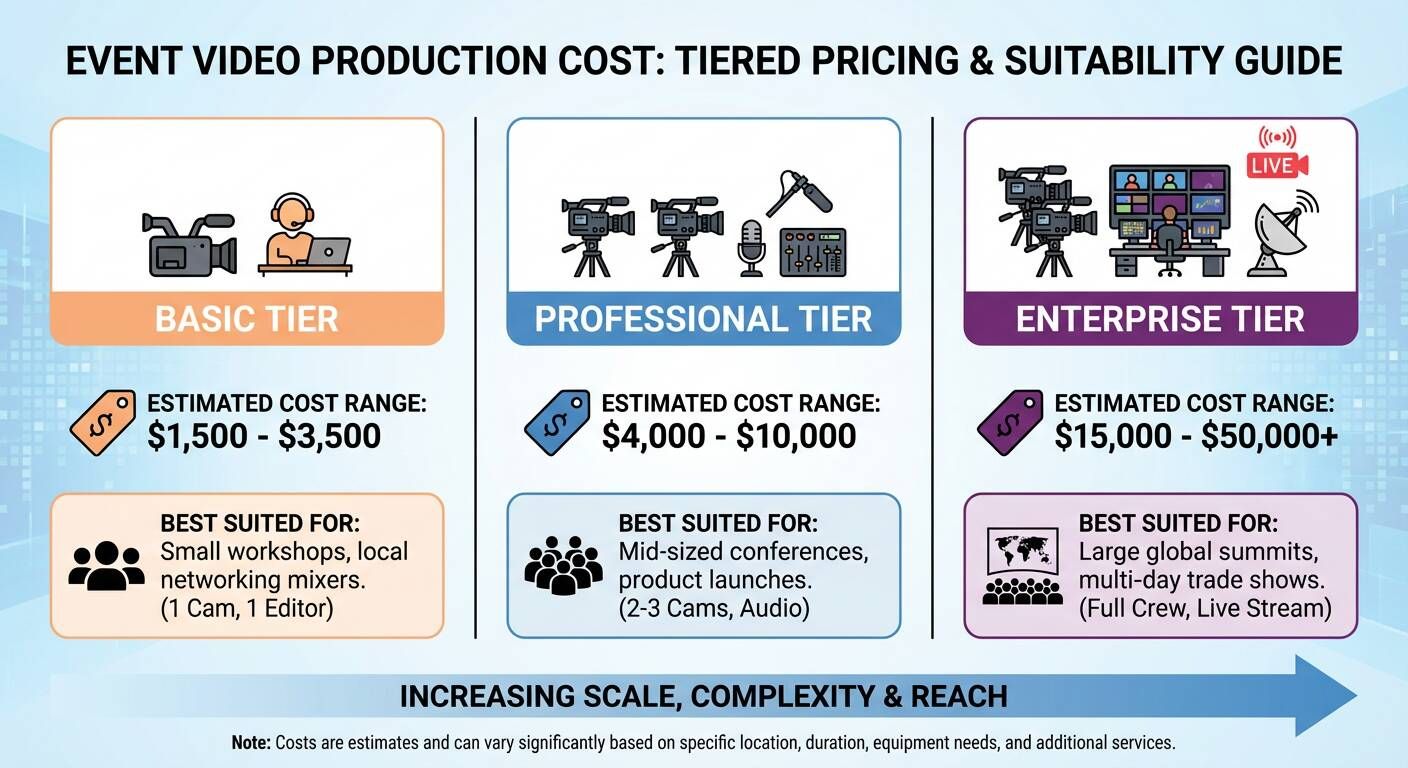
Estimated 2026 Event Video Production Costs
| Production Tier | Estimated Cost Range | Best Suited For |
|---|---|---|
| Basic (1 Cam, 1 Editor) | $1,500 - $3,500 | Small workshops, local networking mixers. |
| Professional (2-3 Cams, Audio) | $4,000 - $10,000 | Mid-sized conferences, product launches. |
| Enterprise (Full Crew, Live Stream) | $15,000 - $50,000+ | Large global summits, multi-day trade shows. |
How to Choose the Right Event Video Production Company
Evaluate Portfolio and Previous Event Work
When evaluating options, you might even consider how to choose the right explainer video company as the criteria for reliability, portfolio quality, and clear deliverables are very similar. Always request to see a production company’s reel specifically dedicated to live events. Do not hire a team that only specializes in controlled studio commercials, as live events require rapid problem-solving and run-and-gun adaptability.
Ask About Production Experience and Crew Size
Inquire about their experience with venues similar to yours. Ensure they have the capacity to scale their crew size if your event expands, and ask if they provide their own dedicated audio engineers.
Understand Deliverables and Editing Timeline
Set clear expectations regarding when the final videos will be delivered. Some agencies take weeks to edit a highlight reel. If you need a "next-day edit" to close out a conference, confirm they have editors working overnight.
Compare Quotes and Production Packages
When reviewing bids from different companies, ensure you are comparing apples to apples. Check if the quote includes unlimited revisions, music licensing fees, and raw footage handoffs, as these are common hidden costs. Alternatively, to supplement your marketing materials on a budget, you might explore how to produce professional explainer videos without agencies.
Common Challenges in Event Video Production (And How to Solve Them)
Poor Lighting Conditions at Events
Event venues love using moody, dim lighting or chaotic colored lasers that look terrible on camera.
- The Solution: Conduct a site visit beforehand to negotiate lighting setups with the venue AV team. Bring fast lenses (f/1.4 or f/1.8) and portable, bi-color LED lights to punch through the darkness.
Audio Quality Problems in Large Venues
Convention centers are echo chambers. Trying to record audio from a camera positioned 50 feet away will result in unusable, hollow sound.
- The Solution: The video team must tap a line directly into the venue’s soundboard (the audio mixer) to record the direct microphone feeds from the speakers on stage.
Capturing Key Moments in Real Time
Live events have no "take two." If the CEO drops a major announcement or the crowd erupts in a standing ovation, the camera must be rolling.
- The Solution: Always employ a multi-camera setup. Keep one camera on a safe, wide shot recording constantly, while the second camera hunts for close-ups and dynamic reactions.
How to Repurpose Event Footage Into Marketing Content
Creating Social Media Clips From Event Highlights
Do not let your footage sit on a hard drive. Extract the best 30-second soundbites from your speakers, crop the video to a vertical 9:16 aspect ratio, and add bold, stylized captions. These perform exceptionally well on TikTok, Instagram, and LinkedIn.
Turning Keynotes Into Educational Content
Full-length presentations can be chopped up into episodic mini-courses. Pair the video footage with the speaker's PowerPoint slides and upload them to your company blog or LMS to create lasting educational resources.
Using Event Videos for Sales and Lead Generation
Embed your high-quality event recap videos directly into follow-up emails sent to attendees and no-shows. Sales teams can also use polished testimonial clips gathered at the event to build trust during client pitches.
Modern Event Video Production Trends in 2026
Hybrid Events and Live Streaming Production
The demand for hybrid events remains massive in 2026. Production teams are no longer just recording for post-event editing; they are live-switching multiple cameras and broadcasting in 4K to remote, global audiences in real-time.
AI-Assisted Video Editing and Content Automation
Post-production is getting faster thanks to AI. Video editors now use AI tools to automatically sync multi-camera footage, remove background noise, and instantly generate highly accurate subtitles, slashing turnaround times.
Creating Multilingual Event Videos for Global Audiences
For global enterprises, restricting event content to one language limits its ROI. If you are learning how to translate a video efficiently, Leadde allows organizations to convert documents such as PowerPoint, PDFs, Word files, or text into structured video presentations with automated scenes and voiceovers while supporting multilingual video creation across 92 languages.
This makes it possible to quickly produce localized recap videos, educational clips, or training materials from event content, ensuring your global workforce and international clients receive the message in their native tongue.
Best Practices for Successful Event Video Production
- Plan filming strategy before the event: Create a shot list and a strict schedule so the crew knows exactly where to be.
- Capture audience reactions and behind-the-scenes moments: B-roll of engaged attendees is what makes the final video feel alive and exciting.
- Use professional microphones for clear audio: Never rely on the camera's built-in microphone for speaking engagements.
- Produce multiple video formats for different platforms: Export horizontal videos for YouTube and vertical cuts for social media natively.
- Prepare highlight videos shortly after the event: Capitalize on the event's momentum by releasing recap content within 48 to 72 hours.
Frequently Asked Questions About Event Video Production
How much does event video production cost?
As of 2026, professional event video production typically ranges from $1,500 for a basic single-camera setup to over $20,000 for multi-day, multi-crew enterprise events requiring live streaming and rapid editing turnarounds.
How long does it take to edit an event video?
Standard turnaround times range from 2 to 4 weeks depending on the complexity of the edits. However, many production companies offer expedited "next-day" highlight reels for an additional rush fee.
What equipment is required for event videography?
A professional setup requires 4K cameras with low-light capabilities, fast zoom lenses, heavy-duty tripods, lavalier and boom microphones, and portable LED lighting to ensure high broadcast quality.
What is the difference between event videography and event video production?
Event videography simply refers to the physical act of recording the event. Event video production involves the entire strategic process: pre-event planning, lighting and audio engineering, multi-camera directing, and comprehensive post-production marketing editing.
Conclusion
Mastering event video production in 2026 is critical for maximizing the ROI of any corporate gathering. By understanding the distinct phases of pre-production planning, live multi-camera filming, and strategic post-production editing, businesses can transform a fleeting one-day event into a library of evergreen marketing assets.
Whether you are hiring a professional crew or leveraging modern AI tools like Leadde to scale and localize your presentations globally, investing in high-quality event video ensures your brand's message reaches, engages, and converts audiences long after the final presentation ends.