Synthesia Review: Is It Worth It in 2026? Honest Pros, Cons, Pricing, and Better Alternatives

If your goal is internal training, onboarding, compliance, or multilingual employee education, Synthesia is absolutely worth considering. It can dramatically reduce video production time, eliminate re-recording costs, and make updates far easier than traditional filming.
However, if your goal is sales videos, paid ads, or customer-facing marketing content that depends on trust, emotion, and persuasion, Synthesia is usually not the best choice. AI avatars still struggle with natural expression, emotional delivery, and authenticity, which can directly hurt conversion performance.
After reviewing real enterprise workflows, testing where Synthesia performs best, and comparing alternatives like Leadde, the conclusion is simple:
Synthesia is excellent for scalable explanation-based videos, but weak for persuasion-based videos.
That distinction determines whether it saves money—or wastes it.
For teams that create videos from PowerPoint decks, PDFs, SOPs, or training documents, Leadde can be a stronger alternative because it automates document-to-video production instead of relying on manual script-first workflows.
What Is Synthesia and Who Is It Best For?
Synthesia is an AI video generation platform that allows teams to create presenter-style videos using AI avatars, text-to-video workflows, and multilingual voice generation—without cameras, studios, or video editors.
Instead of recording a real presenter, you write a script, choose an avatar, select a voice, and generate a finished video.
This makes it especially attractive for:
- L&D teams
- HR departments
- Compliance teams
- Internal enablement teams
- SaaS onboarding teams
- Global enterprise training teams
It is far less effective for:
- Performance marketing
- Sales prospecting videos
- Paid advertising
- Brand storytelling
- Emotional customer communication
The biggest mistake companies make is assuming these use cases are interchangeable.
They are not.
Synthesia Review: The Biggest Strength Is Not the Avatar
Most buyers think they are purchasing an AI presenter.
In reality, the biggest value is workflow efficiency.
The avatar is not the product.
The product is the ability to update videos instantly.
This became obvious in one of the most common enterprise use cases: compliance training.
Case Study: Compliance Training Without Re-Filming
A Learning & Development manager needed to maintain compliance training across multiple departments with frequent policy changes.
Before Synthesia, the workflow looked like this:
- book subject matter experts
- schedule recording sessions
- hire a production team or agency
- edit the video
- re-record sections when policies changed
Even a small script update could trigger major rework.
This created:
- high outsourcing costs
- long production cycles
- repeated re-shoot expenses
After Synthesia, the workflow became:
- update the script
- regenerate the video in minutes
- deploy the new version immediately
No filming.
No presenters.
No production scheduling.
The primary ROI came from avoiding re-recording costs and reducing turnaround time from days or weeks to hours.
This is where Synthesia delivers its strongest ROI.
Not because the avatar looks amazing.
Because operational friction disappears.
Synthesia AI Avatar Quality Review: Good Enough for Training, Weak for Marketing
This is the most important buying decision.
How good are Synthesia avatars really?
The honest answer:
good enough for internal education, often too artificial for external persuasion.
The Main Problem: The “Uncanny Valley” Effect
The most repeated issues include:
- unnatural mouth movement
- robotic pauses
- stiff facial expressions
- weak emotional tone
- poor emphasis in important moments
These issues become far more noticeable when the viewer is expected to trust, buy, or emotionally connect.
For onboarding videos, this is usually acceptable.
For sales videos, it becomes a serious problem.
Case Study: Performance Ads Produced Lower CTR and Lower Conversion
A marketing agency tested AI-generated video ads against human-recorded video creatives.
The goal was simple: reduce production costs for paid advertising while maintaining performance.
Tools compared:
- Synthesia
- HeyGen
- Veo
- traditional human-shot videos
The result was consistent:
AI avatar videos produced:
- lower click-through rates
- lower conversion rates
Even poorly filmed real-person videos often outperformed polished AI avatar videos.
Why?
Trust.
Audiences detect artificial delivery immediately.
When the goal is persuasion, authenticity matters more than polish.
This is the most important limitation of Synthesia.
It explains information very well.
It does not persuade very well.
If you are comparing Synthesia alternatives for training, explainers, or multilingual avatar videos, Leadde is worth testing before you commit to a workflow.
Is There a Better Alternative to Synthesia for Document-to-Video Workflows?
Synthesia is excellent for AI avatar videos, but many teams discover a major limitation once they scale: document workflows.
Most enterprise video projects do not start from a blank script. They start from:
- PowerPoint decks
- SOP documents
- Training manuals
- PDFs
- Product documentation
- Internal process guides
This is where many teams begin comparing Synthesia with newer platforms like Leadde.
Instead of manually copying content slide by slide into a video editor, Leadde focuses on turning existing business documents directly into professional videos.
Teams can upload PPTs, PDFs, Word files, and text content, and the platform automatically generates outlines, scenes, voice-over scripts, and structured video presentations .
For companies producing:
- onboarding videos
- compliance training
- multilingual SOP training
- product education
- internal enablement content
this workflow can significantly reduce manual production work.
According to official product information, Leadde supports:
- 92 languages
- 200+ AI avatars
- layered PowerPoint editing
- one-click multilingual video creation
- interactive “Chat with Video” experiences
- version control and enterprise-grade collaboration
The practical difference is simple:
Synthesia is strong when you already have the final script.
Leadde becomes attractive when your workflow starts with documents.
For teams handling large-scale training content, that distinction matters more than avatar quality alone.
If your workflow starts with a PowerPoint deck or a PDF — not a blank script — Leadde is worth testing before you commit to Synthesia. Upload any deck and generate a video draft in under 3 minutes, no credit card needed.
Synthesia vs PPT to Video: Why Expectations Often Fail
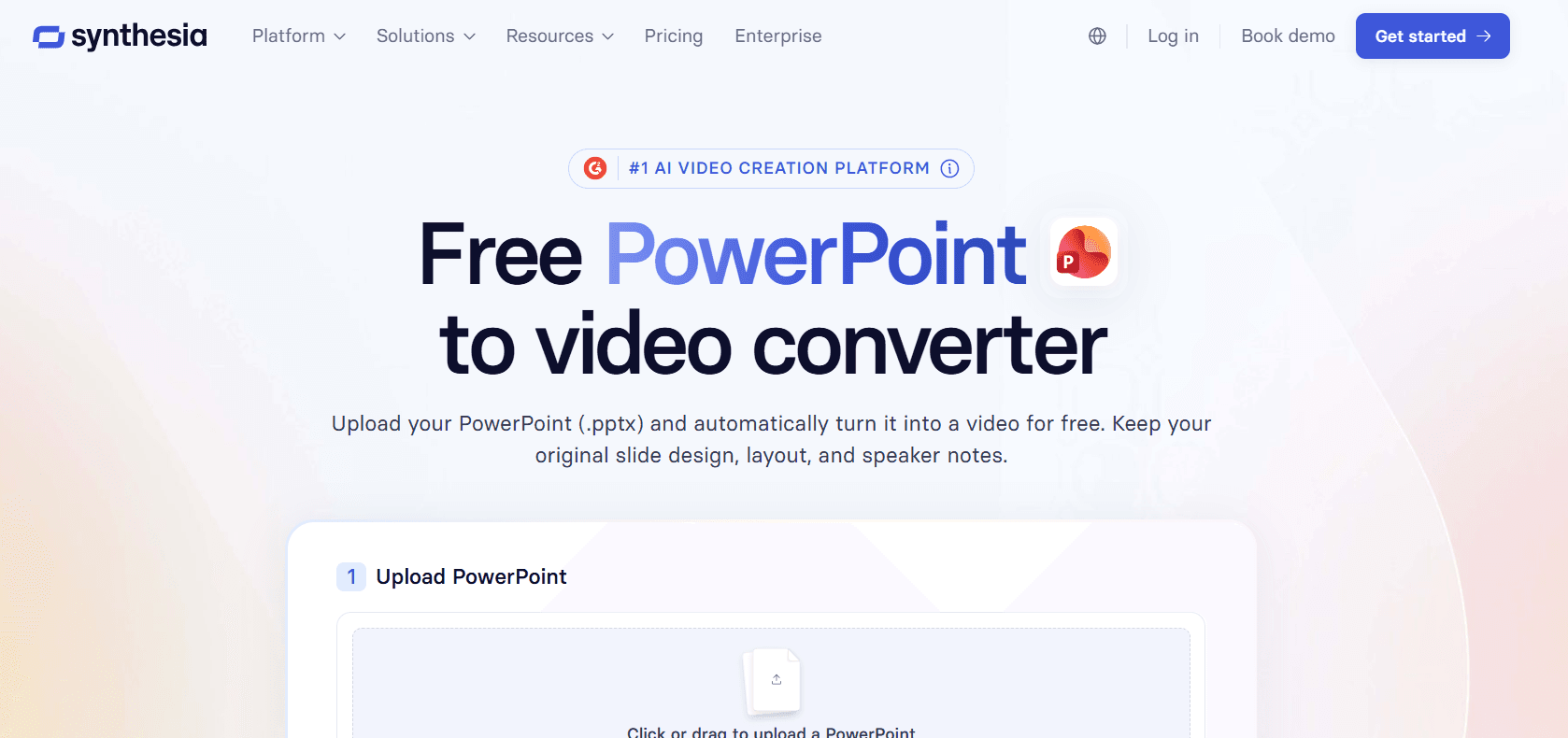
One of the biggest disappointments happens when buyers expect this:
“Upload a PowerPoint and instantly get a great training video.”
That expectation is wrong.
Synthesia improves delivery.
It does not magically improve bad instructional design.
Why PPT-to-Video Often Feels Underwhelming
A weak slide deck turned into an AI presenter is still a weak training experience.
If the content lacks:
- strong learning structure
- engagement design
- narrative flow
- clear visual hierarchy
the final video still feels low quality.
AI does not fix poor content strategy.
It only accelerates production.
My Recommendation
Use Synthesia after instructional design.
Not instead of it.
The best-performing teams use this workflow:
- strong training architecture first
- script optimization second
- AI video generation third
Not the reverse.
This single mindset shift prevents most disappointment.
Synthesia Pricing Review: Is It Too Expensive?
Synthesia Pricing Breakdown (2026 Overview)
| Plan | Price | Best For | Key Features |
|---|---|---|---|
| Basic | Free | First-time users testing AI video creation | 1,200 credits/month, up to 10 minutes of video/month, no credit card required |
| Starter | $14/month (billed yearly) | Small teams and solo creators | Download videos, AI Video Assistant, AI Dubbing, remove Synthesia logo, 1 editor + 3 guests |
| Creator | $59/month (billed yearly) | Growing businesses and content teams | 5 personal avatars, AI Dubbing, branded video pages, API access, multiple avatars per scene |
| Enterprise | Custom Pricing | Large teams and global organizations | Unlimited video minutes, 1-click translations into 80+ languages, 240+ stock AI avatars, unlimited personal avatars, advanced team collaboration |
Synthesia pricing mainly scales based on video volume, collaboration features, avatar customization, and multilingual localization needs. For enterprise teams handling training and onboarding at scale, the higher-tier plans often provide the best ROI.
For small teams, often yes.
For enterprise teams, often no.
Pricing frustration is one of the strongest objections buyers raise.
The issue is not only subscription cost.
It is the usage model.
The Real Pricing Problem: Video Minute Limits
Users consistently dislike:
- annual minute caps
- overage fees
- expensive upgrades
- important features locked behind enterprise plans
This makes the platform feel less like SaaS and more like a production meter.
Especially frustrating features often reserved for higher plans include:
- advanced collaboration
- multilingual workflows
- stronger localization controls
- enterprise permissions
- custom avatars
Is the Custom Avatar Worth It?
This depends entirely on use case.
For internal training at scale:
possibly yes.
For small teams testing AI video:
usually no.
Paying $1000+ for a custom avatar only makes sense when video output is frequent and operationally critical.
Otherwise, standard avatars are usually sufficient.
Synthesia for Multilingual Training Is Where It Creates the Most Value
This is arguably Synthesia’s strongest product-market fit.
Not avatars.
Not design.
Multilingual scaling.
Case Study: Global Employee Enablement Across Multiple Languages
A global enablement team needed to deliver the same training content across multiple regions and languages.
The goal:
Avoid separate recording workflows for every language version.
Before Synthesia, each localization cycle required:
- separate voice talent
- separate recording sessions
- local editing work
- new review rounds
- duplicated production costs
This made updates slow and expensive.
After Synthesia:
one master script → multiple language outputs
This dramatically simplified:
- training deployment
- regional onboarding
- product update communication
Multilingual output was repeatedly identified as the single strongest reason teams stayed with the platform.
This is where Synthesia feels less like a video tool and more like infrastructure.
For global companies, that matters far more than avatar realism.
Synthesia vs HeyGen: Which One Is Better?
This is the most common comparison buyers make.
The answer depends entirely on your use case.
Choose Synthesia If You Need
- internal training
- compliance education
- onboarding
- enterprise reliability
- multilingual localization
- stable team workflows
- governance and approvals
Choose HeyGen If You Need
- marketing videos
- sales outreach
- social content
- more natural-looking presenters
- higher emotional realism
- flexible creative expression
The Simplest Comparison
Synthesia is stronger for systems.
HeyGen is stronger for realism.
If your priority is operational scale, choose Synthesia.
If your priority is human-like delivery, choose HeyGen.
Most teams choosing the wrong tool are solving the wrong problem.
Who Should Not Buy Synthesia
Not every company should use AI avatar video.
You should probably avoid Synthesia if:
- your core channel is paid advertising
- your content depends on emotional trust
- founder-led storytelling drives conversions
- sales conversations require high authenticity
- your audience reacts negatively to obvious AI
In these cases, human video usually wins.
Even low-production real footage often performs better than polished AI delivery.
This is especially true for:
- DTC brands
- personal brands
- sales-led startups
- high-ticket services
- trust-first consulting offers
Synthesia is strongest when information matters more than emotion.
Final Verdict: Is Synthesia Worth It?
Yes—but only if you use it for the right job.
Synthesia is not a universal video replacement tool.
It is a specialized operational tool for repeatable, update-heavy, explanation-driven content.
Best for:
- training
- onboarding
- compliance
- internal communication
- multilingual enablement
Weak for:
- persuasion
- advertising
- sales conversion
- emotional storytelling
The companies that succeed with Synthesia treat it as a workflow engine.
The companies that fail treat it as a human replacement.
That difference determines ROI.
FAQ: Real Questions Buyers Ask Before Choosing Synthesia
Is Synthesia worth replacing human training videos?
Yes—especially for compliance, onboarding, and internal SOP training where updates happen frequently. If content changes often, the savings from instant script updates usually justify the investment.
Do I really need real presenters for onboarding videos?
Not always. For standardized onboarding, AI presenters are often sufficient. Real presenters matter more when leadership visibility, culture-building, or emotional engagement is the goal.
Which is better: Synthesia or HeyGen?
For enterprise training, Synthesia is usually stronger. For marketing and more natural avatar performance, HeyGen is often better.
Is a custom Synthesia avatar worth $1000+?
Only if video creation is frequent and strategically important. For small teams or early testing, standard avatars are usually the smarter choice.
Why does PPT-to-video often disappoint?
Because AI improves delivery, not instructional quality. Poor training structure cannot be fixed by an AI presenter.
Is Leadde a good alternative to Synthesia?
For document-heavy workflows, yes. If your team creates videos from PPTs, PDFs, SOPs, or training manuals, Leadde can be a stronger fit because it focuses on document-to-video automation rather than manual script-first workflows.
Does Synthesia hurt sales video conversion rates?
It can. In performance marketing and sales outreach, AI avatars often reduce trust and lower conversion compared to real human video.
Is multilingual support actually useful or just marketing?
It is genuinely valuable and often the strongest reason enterprise teams adopt the platform. One script across multiple languages creates major workflow efficiency.
Not ready to pay $59/month for Synthesia yet?
If you mainly need to turn training documents, SOPs, or PowerPoints into videos — Leadde does exactly that, and you can start for free. No credit card. No minute caps on the free plan.Most users get their first video done in under 5 minutes.