
Leadde Logo

How Corporate Carbon Accounting Works

An educational overview of corporate carbon accounting, detailing the three emission scopes, calculation methods, and business value.
LBy Leadde Updated August 18, 2026

What the Three Scopes Mean for the People Who Have to Report Them

Corporate carbon accounting sorts emissions into three scopes: Scope 1 covers fuel burned in assets the company controls, Scope 2 covers the electricity and heat it purchases, and Scope 3 covers everything else in the value chain, from purchased goods to business travel to the use of sold products. Scope 3 is usually the largest and the least measurable.

It often accounts for the majority of a reported footprint. Those definitions are easy to state and hard to apply, and the people who have to apply them are rarely sustainability specialists — they are a facilities manager, a procurement lead, and a finance analyst being asked for numbers they have never been asked for before. An explanation aimed at them has to answer "which of these is mine" in the first minute. Kept out of the video entirely is methodology detail: emission factor selection, market-based versus location-based Scope 2, and recalculation policy belong in the inventory management plan, not in a briefing.

This template covers the framework in eight scenes: one on why the scopes exist at all, three taking one scope each with an example drawn from an ordinary business, two on where the data actually comes from, one on the boundary decisions that change a total, and one on what each contributing team is being asked to hand over.

How to Cover Three Emission Scopes Without Losing the Room

The standard failure of a carbon briefing is completeness. The GHG Protocol has fifteen Scope 3 categories, and a video that walks all fifteen will be watched by nobody outside the sustainability team. The job is to compress the framework to the part each viewer must act on.

Cut Scope 3 to the categories that apply to you

Cut Scope 3 to the categories that apply to you

Most organisations report meaningfully against three or four of the fifteen. Name those, say the rest are not material this cycle, and the briefing halves in length without losing accuracy.

Give each scope one example from your own operation

An abstract definition of Scope 1 is forgettable. "The gas boiler in the Leeds warehouse" is not, and it tells the facilities manager immediately that the request is aimed at them.

Separate what is measured from what is estimated

Teams resist reporting when they think a number has to be exact. Saying which figures are activity-based and which are spend-based estimates lowers the barrier and improves what actually comes back.

End on the data request, with a date

The briefing exists to produce a spreadsheet. The final scene should name the file, the owner, and the deadline, or the video is background reading.

Start from the reporting documents you already produce

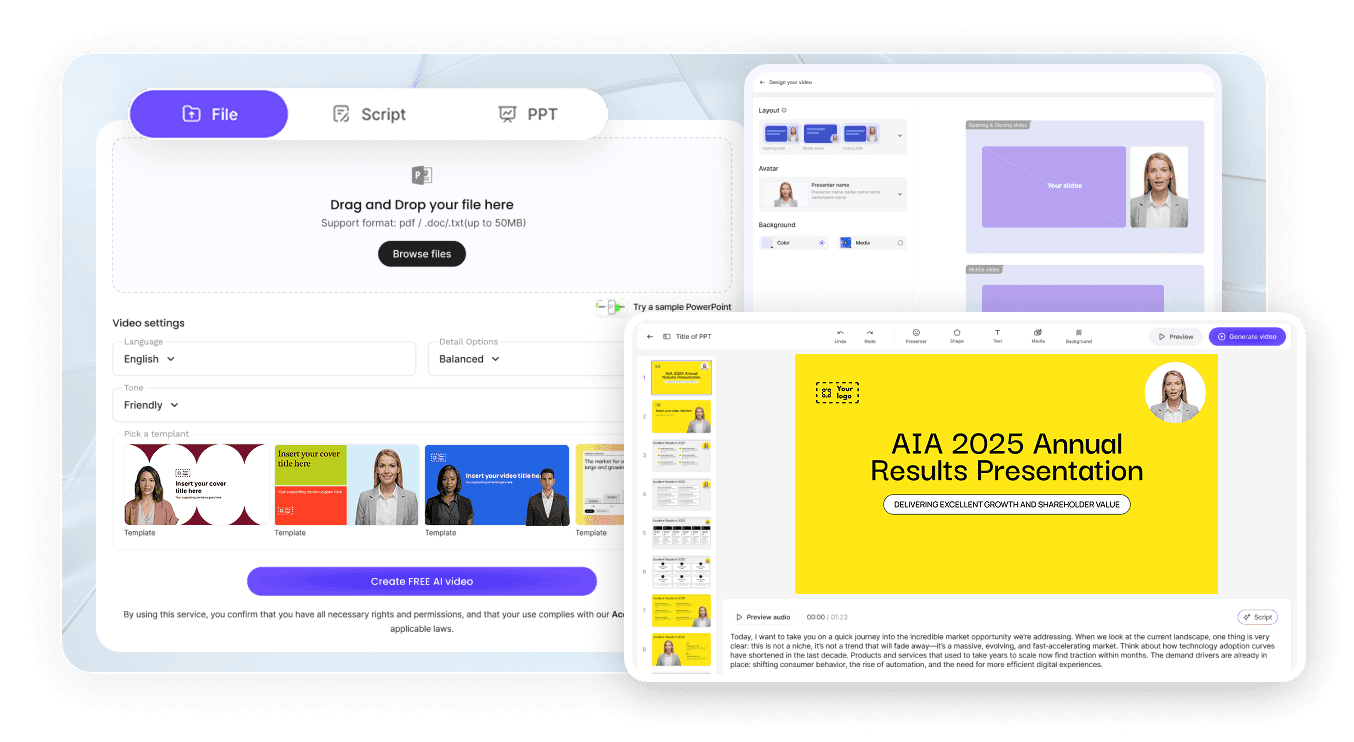
Upload last year's GHG inventory report, the supplier data request, or the reporting boundary memo, in PDF, DOC, DOCX, PPTX, or TXT under 200 MB. The returned scenes are editable and the source file is untouched.

Brief the Teams Who Have to Supply the Numbers

Point it at last year's inventory report and edit what comes back before this cycle's data request goes out.

avatar

Start With This Template. Finish With a Video Ready to Share.

Add your onboarding guide or help-center pages and generate an editable draft in minutes.