
Leadde Logo

How to Set Up a USB Microphone for Clear Voice Recording

A comprehensive guide on physical microphone placement, software gain adjustments, room acoustics optimization, and conducting pre-recording test clips.
LBy Leadde Updated August 21, 2026

What Goes Wrong Between the Microphone and the File

Most bad voice recordings are made before any software is opened. The microphone sits too far away, the room reflects, and the gain is set by guessing. A hand's width from the mouth, slightly off axis, with peaks landing around minus twelve decibels, fixes more than any plugin applied afterwards.

Distance is the single biggest factor and the one people get wrong in the same direction every time. Doubling the distance does not halve the voice; it changes the ratio of voice to room, and the room is what makes a recording sound amateur. Deliberately left off screen is post-production technique: compression settings, noise reduction, and mastering chains belong in an editing module rather than in a setup guide.

The template traces the signal through seven scenes: one on placement distance and angle, one on why speaking across the mic rather than into it removes plosives, two on setting gain and reading a meter, one on treating a room with what is already in it, one on the thirty-second test clip, and one on what to check before recording a full session.

How to Get a Consistent Recording From People Who Are Not Audio Engineers

Course narration is usually recorded by whoever wrote the module, in whatever room is free. Consistency across a series matters more than absolute quality, because a course that changes tone between modules sounds broken even when each module is fine.

Fix the distance with a physical reference

Fix the distance with a physical reference

A hand's width, every time. Anything expressed in centimetres gets estimated differently by each person; a body-based measure does not.

Set gain by peaks, not by loudness

Peaks around minus twelve leaves headroom for a laugh or an emphasis. Recording as loud as possible is the most common cause of unusable takes.

Treat the room before touching the settings

A duvet on a stand behind the speaker and a rug on a hard floor do more than any software. Naming free fixes is what makes this step actually happen.

Make the test clip mandatory

Thirty seconds, played back on headphones, before the session. It catches the fan, the fridge, and the wrong input, all of which are invisible until the recording is finished.

Feed in the recording guide your L&D team already uses

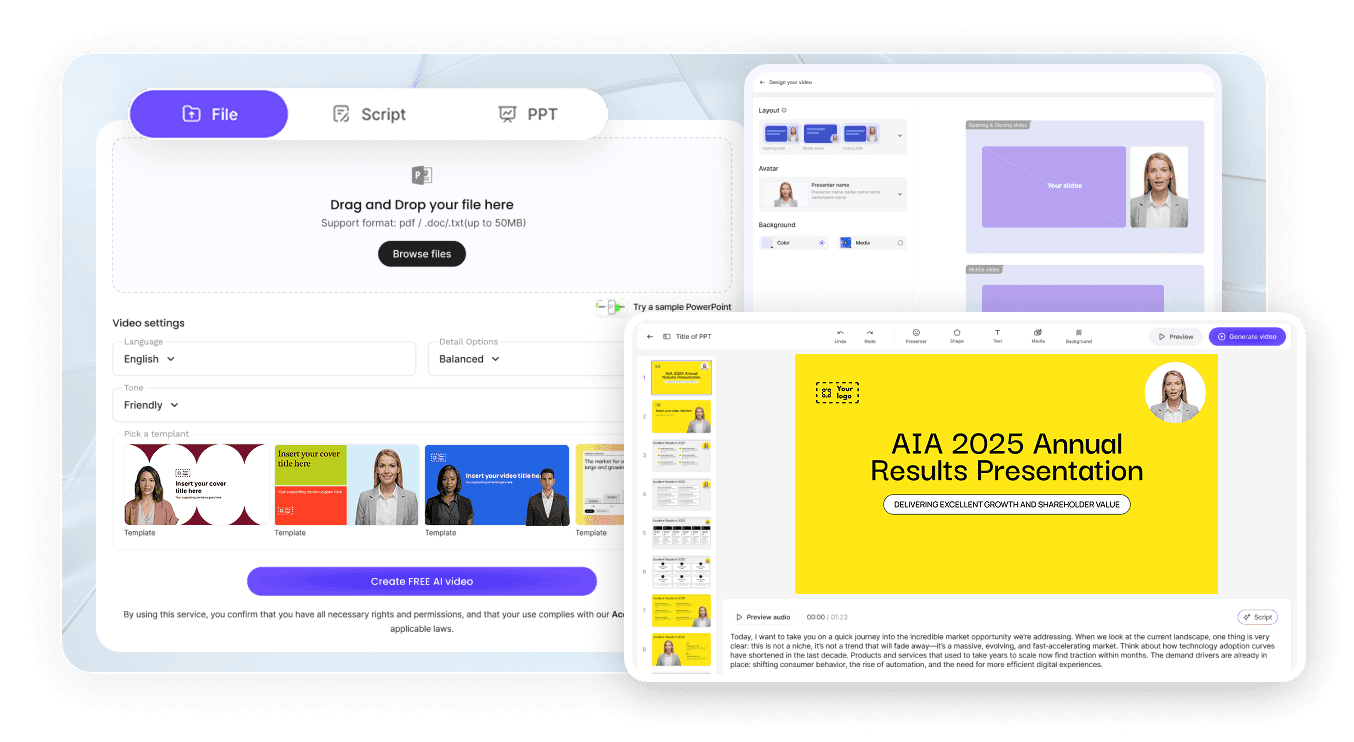
Upload the recording guide, the narration script template, or the studio checklist for the course, up to 200 MB, in PDF, DOC, DOCX, PPTX, or TXT. The draft is fully editable and the file itself is left alone.

Level the Sound Before the First Take

Feed in the recording guide your L&D team already uses and tighten the draft ahead of the next module is narrated.

avatar

Start With This Template. Finish With a Video Ready to Share.

Add your onboarding guide or help-center pages and generate an editable draft in minutes.