
Leadde Logo

Mastering Clear Professional Emails

Learn how to structure professional emails, write effective subject lines, state purposes clearly, and avoid common pitfalls to improve team efficiency.
LBy Leadde Updated August 25, 2026

What Happens to an Email Nobody Can Act On

An email that cannot be acted on is one where the request sits below the context. The reader opens it, scans for what they are being asked to do, does not find it in the first two lines, and closes it to deal with later. Later is where most internal delay comes from.

The writer almost always knows what they want and puts it last out of politeness, building the case before making the ask. That order works in a letter and fails in an inbox of ninety messages, because the reader is triaging rather than reading. Kept out of the video entirely is any real correspondence: internal threads used as examples have to be rewritten as fictional, because a training module circulates for years and the people in the thread did not consent to be a case study.

The module is set out across nine scenes: one on how a work inbox is actually processed, two on subject lines that survive scanning, two on putting the request first and the context after, one on the deadline and what makes one credible, one on tone in short messages, one on when not to send an email at all, and one on the reply that closes a thread.
How to Make a Writing Module People Finish

Business writing training has a credibility problem: everyone believes they write clearly, and the module usually opens by implying otherwise. The version that gets finished shows the reader's experience rather than criticising the writer's.

Open from the inbox, not the outbox

Open from the inbox, not the outbox

Show ninety unread messages and the four seconds each one gets. The problem becomes obvious without anyone being told they write badly.

Give the subject line a job

A subject line states the topic and the required action. Two components, testable, and immediately better than most of what the audience currently sends.

Put the ask above the context

Request first, reasoning below, detail below that. Reversing the instinct is the single highest-value change in the module and deserves the most screen time.

Cover the message that should have been a conversation

Long threads on contested topics are the most expensive failure. Naming the point at which to stop typing is worth more than any formatting rule.

Start from the communications guide already issued

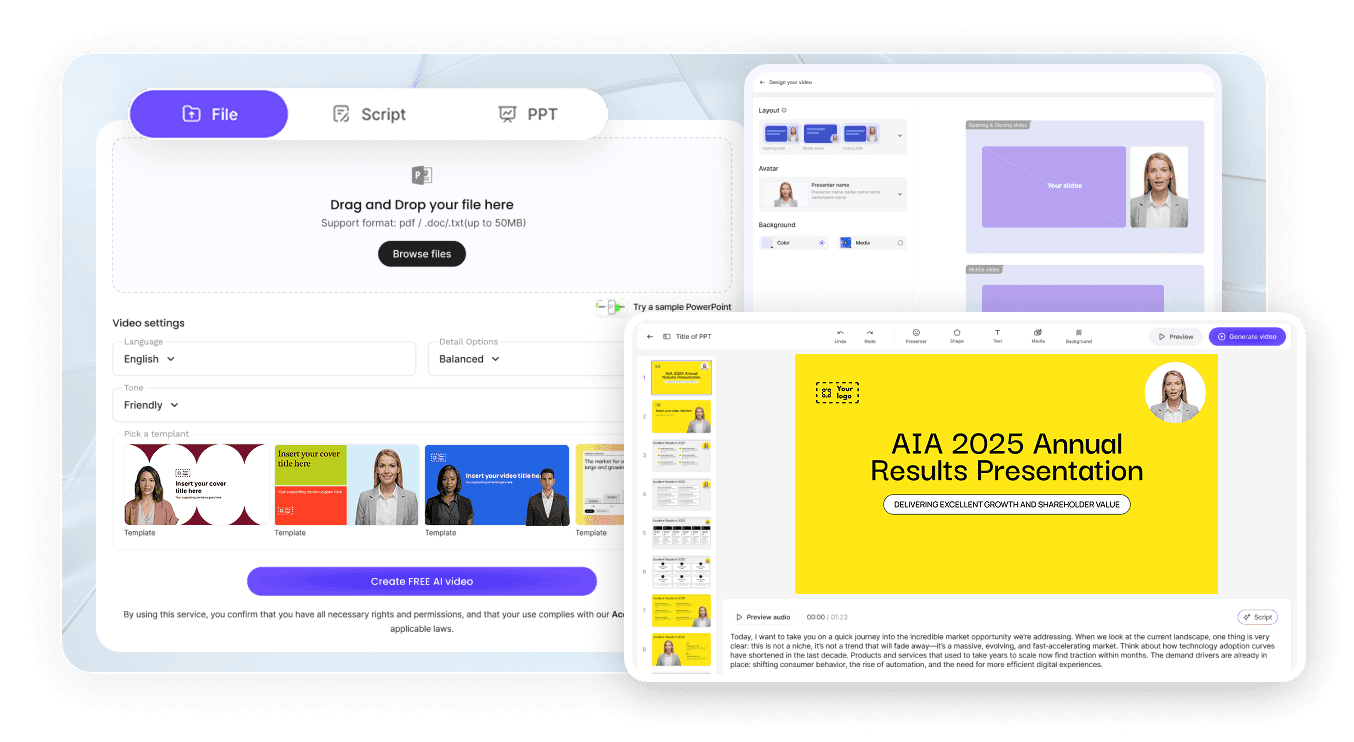
Upload the communications guide, the tone-of-voice document, or the induction pack you send to new starters, in PDF, DOC, DOCX, PPTX, or TXT under 200 MB. The returned scenes are editable and the uploaded document is untouched.

Adapting It to How Your Teams Actually Work

Say which messages belong in chat instead

Say which messages belong in chat instead

Every organisation draws the line differently between email, chat, and ticket. A writing module that ignores your channel policy teaches habits your teams will be corrected for.

Replace the examples with your own message types

Replace the examples with your own message types

Status update, approval request, and escalation are different shapes. Building the scenes around the three your teams actually send makes the module a reference rather than a lecture.

Rebuild it in the languages your teams think in

Rebuild it in the languages your teams think in

Clarity rules transfer across languages, but they are learned fastest in the one someone thinks in. The same nine scenes regenerate across 88 languages and 175 dialects, so a team writing English as a second language can learn the structure first in their own.

Professional Email FAQ

The topic and the action required, in that order, short enough to survive truncation on a phone. "Q3 budget: approval needed by Friday" tells a reader whether to open it now; "Quick question" tells them nothing and gets opened last.

In the first two lines, before the background. Readers triage by looking for what is being asked of them, and context placed above the ask is read as preamble and skipped.

Rewrite them as fictional first. Leadde produces the module from whatever is uploaded and does not redact anything on your behalf, and real threads name colleagues who did not agree to appear in training that outlives the project.

Short enough that the ask and the deadline are visible without scrolling. If the necessary detail will not fit, the detail belongs in an attachment or a document, and the email becomes a pointer to it.

Draft It Once, Not Three Times

Point it at the communications guide already issued to new starters and edit what comes back before the next induction week.

avatar

Start With This Template. Finish With a Video Ready to Share.

Add your onboarding guide or help-center pages and generate an editable draft in minutes.