
Leadde Logo

Research Findings Presentation for Conferences

Presents research background, methodology, key results, limitations, and conclusions in the structure expected at an academic or industry conference.
LBy Leadde Updated August 21, 2026

What a Conference Audience Is Listening For

A conference audience is listening for one thing: whether the finding changes anything they do. Background and methodology exist to make the result credible, not to fill the slot, and an audience that reaches the results slide at minute eleven has already decided how much attention to give it.

Academic training encourages the opposite order, because a paper is read by reviewers who need the method before the claim. A talk is not a paper read aloud, and the audience for each is deciding a different thing. What should never reach the published cut is unpublished data or material under embargo: a recorded talk circulates and persists in a way a room does not, and an embargo broken on video cannot be retracted.

The talk is built across eight scenes: one on the question and why it matters now, one on what was already known, two on method at the depth needed to trust the result, two on the findings themselves, one on limitations stated plainly, and one on what follows from it.

How to Fit a Paper Into a Conference Slot

The constraint is a fixed number of minutes and an audience that will not read a dense slide. Compression means choosing one finding to carry and letting the paper hold the rest, which is uncomfortable and correct.

Put the finding in the first two minutes

Put the finding in the first two minutes

Signposting the result early does not spoil the talk; it gives the audience a reason to follow the method that supports it.

Cut method to what supports the claim

Enough for the result to be believable, not enough to reproduce the study. Reproduction is what the paper is for.

State limitations before the questions do

An author who names the weakness controls how it is discussed. One left for the audience to find becomes the whole question session.

End on the implication, not the summary

What someone in the room should do differently is the memorable close. A recap of what was just said is not.

Load the paper you have already written

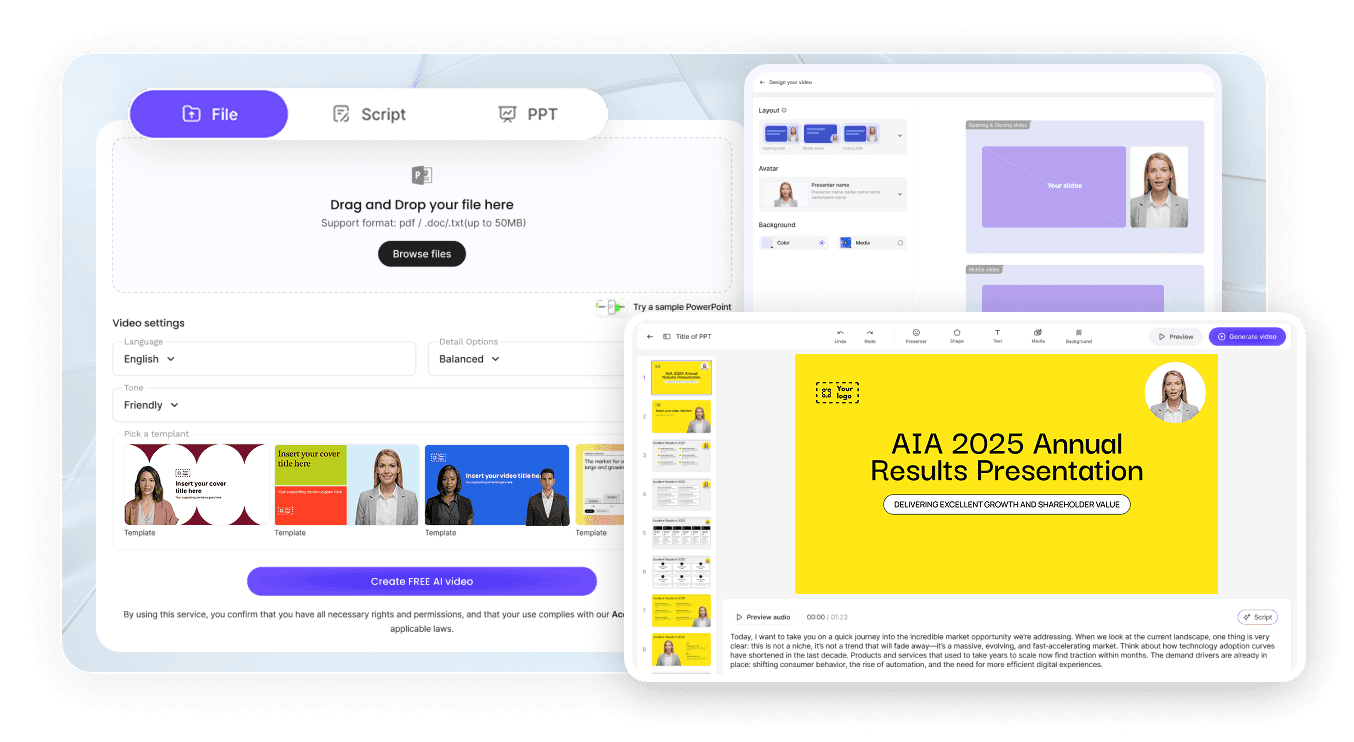
Upload the paper, the conference abstract, or the slide deck prepared for the session. Accepted formats are PDF, DOC, DOCX, PPTX, and TXT, to 200 MB. Every scene stays editable and the original document is unchanged.

Present the Limitation Before the Questions Do

Load the paper you have already written and adjust the scenes before the submission deadline.

avatar

Start With This Template. Finish With a Video Ready to Share.

Add your onboarding guide or help-center pages and generate an editable draft in minutes.