
Leadde Logo

Sociology Animation Maker

A stratification pyramid or a case study on institutions rarely survives a printed page. Leadde builds the sociology animation instead: describe the scene, let AI Motion draw it, and have an AI presenter narrate in the language your class needs.

Use at least 10 words or CJK characters.

Why Leadde is the Best Sociology Animation Maker

Turn Any Sociology Topic Into a Scene-By-Scene Script

Paste a syllabus reading on social stratification, hand in a case study on institutions, or drop in lecture notes on symbolic interactionism, and Leadde breaks the material into a scene-by-scene sociology animation. Structure, socialization, institutions, theory, and social change all run through the same workspace instead of four separate slide decks.

Animate the Systems Static Slides Can't Show

A textbook can describe five social classes, but it cannot show a person moving up or down between them. Leadde's Text-to-Motion turns a written prompt into a dynamic pyramid that redraws itself as mobility shifts, or a network diagram where agents of socialization pull in different directions at once.

Deliver the Same Lesson in 88 Languages

A sociology lecture recorded once can still serve a multilingual seminar: run it through Translate to convert the voiceover and on-screen text into 88 languages, with subtitles available in 9 styles for classrooms that read along.

Keep One Visual Style From Orientation Week to Finals

Brand Kit stores your department's font, color, and logo once, and that Theme carries into every sociology animation you build afterward, from orientation week through the final review session. A lesson on Durkheim ends up looking like the lesson on Marx that preceded it, with no redesign in between.

How to Create a Sociology Animation with AI

A sociology topic moves from a reading assignment to a narrated animation in three steps.
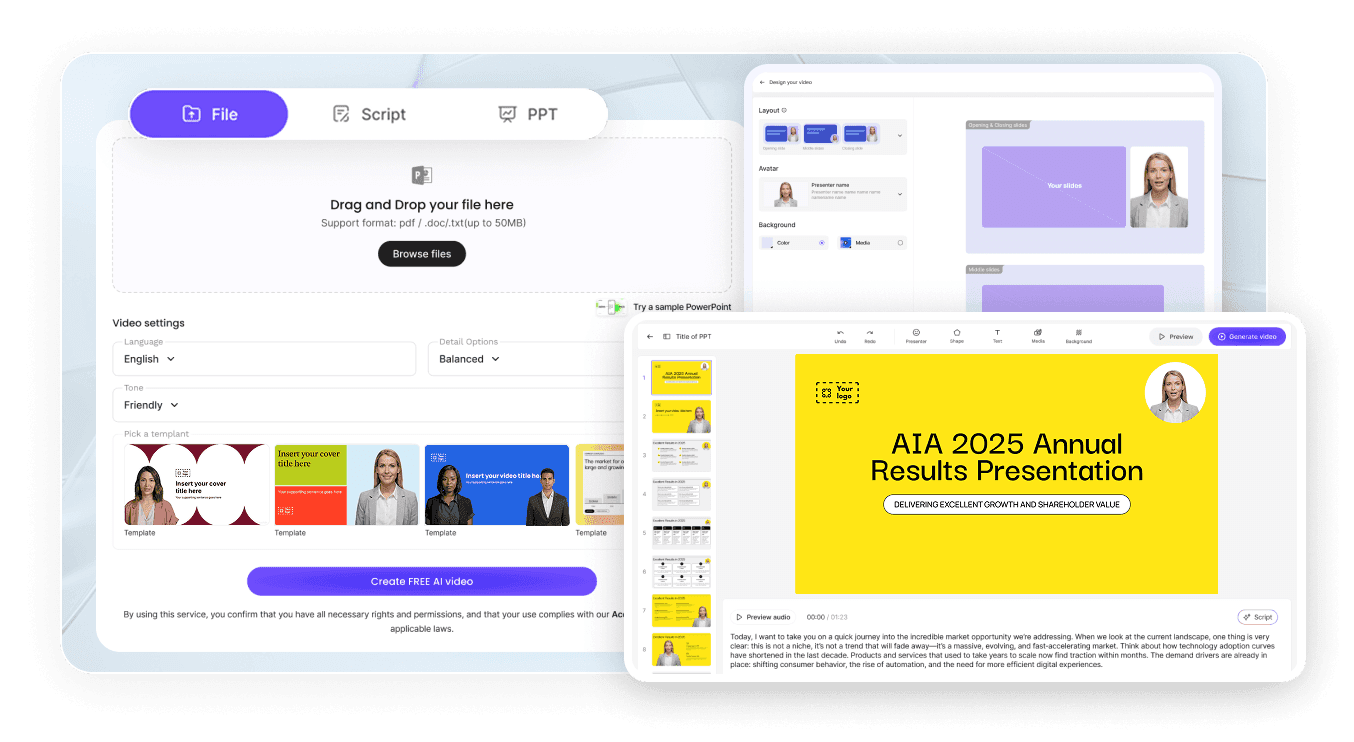
Step 1: Add Your Topic, Notes, or Case Study

Step 1: Add Your Topic, Notes, or Case Study

Start in the AI Video Creator: drop in a syllabus reading or a case study PDF, set the audience from intro sociology to a graduate seminar, and let Leadde draft the outline.

Step 2: Generate Motion and Narration

Prompt Text-to-Motion with a line like "social mobility between three classes" to generate the diagram. Once Text-to-Motion returns the diagram, an AI presenter picks up the narration, its look already set by Brand Kit.

Step 3: Refine, Translate, and Share

Subtitle style is the last setting before the sociology animation renders, pacing already locked in. Reaching a class in a different language just takes a Translate pass, after which the password-protected link goes out with its subtitle file.

Social Structure & Stratification Videos

Social Stratification Animation

Show a population sorted into layers by wealth, education, and occupation, then animate individuals climbing or sliding between those layers over a generation. A social stratification animation turns a static pyramid diagram into a moving model of inequality that students can pause and rewind.

Socialization Animation

Animate how family, school, peer groups, and media each shape a person's norms and values from childhood through adulthood, showing the agents of socialization acting at once rather than in a numbered list. Suits intro sociology, education, and child development courses.

Social Institutions Animation

Walk through how family, education, religion, and the economy each meet a different social need, then animate what happens when one institution fails to deliver, such as a school system losing public trust. A social institutions animation gives structure to an otherwise abstract unit.

Social Mobility Animation

Track a single case, such as a first-generation college graduate, moving between income brackets across two generations, with the animation redrawing the class ladder as the case progresses. A social mobility animation makes intergenerational data concrete instead of statistical.

Sociological Theory & Social Change Videos

Functionalism vs Conflict Theory Animation

Animate the same social event, such as a factory closing, once through a functionalist lens focused on stability and once through a conflict lens focused on competing class interests. Students see two theories applied to one case instead of memorizing two abstract definitions.

Symbolic Interactionism Animation

Show Goffman's dramaturgy at work: a person adjusting their presentation as they move from a job interview to a family dinner, with labeling theory animated alongside it as a second scene. A symbolic interactionism animation grounds micro-level theory in an everyday interaction.

Deviance and Social Control Animation

Animate Merton's strain theory, tracing the gap between a culturally approved goal and the legitimate means to reach it, then show conformity, innovation, ritualism, retreatism, and rebellion as five different paths out of that gap. Fits criminology and deviance units directly.

Social Change and Modernization Animation

Animate a rural, agrarian community shifting into an urban, industrial one, tracking population movement, changing family structure, and new institutions appearing as the timeline advances. A social change animation compresses a century of modernization into one replayable scene.

Trusted by Sociology Teachers, Tutors, and Social Studies Creators

Every Unit, One Sociology Workspace

Structure, socialization, institutions, theory, and social change all live in the same Leadde workspace, so a full-semester syllabus becomes one continuous set of animations instead of five separate production tools stitched together by hand.

Swap the Case Study, Rebuild the Animation

A case study goes out of date, or a new dataset replaces last year's numbers. Open the saved project, edit the script with the updated example, and Leadde regenerates the sociology animation without a re-shoot or an outside editor.

Built-In Discussion Panel for Every Clip

Every sociology animation shared through a password-protected Leadde link carries a chat panel next to the video, where a student can ask why a theory applies to a specific case without emailing the instructor separately.

Spot the Theories Students Replay Most

Whether students are replaying the conflict theory unit more than the functionalism one is visible in Leadde's analytics dashboard, which reports impressions, views, average watch time, and completion rate per animation for a professor to check before planning a review session.
compliance background

Sociology Animation Ideas & Use Cases

Intro Sociology & Social Studies Lessons

A unit on stratification, socialization, or institutions becomes a rewatchable animated lesson for high school social studies or an intro college course.

Undergraduate Sociology & Social Theory

A theory seminar assembles functionalism, conflict theory, and symbolic interactionism into one set of animated comparisons for a 300-level course.

Self-Paced Course Modules

Package a sociology unit as a standalone narrated video for a self-paced platform such as Coursera or a school's own learning portal.

Review Sessions Before Finals

Strain theory and the demographic transition model are two of the topics a tutoring session can turn into a short, replayable clip for the week before finals.

FAQs

A sociology animation maker replaces a flat slide on class, culture, or social theory with a narrated video that moves. Start from a blank prompt or your own lecture notes, and either path ends with an AI presenter narrating the finished scene in the language your class needs.

Signing up for Leadde is free and card-free, so a first sociology animation can get moving the same day. What a given plan includes beyond that starting point is a question for leadde.ai/pricing, not a fixed rule worth memorizing.

You can animate any sociology topic that fits a scripted lesson, including social stratification, socialization, social institutions, social mobility, functionalism, conflict theory, symbolic interactionism, deviance, and social change. If none of these fit your syllabus, describe your own case study or reading directly and Leadde will still build a scene-by-scene breakdown.

Yes. With 88 languages and 175 dialects available, a sociology animation needs only one build: Translate regenerates the voiceover and on-screen text so a bilingual or international class can follow along in their own language.

A pair of tools built the visuals on this page, both under the sidebar's AI Tools > Create Media menu: Motion for one specific action or explanation on its own, and Text-to-Video for turning a complete prompt into a full video clip using your account credits.

Ready to try Leadde?

Start creating sociology animation videos today. Bring a reading list, skip the credit card, and skip the animation software entirely.

avatar