
Leadde Logo

Anatomy Animation Maker

A skeleton chart or a static organ diagram shows only one layer of a body system at a time. Leadde turns a lesson plan into an anatomy animation video with Text-to-Motion and a narrated AI presenter, covering structure and function in one scene instead of a page of labels.

Use at least 10 words or CJK characters.

Why Leadde is the Best Anatomy Animation Maker

Cover Every Body System From One Lesson Plan

From the skeletal frame to the endocrine glands, Leadde turns any system or textbook chapter into a labeled, narrated anatomy animation. Anatomy and physiology teachers, nursing faculty, and course designers work from the same workspace, so one workflow covers the whole syllabus instead of a different tool for every unit.

Text-to-Motion for Structures You Can't See Move

A textbook diagram can't show synovial fluid cushioning a joint or peristalsis pushing food through the intestine. Describe a specific motion, a muscle crossing a joint, a hormone reaching a target organ, and Text-to-Motion renders it as a moving scene instead of a static arrow in a textbook.

Narrated Body System Videos in 88 Languages

An anatomy animation doesn't have to sound like a recorded lecture: pick from 300 AI avatars on the Expressive IV Engine for natural expressions and full-body movement, then send the script and on-screen labels through Translate for a class studying in 88 languages.

Templates and Brand Kit for Every Unit

Fifty templates for lecture, lab walkthrough, and exam recap videos all pull from a single Brand Kit setup, so a program's colors, logo, and font never need re-entering. A skeletal system unit in week two and an endocrine unit in week ten can share the same visual identity without a new design request.

How to Create an Anatomy Animation with AI

From a course outline to a finished anatomy animation takes three steps in Leadde, with no 3D modeling software to learn.
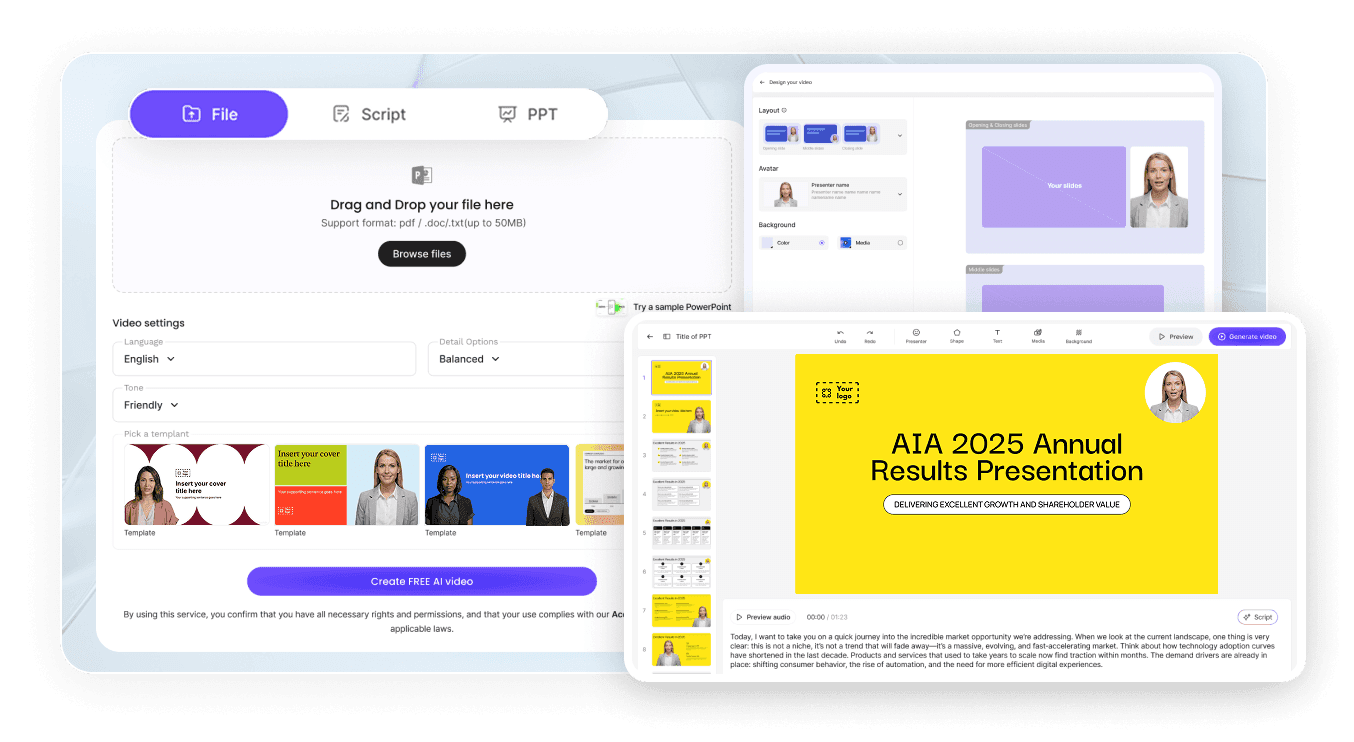
Step 1: Add Your Textbook Chapter or Course Outline

Step 1: Add Your Textbook Chapter or Course Outline

Drop a textbook chapter or course outline straight into Leadde, or send it to the Knowledge Base instead. Naming the audience is the only setup step before a first-pass scene sketch comes back for editing.

Step 2: Generate the System Animation and Narration

In Text-to-Motion, describe the structure in motion, a synovial joint flexing or a hormone reaching its receptor. Cast an AI presenter, label the diagram, and keep the scene on brand with Brand Kit.

Step 3: Refine, Translate, and Share

Labels get a final check alongside the pacing before the video renders. From there, either share the link behind its password screen, or run Translate first if a different cohort needs the narration in another language.

Skeletal & Muscular System Animation Videos

Skeletal System Animation

Label the axial and appendicular skeleton, joint types, and bone landmarks in one animated pass. A skeletal system animation gives a GCSE, A-Level, or undergraduate anatomy class a structure students can follow instead of memorizing from a flat diagram.

Muscular System Animation

Animate a muscle fiber sliding past its neighbor during contraction, then zoom out to the major muscle groups working together in a movement. A muscular system animation connects the cellular mechanism to the visible motion in the same scene.

Joint Movement Animation

Show flexion, extension, rotation, and the synovial fluid that cushions a joint through its full range of motion. A joint movement animation is the scene a physiotherapy or kinesiology course reaches for when a photo of a knee is not enough.

Skeletal Muscle Contraction Animation

Walk through the sliding filament mechanism, from calcium release to actin and myosin overlapping, at a pace students can pause and rewind. A skeletal muscle contraction animation turns a dense physiology paragraph into a sequence they can actually follow.

Digestive, Endocrine & Lymphatic System Animation Videos

Digestive System Animation

Trace a meal from the mouth through the stomach, small intestine, and colon, with peristalsis and enzyme action shown at each stage. A digestive system animation lets students watch the whole transit rather than study one cross-section diagram.

Endocrine System Animation

Show a gland releasing a hormone into the bloodstream and reaching a target organ elsewhere in the body, the kind of distance a static diagram usually loses. An endocrine system animation keeps the source, the pathway, and the target in one continuous scene.

Lymphatic and Immune System Animation

Animate lymph draining through nodes and vessels alongside a white blood cell responding to a pathogen. A lymphatic and immune system animation makes an otherwise invisible defense process visible for a health science or nursing class.

Urinary System Animation

Follow blood entering the kidney, filtering through a nephron, and leaving as urine, staged the way a renal physiology unit usually sequences it. Filtration, reabsorption, and secretion move instead of sitting still on a labeled urinary cross-section.

Trusted by Anatomy Teachers, Tutors, and EdTech Creators

One Workspace for the Whole A&P Syllabus

A full course spans several systems, not one, so Leadde keeps the whole set, skeletal through lymphatic, inside a single workspace. Course readings and diagrams go into the Knowledge Base once and stay ready for whichever system comes next.

Update a Video the Same Day the Textbook Does

A new edition changes a term or a diagram, or a syllabus swaps one system for another. A syllabus swap or a new textbook edition doesn't call for a re-shoot: change the script inside the saved project and Leadde regenerates the video the same afternoon.

Let Students Ask About a Structure While It's Fresh

Send an anatomy animation out through a password-protected Leadde link, and a student can drop a question about a structure into the chat panel right after watching, rather than saving it for office hours. Office hours become optional once the recording can field that question on its own.

See Which System Needs a Second Pass

Leadde's analytics panel lists watch time, completion rate, interaction count, impressions, and views per video, singling out which body system needs a second explanation.
compliance background

Anatomy Animation Ideas & Use Cases

GCSE & A-Level Anatomy and Physiology

Turn a body-system chapter into a short video students can rewatch the night before a test, next to their usual diagrams and slides.

Nursing and Allied Health Programs

Build a semester of system-by-system videos for a nursing or allied health cohort, translated for students who study in a second language.

Medical and Pre-Med Prep

Turn a dense systems review into a short animation students replay before an exam, covering the structures and functions most likely to be tested.

Online Anatomy Courses

Turn a self-paced anatomy course into a set of narrated videos for Udemy, Teachable, or a school's LMS, one system per lesson.

FAQs

A body systems animation maker turns a system's structures and functions into a narrated, animated video that students can rewatch. Paste a description or a lesson outline, and Leadde assembles the Motion scenes, casts a narrated AI presenter, and outputs the video in your students' language if you need it translated.

There is no charge to open a Leadde account, and no card is asked for at signup. A full anatomy course is easier to scope once leadde.ai/pricing has been checked, since each paid plan covers something different.

You can animate any system that fits a scripted lesson: skeletal, muscular, digestive, endocrine, lymphatic, urinary, and more, alongside the cardiovascular, nervous, and respiratory systems covered on their own pages. Paste the notes for whichever system your class covers next, and the AI splits them into scenes for you.

88 languages and 175 dialects are available through Translate, more than enough for an anatomy animation built in one language first and adapted as needed. Run it through Translate whenever a student needs the script and labels in their own.

The sidebar's Create Media panel, reached through AI Tools, is where this page's clips came from. Motion took the short prompts, one structure or process apiece, and Text-to-Video handled anything long enough to need a full script and a share of account credits.

Ready to try Leadde?

A body-systems lecture doesn't have to stay a static slide. Registering is free, skips the credit card, and installs no 3D software.
avatar