
Leadde Logo

Psychology Animation Maker

Psychology theories rarely survive a static slide: a conformity experiment or an attachment style needs motion to make sense. On Leadde, that motion becomes a psychology animation in one pass, an AI Motion diagram builds the scene and an AI avatar narrates it.

Use at least 10 words or CJK characters.

Why Leadde is the Best Psychology Animation Maker

Structure Any Psychology Topic Into a Script

From classical conditioning and memory encoding to Piaget's stages and conformity experiments, Leadde turns a lesson plan, textbook chapter, or lecture outline into a scene-by-scene psychology animation. Cover cognitive, developmental, behaviorist, and social psychology branches in one workspace instead of assembling slides, stock footage, and a separate voiceover tool for each unit.

Turn a Theory Into a Moving Diagram

Static slides can't show a reinforcement schedule building a response curve or a stimulus and response arrow completing a conditioning loop. Leadde's Text-to-Motion turns a written prompt into an animated diagram, picking the aspect ratio and on-screen text language so a Skinner box trial or an Asch line-judgment task plays out step by step.

Narrate Every Lesson in a Student's First Language

The narration goes to one of 300 AI avatars, its expressions and full-body movement rendered through the Expressive IV Engine instead of a stiff voice reading over static slides. When the class isn't English-speaking, Translate resets that same narration and the on-screen captions across 88 languages.

Reuse One Look Across the Whole Unit

Upload your department's logo, set a brand color, and pick a font once inside Brand Kit, then apply that Theme to every psychology animation you build this term. Start new topics from a saved template instead of rebuilding the layout, so a unit on cognitive bias looks like the unit on attachment theory that came before it.

How to Create a Psychology Animation with AI

No animator on staff, no problem: a psychology animation comes together in three steps.
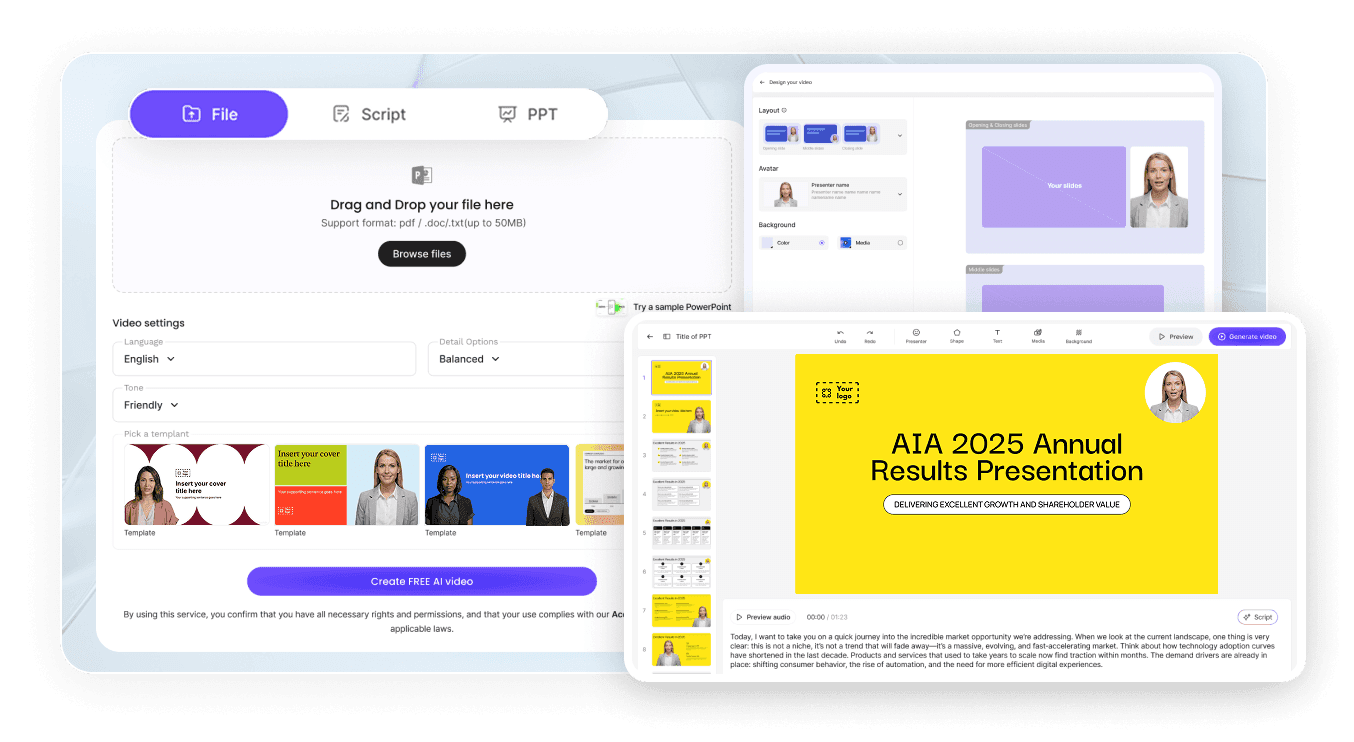
Step 1: Add Your Topic, Notes, or Course Reading

Step 1: Add Your Topic, Notes, or Course Reading

Open the AI Video Creator and upload a lecture outline, textbook chapter, or slide deck. Pick an audience, from Introductory Psychology to a corporate training session, and Leadde drafts the scene breakdown.

Step 2: Generate Motion and Narration

Open Text-to-Motion and generate a diagram from a prompt such as "operant conditioning schedule" or "Piaget's stages." Continue the result in Studio, add an AI presenter, and apply your Brand Kit.

Step 3: Refine, Translate, and Share

Pacing gets checked, then the psychology animation renders with its subtitles attached. For a class in another language, run the script through Translate first, then share the password-protected link where students can ask questions.

Cognitive & Developmental Psychology Videos

Memory Encoding and Retrieval Animation

Animate how information moves from sensory memory into short-term storage and gets encoded for long-term retrieval, then show retrieval cues pulling it back out. A memory encoding and retrieval animation gives students a visual model instead of a flat textbook diagram, and it suits AP Psychology and introductory cognitive psychology courses particularly well.

Selective Attention Animation

Show how a filter model screens competing sound and visual input, letting one conversation through while others fade, then animate the cocktail party effect breaking that filter. A selective attention animation makes an invisible cognitive process visible for AP Psychology, cognitive science, and human factors courses.

Piaget's Stages of Cognitive Development Animation

Walk through sensorimotor, preoperational, concrete operational, and formal operational stages, showing a child's changing grasp of object permanence and conservation scene by scene. A Piaget's stages animation ties abstract theory to observable behavior for education, child development, and developmental psychology courses.

Attachment Theory Animation

Animate Ainsworth's Strange Situation and Bowlby's attachment styles, showing a child's response to separation and reunion with a caregiver across secure, avoidant, and anxious patterns. An attachment theory animation turns a classic experiment into a lesson students can rewatch before an exam.

Behaviorism & Social Psychology Videos

Classical Conditioning Animation

Animate Pavlov's dog learning to associate a bell with food, tracking the shift from an unconditioned to a conditioned response across repeated trials. A classical conditioning animation makes the stimulus and response timeline concrete for AP Psychology and introductory behaviorism lessons.

Operant Conditioning Animation

Show a Skinner box trial building a response curve across fixed and variable reinforcement schedules, then compare it against extinction and punishment. An operant conditioning animation lets students compare reinforcement schedules side by side instead of memorizing four definitions.

Conformity and Obedience Animation

Animate Asch's line-judgment task and Milgram's obedience experiment as parallel scenes, showing where a participant's private judgment breaks under group or authority pressure. A conformity and obedience animation gives social psychology students a replayable model of two landmark studies.

Groupthink Animation

Walk through the conditions that push a cohesive group toward groupthink, from suppressed dissent to an illusion of unanimity, then animate the flawed decision that follows. A groupthink animation connects a classroom case study to real organizational and political decision-making.

Trusted by Psychology Teachers, Tutors, and Behavioral Science Creators

One Workspace for the Whole Psych Syllabus

From an intro unit on classical conditioning to a capstone project on social influence, Leadde covers cognitive, developmental, behaviorist, and social psychology in one workspace. Build a full semester of animated lessons without switching between a slide deck tool, a stock footage site, and a separate voiceover recorder.

Rewrite the Script, Regenerate the Scene

Textbooks get new editions, exam boards shift emphasis, and a case study you used last year gets replaced. Open the saved project, swap the script, and Leadde rebuilds the scene from the new text, skipping any re-recording or outside animator.

Students Ask Questions Inside the Video

Send students a password-protected Leadde link to the psychology animation, and a chat panel sits beside the video where they can ask a follow-up question without leaving the page. A confusing point in an attachment theory lesson gets a response right where the student is watching.

See Which Theories Need a Second Pass

A conditioning unit with low completion shows up fast in Leadde's analytics: impressions, total views, average watch time, and completion rate for every psychology animation, all reported automatically, well before the exam instead of after it.
compliance background

Psychology Animation Ideas & Use Cases

AP Psychology & High School Lessons

A weak unit on memory, conditioning, or developmental stages turns into a rewatchable animated lesson before the next quiz or the AP exam.

Undergraduate Psychology & Research Methods

A university seminar assembles cognitive processes, developmental theory, and classic social psychology experiments into one set of animated course modules.

Corporate Behavioral Science Training

Turn a behavioral economics or decision-making concept into a short animated video for onboarding, compliance, or management training sessions.

Exam Prep and Tutoring Sessions

A student stuck on attachment styles or reinforcement schedules gets a short, focused review video to replay the night before a test.

FAQs

Think of a psychology animation maker as a production assistant for psychology content: hand it a theory, an experiment, or a set of lecture notes, and it returns a narrated, animated explainer video covering conditioning, cognition, development, or social behavior. On Leadde, a written prompt becomes the AI Motion scene, and an AI presenter delivers the narration in any of 88 supported languages.

A first psychology animation can start under a free account, no card required to register. A paid tier adds more than the free account does, and leadde.ai/pricing is where a psychology instructor can compare the two before choosing.

You can animate any psychology topic that fits a scripted lesson, including classical and operant conditioning, memory and attention, Piaget's stages of development, attachment theory, conformity, obedience, and groupthink. You can also skip the topic cards above entirely: paste your own lecture notes directly, and Leadde builds the scene breakdown from that material instead.

Yes. A psychology animation built in English can be regenerated for a bilingual or ESL classroom through Translate, which resets both the voiceover and the on-screen text across 88 languages and 175 dialects.

Leadde keeps two separate generators behind the sidebar's AI Tools menu, both listed under Create Media. The Motion tab handles one action or explanation at a time, while turning a text prompt into a full video clip is Text-to-Video's job, using account credits to render it.

Ready to try Leadde?

Behaviorism and conditioning experiments explain better in motion than on a printed slide. No credit card, no software to install, just a lesson plan to start from.
avatar