MiniMax H3 Pricing 2026: API Costs, Hidden Fees, Credits & Real Cost per Video

MiniMax H3 currently costs $0.08 per generated second at 768P and $0.13 per second at 2K through MiniMax’s pay-as-you-go API. Regenerating a 768P output at 2K costs another $0.05 per second, so a basic 10-second video costs $0.80 at 768P or $1.30 at 2K before additional reference or Context-IR charges.
The headline rate, however, is only part of the real production cost. Reference videos can add billable input seconds, while retries and rejected outputs increase the amount spent before a usable clip is approved. For production teams, cost per usable video is often more meaningful than price per generated second.
This matters for broader AI video workflows as well. Platforms such as Leadde, which create informational videos from documents, training materials, and product information into structured videos, show why commercial video creation is evolving and why base video generation is only one layer of the workflow. This guide breaks down MiniMax H3 pricing across API fees, references, regeneration, providers, self-hosting, and the real cost of producing a video you can actually use.

MiniMax H3 Pricing: How Much Does MiniMax H3 Cost in 2026?
What Is the Current MiniMax H3 Price per Second?
MiniMax currently prices H3 at $0.08 per generated second for 768P and $0.13 per second for 2K. A separate regeneration endpoint upgrades an existing 768P result to 2K for $0.05 per second. MiniMax also charges for some multimodal inputs: reference audio is free, the first five reference images are free, additional images cost $0.04 each, and reference video is billed by its input duration at the selected output-resolution rate.
How Much Does a 5-, 10-, or 15-Second H3 Video Cost?
| Video Length | 768P | 2K |
| 5 seconds | $0.40 | $0.65 |
| 10 seconds | $0.80 | $1.30 |
| 15 seconds | $1.20 | $1.95 |
These figures represent base output cost only. They do not include billable reference videos, extra reference images, Context-IR usage, or additional attempts required to produce an acceptable result.
For scale, 100 ten-second 2K generations would have a base generation cost of $130 if each clip required only one attempt and no paid references. Production budgets should rarely assume that every first generation will be approved.
What Do You Actually Get for the H3 Price?
H3 is more than a text-to-video model. MiniMax supports text-to-video, first- and last-frame generation, and reference-based workflows using images, video, or audio. H3 can generate up to 15 seconds of video with native stereo audio, while the official system supports 768P and 2K outputs.
That matters when comparing AI video prices. A cheaper silent-video model may still require separate AI voice, music, sound-design, or synchronization steps. Cost per finished audiovisual asset is therefore more useful than cost per video second alone.
How Is MiniMax H3 Pricing Calculated Beyond the Base Rate?
The Five-Layer MiniMax H3 Cost Stack
A practical way to budget H3 is to separate cost into five layers:
- Base generation — the 768P or 2K output.
- Reference inputs — billable video and additional images.
- Context processing — optional H3-Context-IR usage.
- 2K regeneration — upgrading approved 768P outputs.
- Retry cost — generations that technically succeed but do not pass creative or quality review.
The first four can appear directly in MiniMax billing. The fifth is a production cost that teams need to measure themselves.
How Much Do Image, Video, and Audio References Add?
Reference-image pricing is relatively simple: five images are included, and images six through nine cost $0.04 each. Audio reference input is free. Reference video is more important for budgeting because its duration is also billed.
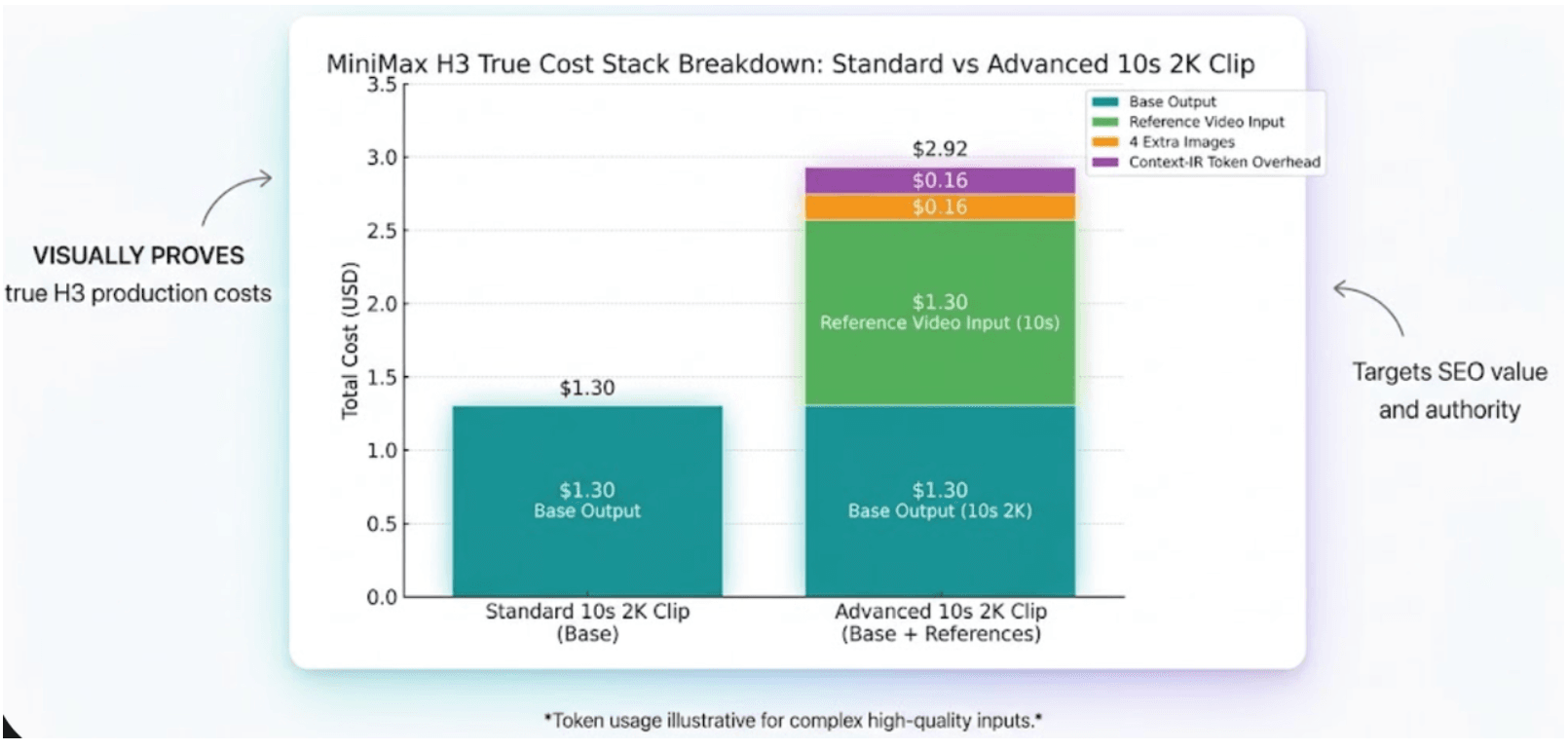
For example, generating a 10-second 2K output from a 10-second reference video creates $1.30 of reference-video input cost plus $1.30 of output cost, or $2.60 before other charges.
This is why $0.13 × output duration can underestimate reference-heavy workflows.
Does H3-Context-IR Add Another Cost?
Yes. MiniMax prices H3-Context-IR at $0.90 per million input tokens and $3.60 per million output tokens. Its role is to interpret relationships among text, images, video, and audio before passing structured context to H3-Base.
That architecture helps explain why complex H3 pricing is better understood as:
multimodal understanding → base generation → optional 2K regeneration
rather than simply “prompt in, video out.”
Does Generating MiniMax H3 at 768P and Regenerating to 2K Actually Save Money?
Why $0.08 + $0.05 Equals the Direct 2K Price
For base output, the arithmetic is straightforward:
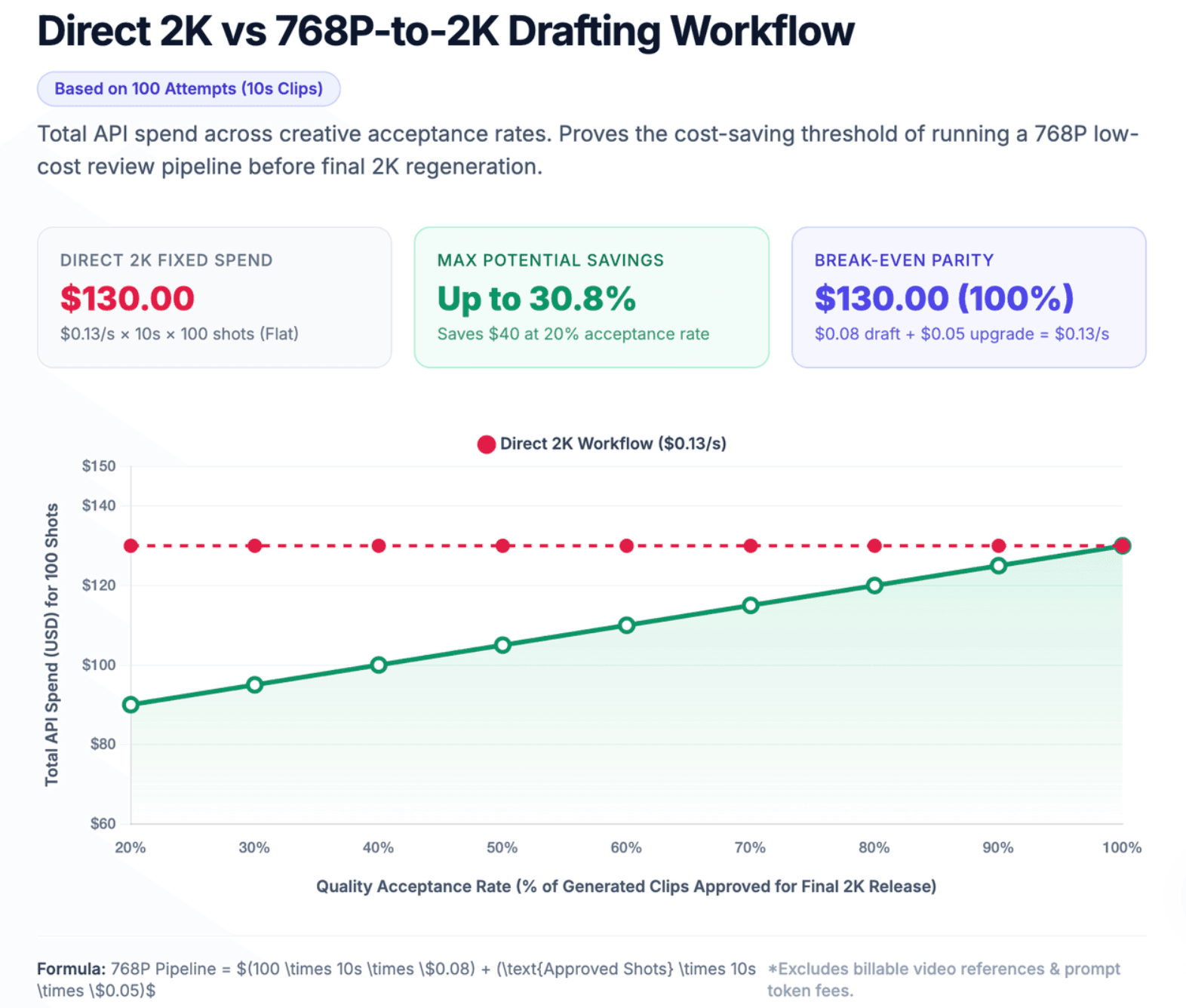
$0.08/sec for 768P + $0.05/sec for 2K regeneration = $0.13/sec.
That equals the current direct 2K generation rate.
So if every 768P draft is eventually regenerated to 2K, the basic output cost is not lower.
When Does the 768P-First Workflow Actually Save Money?
The savings come from drafts you reject before upgrading.
Suppose a five-second concept is uncertain:
- Direct 2K test: $0.65
- 768P test: $0.40
- If rejected at 768P: no $0.25 regeneration cost is spent.
This makes 768P useful as a low-cost validation stage, not simply a cheaper final-output setting.
A Practical 768P-to-2K Draft Workflow
Before paying for final 2K output:
- Generate the risky concept at 768P.
- Check character or product identity, motion, camera behavior, dialogue, and reference adherence.
- Reject weak generations early.
- Regenerate only approved clips at 2K.
From an AI video production perspective, this is especially useful for shots where physical motion, product preservation, or synchronization matter more than fine resolution during the first review, particularly when evaluating traditional commercial video production vs AI video creation.
Where Is MiniMax H3 Cheapest to Use: Direct API, Credits, OpenRouter, Sogni, or Atlas Cloud?
How Do Pay-as-You-Go, Token Plans, and Video Packages Differ?
MiniMax currently directs H3 users toward its pay-as-you-go API. The dedicated Token Plan page lists MiniMax H3 among special models that are not currently supported, while the Video Packages documentation also says H3 is not yet included and recommends pay-as-you-go or a custom plan.
This distinction matters because MiniMax billing products should not be treated as interchangeable. Before buying a subscription or credits for H3, verify that the specific billing method supports the H3 endpoint you intend to use.
MiniMax Direct vs OpenRouter vs Sogni vs Atlas Cloud
| Route | Current Pricing Signal | What Is Different |
| MiniMax Direct | $0.08/s 768P; $0.13/s 2K | Official pricing and regeneration |
| OpenRouter | From $0.13/s | Unified third-party API; MiniMax provider |
| Sogni Standard | $0.08/s | Open-weight infrastructure, up to 768P |
| Sogni Turbo | $0.03/s | Distilled third-party Turbo workflow |
| Atlas Cloud | Provider-specific | Hosted endpoints and pricing can differ |
OpenRouter currently lists H3 from $0.13 per second. Sogni lists Standard H3 at $0.08/sec and its own Turbo implementation at $0.03/sec, but Sogni currently limits H3 output to 768P and uses a different open-weight deployment model.
Third-party pricing can change quickly. Atlas Cloud's August 3 pricing article, for example, documented its H3 endpoints at $0.14/sec while distinguishing that from MiniMax's official $0.13/sec 2K rate.
Why Do Different Websites Show Different H3 Prices?
Differences usually come from date, resolution, provider, or hosting method. Older articles may still show launch-era rates, while third-party platforms may add their own pricing structure or expose only selected resolutions.
For current pricing, use this evidence order:
MiniMax official pricing → current provider model page → dated third-party testing → community discussion.
That approach is especially important for H3 because both pricing and open-weight deployment options are evolving quickly.
What Does MiniMax H3 Really Cost per Usable Video in Production?
Why Cost per Generation Is Not Cost per Usable Video
A model can successfully return a file that still fails creative review.
A more practical metric is:
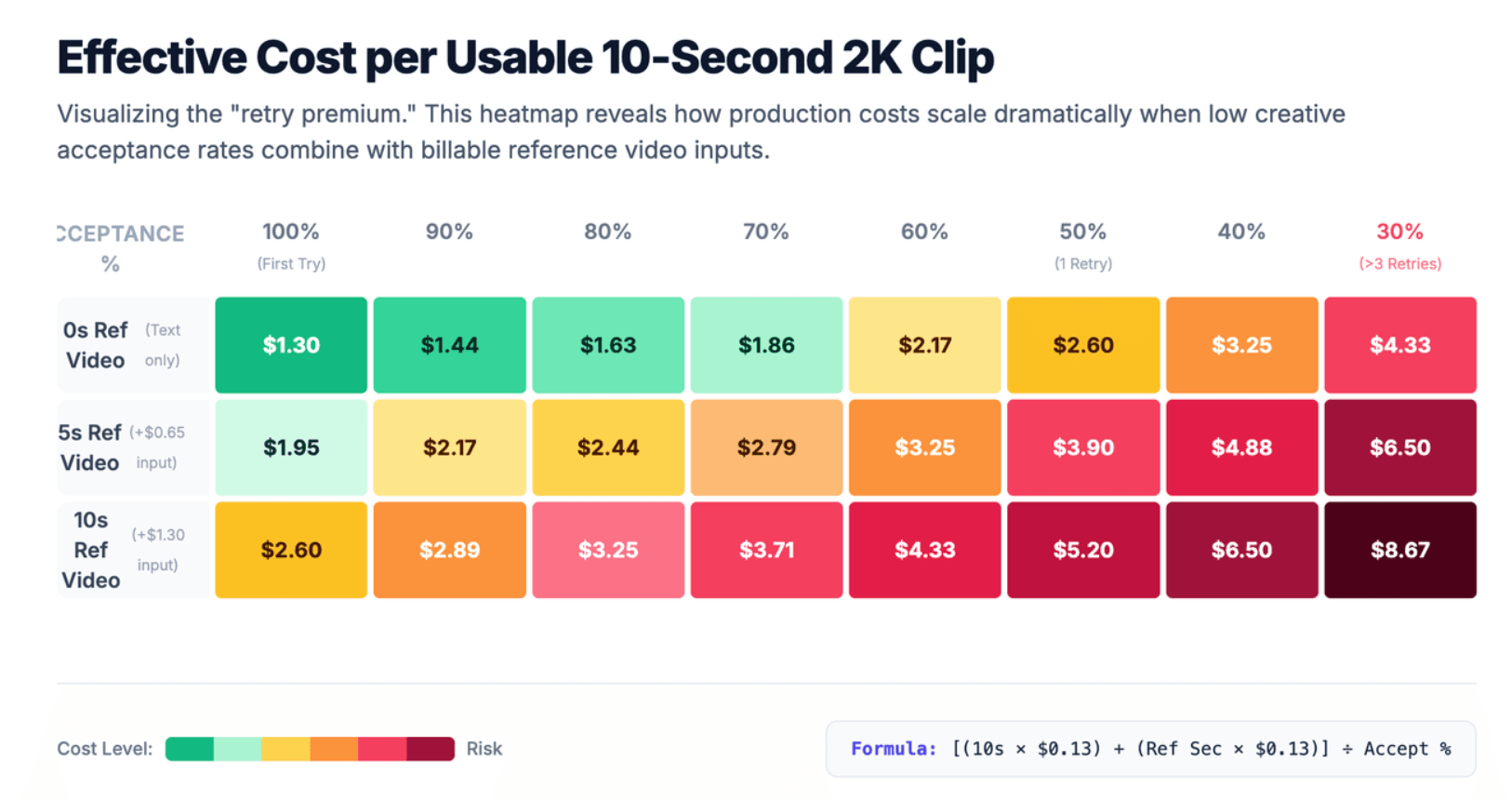
Cost per usable video = total generation spend ÷ approved outputs
If ten 10-second 2K attempts cost $13 in total but only six are accepted:
$13 ÷ 6 = about $2.17 per usable clip.
The API price has not changed. The effective production price has.
How Do Retries and Reference Workflows Change the Real Cost?
Reference workflows introduce what I call a retry premium: the additional spend created when technically successful generations still need to be replaced.
Community H3 discussions have raised practical questions around reference-audio matching, reference-to-video quality, input compatibility, and local workflow performance. These reports are not controlled benchmarks, so they should not be generalized into an H3 failure rate. They do show why teams should measure their own acceptance rate rather than assume every reference-conditioned output will be usable.
A useful rule is to test the highest-risk variable first. If a 15-second concept depends on one difficult motion or product interaction, a shorter test can expose the problem before the full shot is generated.
What Should You Measure Before Scaling H3 Production?
Run a small pilot and record:
- attempted clips
- generated seconds
- paid reference seconds
- approved clips
- acceptance rate
- retries per approved clip
- percentage upgraded to 2K
- human review time
- total spend
- cost per approved clip
This distinction becomes particularly important in structured video workflows. Leadde, for example, is designed to turn SOP documents into training videos and convert business knowledge into structured content. In workflows like these, generation is only one production stage; content structure, review, video localization, updates, and final approval also determine the cost of scaling a video library.
Is MiniMax H3 Worth the Price Compared With Self-Hosting and Other AI Video Models?
Is MiniMax H3 Free if You Run the Open Weights Locally?
The H3 weights make local deployment possible, but open weights do not mean zero production cost. MiniMax's official model card describes H3-Base as the 768P generation component, while H3-Context-IR is a hosted preprocessing system and is not included in the current open-weight release. The complete system also includes H3-Regenerate-2K.
Local deployment replaces API charges with costs such as GPU hardware or rental, system memory, storage, engineering, maintenance, and inference time.
When Is Self-Hosting Cheaper Than the H3 API?
There is no universal break-even point. The useful comparison is:
Self-hosting monthly TCO ÷ approved videos
versus
Hosted API spend ÷ approved videos.
For local workflows, also measure approved clips per GPU-hour. Community tests show that H3 performance varies substantially with GPU, quantization, resolution, and optimization, which makes a single hardware-cost claim unreliable.
Self-hosting becomes more attractive when volume and GPU utilization are high enough to offset infrastructure and engineering overhead—not simply because the API fee disappears.
How Should You Compare H3 With Seedance, Kling, Veo, or Sora?
Do not begin with a price-per-second leaderboard. Compare:
| Dimension | Why It Matters |
| Price per second | Base generation budget |
| Resolution | Final delivery requirements |
| Native audio | May remove extra production steps |
| Reference control | Determines creative consistency |
| Duration | Affects shot planning |
| Retry rate | Changes effective cost |
| Local deployment | Changes infrastructure economics |
| Cost per approved output | Best production-level metric |
H3 is particularly relevant when a workflow benefits from native audiovisual generation, multimodal references, first/last-frame control, or short commercial-quality shots. When benchmarking alternative models like Seedance 2.5, another tool may offer better value when the priority is lower-cost experimentation, different editing controls, longer generations, or a provider ecosystem that better fits the production stack. H3 officially supports reference images, video, and audio alongside text and first/last-frame workflows.
FAQ
How much does a 10-second MiniMax H3 video cost?
A basic 10-second H3 generation costs $0.80 at 768P or $1.30 at 2K under MiniMax's current pay-as-you-go pricing. Reference-video input, additional images, Context-IR, or retries can increase the effective cost.
How much does a 15-second MiniMax H3 video cost?
The base cost is $1.20 at 768P or $1.95 at 2K. These figures assume no additional billable reference materials.
Is MiniMax H3 $0.13 per video or per second?
It is $0.13 per generated second for 2K output, not $0.13 for an entire video. A five-second 2K clip therefore costs $0.65 before additional charges.
Does MiniMax H3 charge extra for native or reference audio?
Native audio is part of H3's audiovisual generation capability, while reference audio input is currently listed as free. Other multimodal inputs, particularly reference video, can add charges.
Are MiniMax H3 reference images free?
The first five reference images are free. Images six through nine cost $0.04 each during standard generation.
Why do different websites show different MiniMax H3 prices?
Prices can reflect different dates, resolutions, providers, hosting approaches, or platform fees. For the direct API, use MiniMax's current official pricing page as the primary source rather than launch-era articles or reseller pages.
Is MiniMax H3 free if I download the open weights?
There is no per-second hosted API fee when you run the available weights yourself, but local inference still has hardware, memory, power or cloud-GPU, engineering, and maintenance costs. The current open-weight release also does not reproduce every hosted H3 component locally.
Conclusion
MiniMax H3's headline pricing is straightforward, but the cheapest rate per second is not necessarily the cheapest way to produce an approved video. Resolution, reference inputs, regeneration, provider choice, retries, and local infrastructure can all change the economics of overall video production cost. For creators and production teams, the most useful metric is ultimately cost per usable video—not simply cost per generated second.