
E-Learning Video Production Cost: How to Save 80% on Your Budget

As of 2026, the average e-learning video production cost ranges from $1,000 to $5,000 per finished minute when using traditional production agencies. However, the adoption of AI-driven video platforms has drastically reduced this expense, bringing the cost down to between $25 and $150 per minute for automated, presenter-led content. The final budget for your corporate training videos will heavily depend on the chosen format—such as screencasting, 2D animation, or live-action—alongside hidden expenses like multilingual localization and future content updates.
High traditional fees and weeks of editing can quickly drain corporate training budgets. Leadde changes this. You can turn any document or text into a professional business video automatically in minutes. Super fast and scalable, Leadde saves over 80% of production costs and 90% of content creation time.

Understanding the Average Cost of Educational Videos in 2026
As of 2026, available information suggests that budgeting for corporate training requires a clear understanding of modern pricing models. The industry has shifted dramatically, offering diverse options ranging from expensive agency retainers to highly efficient AI platforms.
Cost Per Finished Minute: A Comprehensive Breakdown
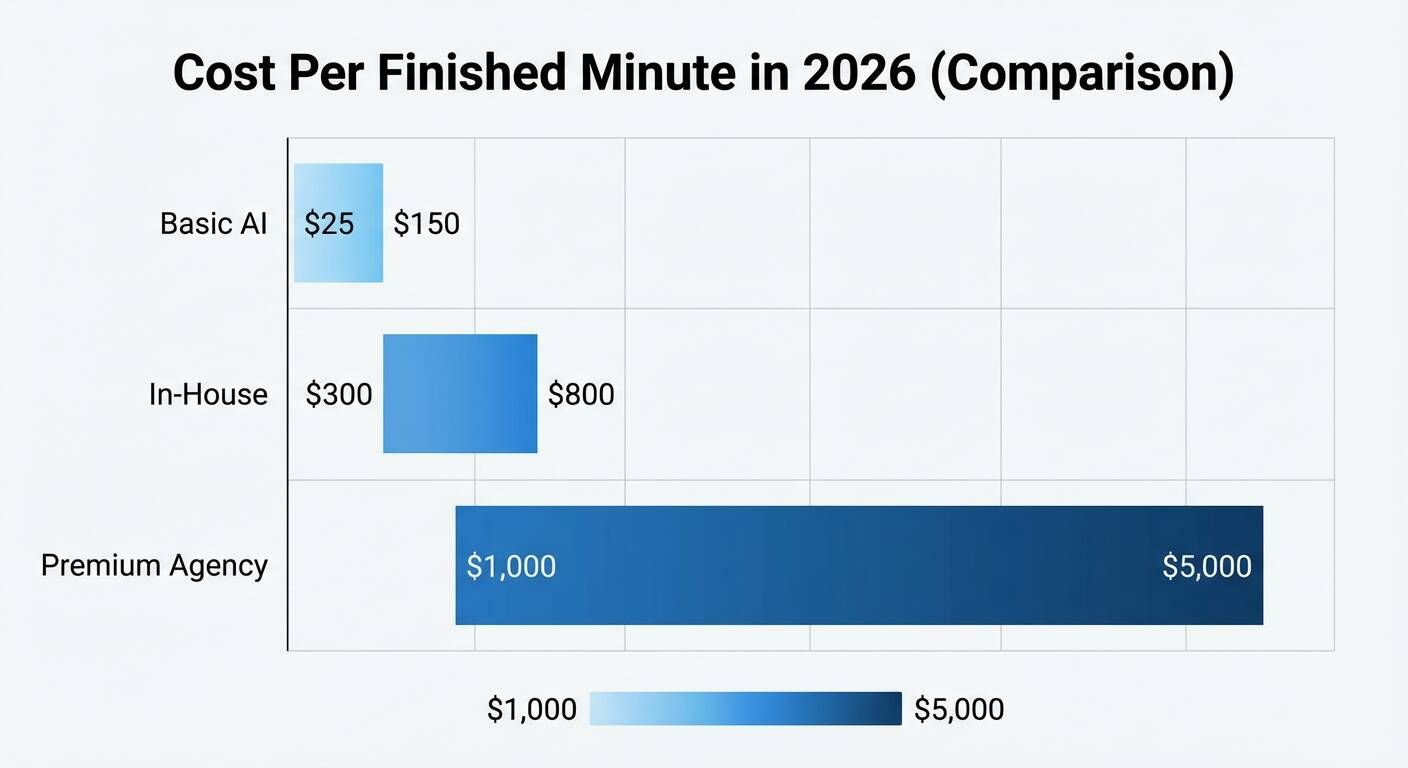
The "per finished minute" metric is the gold standard for estimating an e-learning video production cost. Depending on the complexity and technology used, prices can vary drastically. Average 2026 Pricing Tiers:
- Basic AI Automation: $25 – $150 per minute.
- Standard In-House Production: $300 – $800 per minute.
- Premium Agency Production: $1,000 – $5,000+ per minute.
Traditional Agency Pricing vs. In-House Video Creation
Deciding between outsourcing and building an in-house team fundamentally impacts your bottom line. Agencies provide a hands-off experience but charge premium rates for overhead.
Key Differences:
- Agencies: High upfront costs, rigid revision cycles, but professional-grade output.
- In-House Teams: Requires initial investment in equipment and software, but drastically lowers the long-term cost per video.
- Hybrid AI Model: Uses internal staff paired with generative AI to achieve agency-quality results at a fraction of the cost.
Core Elements That Drive Up Your Corporate Training Video Budget
To control your corporate training video budget, you must identify where the money goes. Traditional video creation is a multi-stage process where expenses compound quickly.
| Production Phase | Budget % | Major Cost Drivers |
|---|---|---|
| Pre-Production | 20% - 30% | Instructional designers, scriptwriters, storyboarding |
| Production | 40% - 50% | Studio rental, actor day-rates, camera crew, lighting |
| Post-Production | 20% - 30% | Video editing, motion graphics, professional voiceovers |
Pre-Production: Scriptwriting, Storyboarding, and Planning
This foundational phase often consumes 20% to 30% of the total budget. It involves heavy human labor and cross-departmental alignment.
Major Cost Drivers:
- Hiring instructional designers and professional scriptwriters.
- Creating detailed visual storyboards.
- Project management and stakeholder approval hours.
Production: Studio Rentals, Actors, and Crew Fees
The actual shoot is typically the most expensive phase of traditional video creation. Every hour on set drains the budget rapidly.
Production Expenses Include:
- Daily rates for directors, camera operators, and lighting technicians.
- Studio or location rental fees.
- Talent fees for professional presenters and actors.
Post-Production: Editing, Motion Graphics, and Voiceovers
Post-production is where the raw footage is refined, often taking weeks to complete.
Post-Production Costs:
- Video editing and color grading.
- Adding custom 2D/3D motion graphics to explain complex concepts.
- Recording and syncing professional voiceovers.
Comparing Instructional Video Costs by Style and Format
| Video Format | Cost Level | Engagement Level | Production Speed |
|---|---|---|---|
| Screencasting / Tutorials | Low ($) | Low to Medium | Fast (Days) |
| 2D Animation / Explainer | Medium ($$) | High | Slow (Weeks) |
| Talking Head / Presenter-Led | High ($$$) | Very High | Slow (Weeks) |
| AI Avatar-Led (Leadde) | Low ($) | Very High | Instant (Minutes) |
The visual format you choose is the primary dictator of your final instructional video costs.
Screencasting and Software Tutorials ($)
Screencasting is the most budget-friendly traditional format. It is ideal for software walkthroughs and basic technical training.
- Pros: Fast to produce, requires minimal equipment.
- Cons: Low engagement, difficult to update when software interfaces change.
2D Animation and Explainer Videos ($$)
Animated videos are excellent for abstract concepts but require specialized illustrators and animators, pushing costs higher.
- Pros: Highly engaging, great for conceptual or compliance training.
- Cons: Custom animation is time-consuming and expensive to revise later.
Presenter-Led "Talking Head" Training Modules ($$$)
Live-action videos featuring a human presenter build trust and engagement but are the most expensive traditional option.
- Pros: High human connection, authoritative tone.
- Cons: Requires cameras, lighting, studios, and actors, making it incredibly costly to scale.
The Hidden Expenses in the E-Learning Video Lifecycle
Many organizations miscalculate their ROI because they ignore the post-launch expenses. The true cost of a video extends far beyond its initial publication.
Content Maintenance: The Cost of Updating Legacy Training Videos
Information decays rapidly. When a company updates its Standard Operating Procedures (SOPs) or software, the training videos immediately become obsolete.
The Updating Dilemma:
- Re-shooting live-action videos requires re-hiring the original actor and crew.
- Re-animating specific scenes is costly and delays training rollouts.
Global Localization: Translating Content for Multilingual Teams
For global enterprises, localizing a single training video into multiple languages can double or triple the initial budget.
Traditional Localization Costs:
- Hiring specialized translators for technical scripts.
- Booking local voiceover artists for dubbing.
- Re-editing on-screen text and graphics for each language version.
2026 Trends: How AI is Redefining Video Production Costs
As of 2026, available information suggests that generative AI has completely disrupted traditional video pricing models, shifting the paradigm from manual labor to automated generation.
Erasing Production Timelines with Document-to-Video Technology
The traditional workflow is being replaced by platforms that ingest text and output fully produced videos. This eliminates the need for expensive cameras, studios, and weeks of editing.
Interactive Learning: The Rise of "Chat with Video"
Modern e-learning is moving away from passive viewing. AI now allows viewers to actively engage with the content, transforming static files into interactive knowledge bases.
How to Slash E-Learning Production Costs by 80% with Leadde
Leadde is a generative AI video platform designed for businesses to transform documents and content into professional, multilingual, and interactive videos for internal communication in minutes. Organizations using Leadde report up to an 80% reduction in video production costs.
Transforming PDFs and PPTs into Professional Videos in Minutes
Leadde completely automates the traditional workflow. It converts business content such as PowerPoint files, PDFs, Word documents, scripts, and text into structured video presentations.
Key Automation Features:
- The system automatically generates outlines, scenes, voice-over scripts, and visual layouts.
- Through Slide Presenter, Leadde supports layered PowerPoint import and editing, allowing users to edit individual layers such as text and icons.
- This results in up to a 90% reduction in content creation time.
Scaling Global Training with 92+ Languages and AI Avatars
Localization is no longer a massive budget drain. Leadde supports large-scale multilingual video workflows across 92 languages.
Global Scaling Capabilities:
- Users can generate multilingual drafts directly within the editor or from shared video links.
- Leadde offers a diverse library of 200+ AI avatars and supports the creation of personal digital avatars from user-uploaded photos.
- With Chat with Video, viewers can interact with video content and ask questions, transforming videos into interactive learning resources.
Leadde vs. Synthesia vs. HeyGen: Which Delivers the Best ROI?
When evaluating AI video platforms for employee onboarding or corporate training, Leadde offers distinct advantages in pricing and enterprise features.
| Feature | Leadde | Synthesia | HeyGen |
|---|---|---|---|
| Starter Plan Pricing | $19/month, unlimited videos | $29/month, 10 minutes per month | $29/month, unlimited videos |
| Document to Video | Maintains business branding, supports auto layout and auto highlight | Based on fixed, non-editable templates, no auto layout | Not supported |
| Interactivity | Video chat + chat-enabled interactive avatars | Standard one-way video output | Standard AI video output |
| Languages | 170+ languages with accents | 140+ languages | 40+ languages |
How to Allocate Your 2026 Video Budget
To maximize your budget, follow a structured approach to decision-making.
Steps to Allocate Your Budget:
- Assess Volume: Determine how many minutes of video you need annually. High volume heavily favors AI tools.
- Evaluate Update Frequency: If your SOPs change frequently, avoid live-action and choose a platform with easy editing capabilities.
- Identify Localization Needs: Count your target languages. If you need more than two, traditional dubbing is not cost-effective.
- Adopt Automation: Utilize platforms like Leadde to handle the bulk of internal training, reserving expensive agency budgets for high-end external marketing.
Conclusion: Maximizing the ROI of Your Training Content
The e-learning video production cost landscape has fundamentally changed. If you are looking to budget for compliance and safety training, understanding these shifts is crucial. While traditional agencies still charge thousands of dollars per finished minute for complex projects, the vast majority of corporate training and instructional content can now be produced for a fraction of that price.
Hidden costs like content maintenance and multilingual localization often destroy training budgets. By adopting AI-driven platforms that support direct document-to-video conversion and interactive avatars, organizations can drastically lower their expenses. Tools like Leadde not only reduce production costs by up to 80%, but they also future-proof your content, ensuring that your corporate training remains scalable, engaging, and cost-effective in 2026 and beyond.