Video Dubbing with AI: How It Works & Best Tools for 2026
Video dubbing with AI is the automated process of translating a video to replace its original spoken dialogue with a synchronized synthetic voiceover in a target language, preserving the speaker's vocal identity, cadence, and emotional delivery. For global enterprises and digital educators, it eliminates the traditional bottlenecks of studio booking, voice actor casting, and manual timeline editing.
From an instructional design perspective, training and product teams spend disproportionate effort converting existing documentation into video assets, only to encounter another barrier when localizing them across international markets. Modern AI video workflows close this operational gap: platforms like Leadde allow teams to turn SOP documents into training videos in minutes and slide decks into baseline assets automatically, while integrated AI dubbing helps scale video localization for a global audience in minutes rather than weeks.
In this guide, you will examine the technical architecture behind modern voice synthesis, compare the leading dubbing platforms for corporate and educational content, and learn how to implement an automated localization workflow that maintains instructional clarity at scale.
AI Video Dubbing: What Is It and Why Do Content Teams Need It?
An AI video dubbing tool is a software platform that uses artificial intelligence to automatically transcribe, translate, and generate new voiceover audio for existing video assets. Advanced platforms utilize voice cloning to maintain the speaker's original tone, pacing, and vocal characteristics, ensuring that the localized version feels authentic to native audiences.
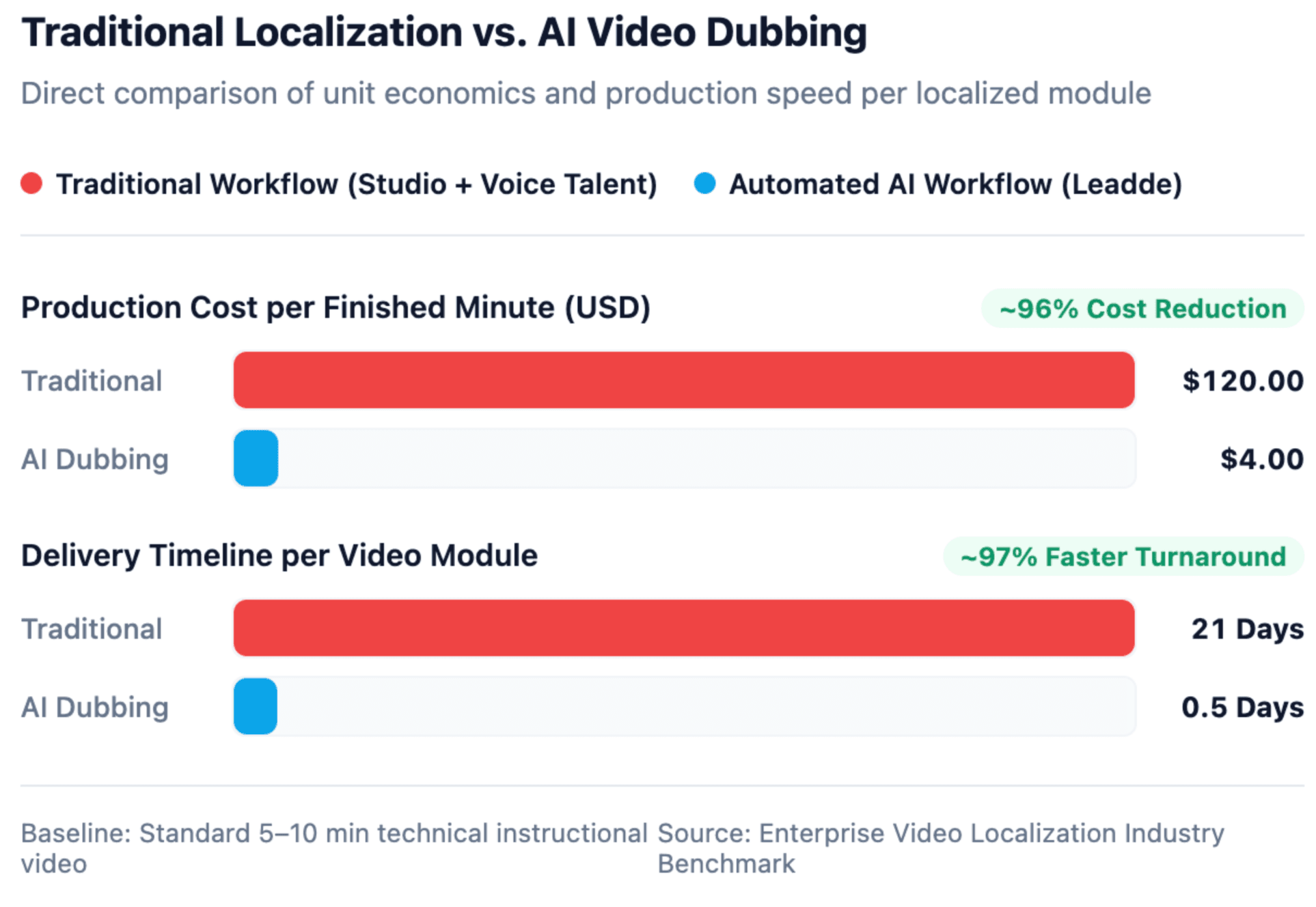
From an instructional design perspective, the traditional localization cycle—transcribing, translating, recording, and re-editing—creates a significant bottleneck for global training rollouts. Content teams face mounting pressure to deliver localized media quickly without sacrificing instructional accuracy. While traditional methods ensure high emotional control, they are financially and operationally unsustainable for scaling modern video libraries. AI video dubbing automates these repetitive production stages, enabling organizations to adapt video content for global markets and maintain brand consistency at a fraction of the cost.
How Does the AI Video Localization Process Actually Work?
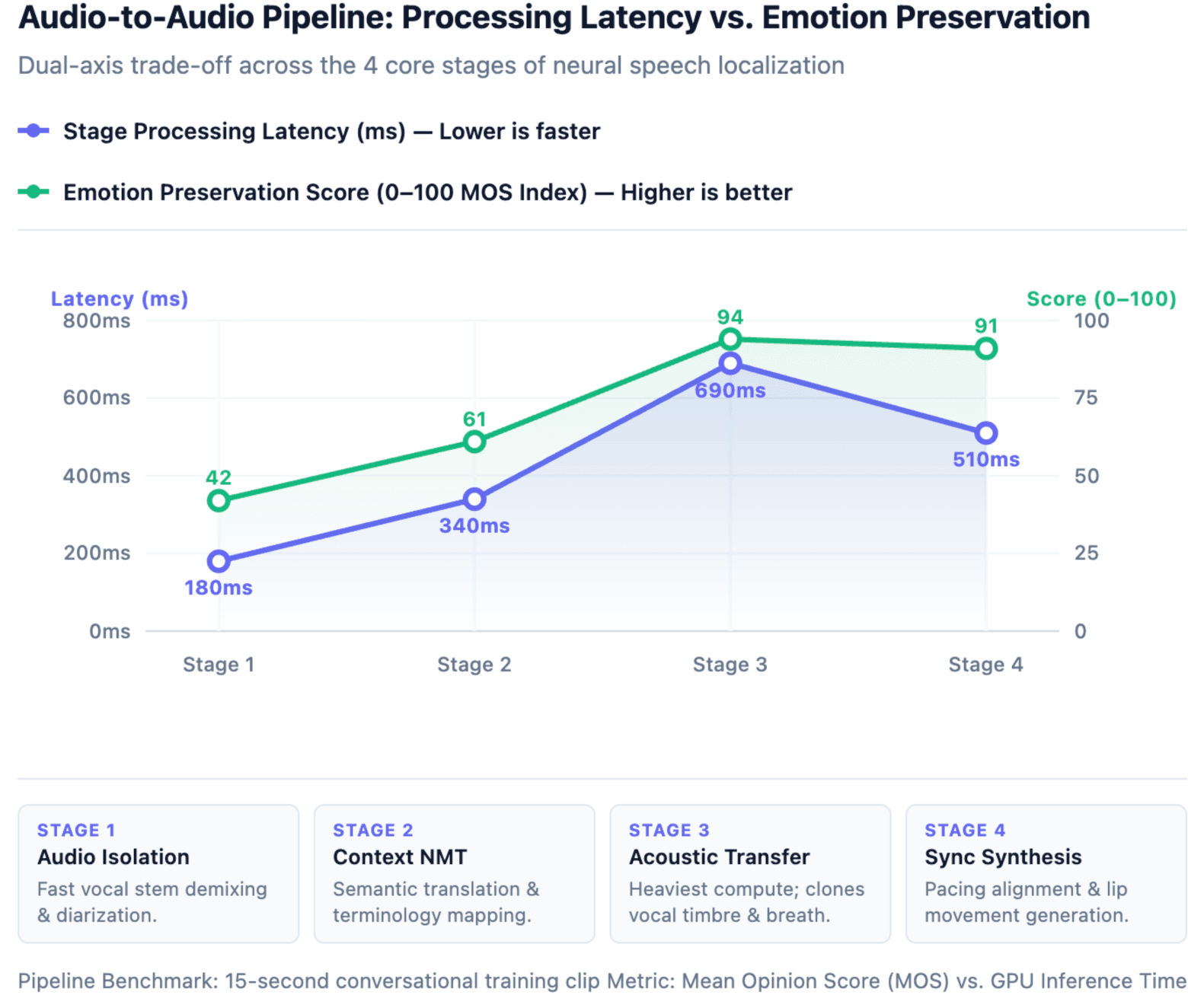
In professional video workflows, seamlessly replacing audio without disrupting the visual flow requires a synchronized technical pipeline. Early text-to-speech tools sounded robotic and frequently overwrote critical background audio. Today's AI models isolate the vocal layer, ensuring background music and ambient sounds remain intact.
Speech Recognition and Diarization
The AI engine isolates the primary speech layer from background noise, accurately transcribes the spoken words, and identifies multiple distinct speakers (diarization) within the same video. This initial text extraction forms the foundational transcript that will be localized.
Context-Aware Localization
Instead of a literal word-for-word translation, advanced AI adapts phrasing, idioms, and technical terminology so the output sounds natural to native audiences. Professional platforms allow teams to review and edit this text to prevent instructional errors from cascading, functioning like a dedicated video translator for enterprise workflows.
Audio-to-Audio Voice Cloning
Rather than generating a voice purely from a text transcript, modern generative models condition the output directly on the source audio performance. The AI captures breath patterns, micro-pauses, and emotional cadence, building upon modern breakthroughs in how to make an AI voice and mapping those vocal nuances onto the translated language.
Timing and Visual Alignment
Because translated sentences vary in length across languages—for instance, German translations are often longer than English—the AI dynamically adjusts the pacing of the generated audio to match the original video's visual cues, slide transitions, and mouth movements.
What Are the Best AI Dubbing Tools for Creators and Enterprises?
Different communication goals require distinct localization strategies. An educator transforming a static PDF into a global compliance video has vastly different software requirements than a social media manager dubbing a short promotional vlog.
| Option | Best For | Advantages | Limitations |
| Leadde | Educational & Training Videos | Built specifically for document-to-video workflows; transforms PDFs, SOPs, and slides into structured, localized training videos across 88 languages and 175 dialects. | Heavily focused on scalable corporate and instructional content rather than standalone social media editing. |
| ElevenLabs | Emotive Audio Localization | Industry-leading natural voice cloning and audio-to-audio emotion transfer; supports over 90 languages and accents. | Primarily an audio-focused pipeline; requires external tools if visual lip-syncing is needed. |
| HeyGen | Presenter Visual Localization | High-accuracy visual lip-syncing and robust custom AI avatar generation for talking-head videos. | Premium dubbing and lip-sync features consume separate credit pools; can experience drift on longer videos. |
| Canva (EasyDubbing) | Quick Marketing Videos | Integrated directly into the Canva editor; fast one-click translation and voice cloning for social media content. | Best suited for short-form clips; lacks deep enterprise learning management system integrations. |
How Can You Implement a Scalable Document-to-Video Dubbing Workflow?
Training teams often spend significant time converting documents and presentations into videos before localization can even begin. Relying on manual recording for every language variation is an outdated and unscalable approach.
Generating the Baseline Video from Documents
Instead of recording a human presenter from scratch, use an AI video generator like Leadde to ingest existing organizational knowledge, such as learning how to convert a PDF manual into a training video or Word SOPs. The platform automatically structures the document into logical scenes, generates an instructional script, and applies an initial AI presenter and voiceover.
Auditing the Source Transcript
Before initiating the dubbing process, content teams should manually review the base transcript. Correcting a misheard technical term or proprietary acronym in the source language prevents that error from multiplying across multiple target languages.
Applying Cloned Voice and Localizing at Scale
Process the approved baseline video through the dubbing engine, ensuring the tool preserves the AI instructor's voice and emotional tone. Review the localized outputs and export the final videos alongside generated multilingual subtitles (SRT files) for complete accessibility compliance, helping synchronize global training with AI video tools across distributed teams.
What Are the Common Challenges of Scaling Multilingual Videos?
While AI video generation is increasingly adopted, many creators and educators explore how people are making realistic AI videos while wrestling with the challenge of maintaining natural delivery and visual consistency. Understanding these limitations is critical for building scalable workflows.
Solving Lip-Sync Drift on Long-Form Content
Many AI visual dubbing tools struggle with long continuous shots, often resulting in visual drift or a disconnect between audio and mouth movements after a few minutes. To mitigate this, professionals process long videos in manageable chunks or strategically use B-roll and presentation slides to cut away from the presenter's face.
Managing Language Expansion and Cognitive Load
When translating technical content from English into languages like German or Spanish, text expansion naturally occurs. If an AI tool crams a longer translation into a compressed time window, the speech becomes unnaturally rushed, significantly increasing learner cognitive load. Instructional designers must edit localized scripts to be more concise rather than artificially speeding up the audio.
Handling Multi-Speaker Diarization
While automated tools are convenient for fast distribution, they often fail to recognize or preserve distinct voices when multiple people are speaking. For panel discussions or interview videos, content teams must use dedicated AI platforms capable of diarization to clone multiple unique speakers simultaneously without merging vocal profiles.
Frequently Asked Questions (FAQ)
Does AI dubbing maintain the original speaker's emotion?
Yes. Modern AI dubbing systems use audio-to-audio modeling. Instead of just reading a translated text transcript, the AI analyzes the emotional delivery, pitch, and breath patterns of the original audio and applies those same inflections to the target language.
How do you turn training documents into dubbed videos?
Platforms like Leadde specialize in document-to-video workflows. Users can upload existing PDFs or presentations, learn how to create multilingual video lectures with AI, and convert the text into a structured educational video with an AI voiceover, which can then be easily translated and dubbed into multiple languages.
Can AI dubbing preserve background noise and music?
Yes. Modern AI dubbing tools isolate the primary speech layer from background audio. They replace only the spoken words with the translated voiceover while keeping original music, sound effects, and ambient noise completely intact.
Why is YouTube's auto-dubbing not enough for corporate training?
While YouTube's built-in translation is efficient for casual distribution, it often fails to preserve the emotional intonation of the speaker, struggles with multi-speaker diarization, and does not clone the original voice, which reduces the professional quality required for corporate training.
Is AI video localization secure for proprietary business data?
Enterprise-grade AI video platforms offer robust data privacy controls to ensure that proprietary training materials and cloned voice data are not used to train public AI models. Always verify a platform's enterprise security compliance before uploading internal documents.
AI video dubbing has transformed how organizations approach global communication, turning a historically expensive and time-consuming localization cycle into an agile, automated workflow. By combining intelligent document-to-video generation with advanced voice cloning and careful quality oversight, content teams can successfully scale engaging, multilingual training libraries across international markets.