
How Pharma Teams Can Turn Training Documents into Videos in 2026

Pharma teams can turn training documents into videos by using approved SOPs, regulatory PDFs, clinical trial protocols, pharmacovigilance guidelines, and onboarding decks as the source of truth, then converting them into short, role-based video modules.
A secure workflow typically includes document auditing, AI-assisted script extraction, automated scene layouts, localized voiceovers, captions, and AI avatars, followed by SME, QA, PV, or compliance review before publishing.
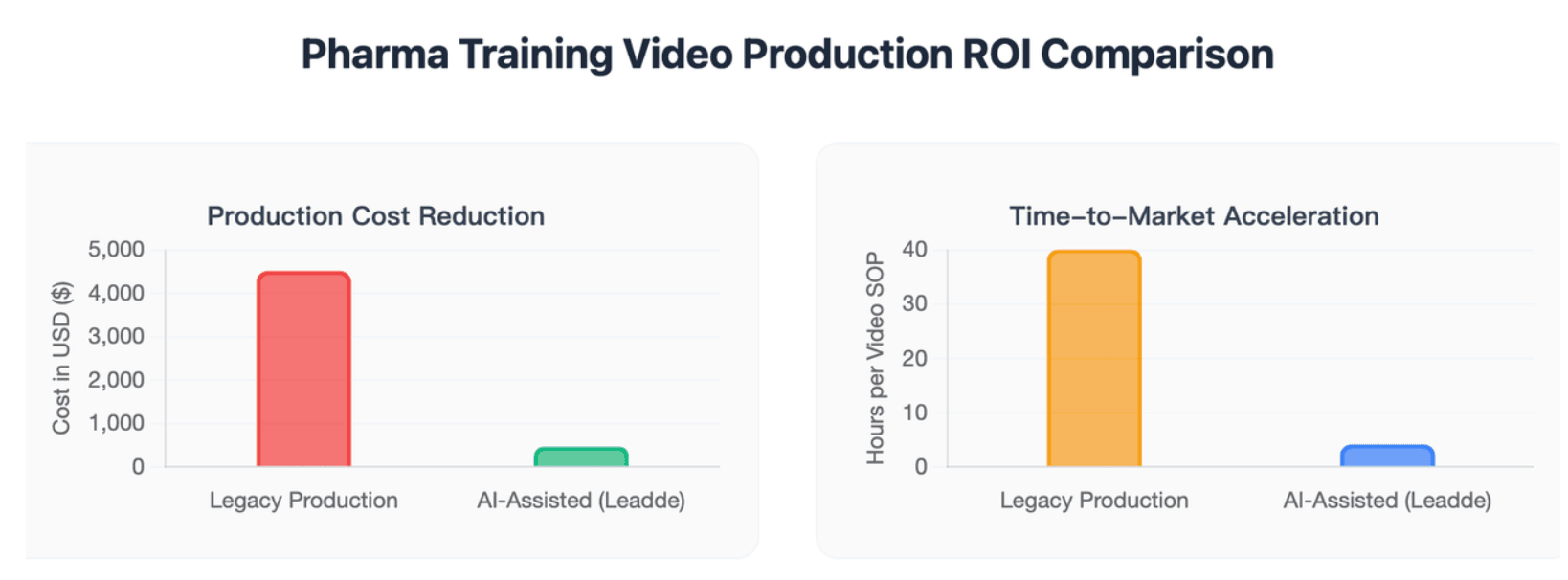
Dense manuals create compliance fatigue, slow onboarding, and make every SOP update expensive. Leadde helps pharma L&D teams turn documents and text into professional business videos automatically—in minutes—cutting video production costs by over 80% and saving up to 90% of content creation time.
How Pharma Teams Can Turn Training Documents into Videos Without Losing Compliance Control?
Pharma teams can turn training documents into videos safely when the process starts with approved source documents, not with open-ended AI prompts. The goal is not to replace compliance review. The goal is to convert validated knowledge into clearer, shorter, easier-to-update training assets.
FDA requires personnel involved in drug manufacturing, processing, packing, or holding to have appropriate education, training, and experience, including training in cGMP requirements that apply to their roles. That makes training video creation a regulated content workflow, not just a creative production task. (电子联邦法规)
Start with Approved SOPs, PDFs, PowerPoints, and Training Manuals as the Source of Truth
The safest workflow begins with the latest approved version of each training document.
Before creating a video, pharma teams should confirm:
- Document owner
- SOP or policy number
- Version number
- Effective date
- Target role
- Required reviewer group
- Training matrix assignment
This prevents a common problem: creating a polished video from an outdated SOP, draft protocol, or regional document that was never approved for global training.
Convert Each Document Section into Traceable Video Scenes, Scripts, and Knowledge Checks
A strong pharma video workflow should map each video scene back to the original document section.
For example:
| Source Document Section | Video Output | Training Evidence |
| SOP Section 4.1: Responsibilities | Role-specific scene | Assigned learner group |
| SOP Section 5.2: Procedure | Step-by-step video segment | Completion record |
| SOP Section 5.3: Exceptions | Scenario-based example | Quiz question |
| SOP Section 7: Records | Documentation reminder | Knowledge check |
This source-to-scene traceability is one of the biggest gaps in generic AI video tools. Pharma teams need to know not only that a video was created, but also which approved source each script line, scene, quiz, and visual element came from.
Use AI for Drafting, but Keep SME, QA, PV, and Compliance Teams in the Approval Loop
AI can accelerate scripting, scene planning, narration, subtitles, and multilingual medical training video drafts. It should not be treated as the final authority on GMP, PV, safety, quality, or medical content.
A controlled review loop should include:
- SMEs for scientific and operational accuracy
- QA for GxP and SOP alignment
- PV reviewers for case handling, timelines, and reporting rules
- Compliance or legal reviewers for regulated claims and internal policy alignment
- L&D teams for learning quality and role fit
For electronic records and signatures, pharma teams should also consider whether Part 11 controls apply to training completion records, approvals, and audit trails. FDA’s Part 11 guidance explains the scope and application of electronic records and electronic signatures under 21 CFR Part 11. (U.S. Food and Drug Administration)
Why Do Traditional Text-Heavy Training Documents Fail Modern Pharma Teams?
Traditional pharma training often relies on PDFs, long SOPs, PowerPoint decks, policy binders, and static LMS modules.
These documents may be accurate, but they are often not designed for learning. They explain the rule, but they do not always show what the employee must do in a real workflow.
The Regulatory Risks of Compliance Fatigue and SOP Misinterpretation
Compliance fatigue happens when employees are assigned too many dense documents, too often, with too little context.
In pharma, this can lead to:
- Skimming instead of understanding
- Memorizing terms without knowing the workflow
- Missing role-specific requirements
- Confusing old and new SOP versions
- Treating training as a checkbox
Video cannot remove the need for approved documents. But teams can deploy specialized workflows to create compliance and safety training videos on a budget that turn critical procedures into short, structured, repeatable modules that help employees understand what to do, when to do it, and what mistakes to avoid.
Pharmacovigilance Bottlenecks: When Static SOPs Delay Case Intake, Triage, or Reporting
Pharmacovigilance teams often work under strict timelines and complex decision rules.
Static SOPs can create bottlenecks when employees must interpret:
- Whether information qualifies as a reportable case
- Which seriousness criteria apply
- How to enter case details
- When to escalate
- Which regional reporting timeline applies
- How to code events accurately
EMA’s Good Pharmacovigilance Practices are designed to support pharmacovigilance performance across the EU, including modules covering areas such as individual case safety reports, signal management, and risk minimisation. (European Medicines Agency (EMA))
For highly structured healthcare compliance training videos from SOPs, visual guides should not simply read the document aloud. They should actively show decision paths, case examples, escalation triggers, and documentation expectations.
The Financial Drain of Legacy Video Production, Re-Recording, and Content Obsolescence
Traditional training video production is slow because it often requires:
- Scriptwriting from scratch
- SME recording sessions
- Studio or screen capture setup
- Voiceover production
- Editing
- Subtitle creation
- Localization
- Re-recording after SOP changes
The real cost is not only the first video. It is the cost of keeping healthcare training videos updated after every SOP revision, inspection finding, CAPA, system update, or regulatory change.
This is why AI-assisted document-to-video workflows are valuable: they reduce the manual production burden while keeping teams closer to the approved source material.
What Pharma Training Documents Should Become Video SOPs, Microlearning, or Interactive Modules?
Not every document should become one video. The best candidates are documents that explain repeatable processes, decisions, risks, or role-based actions.
The key rule is simple: one video should support one job task, one decision, or one learning objective.
GMP SOPs, Cleanroom Procedures, Batch Records, and Audit Trail Review Workflows
Good Manufacturing Practices (GMP) require absolute clarity across every stage of development. Finding the best AI SOP video software for training teams is crucial because cleanroom protocols, clothing changes, and equipment calibration are best taught through visual instruction. Visual media shows the precise physical speed and technique required to maintain product sterility.
Visualizing batch record logging procedures reduces mistakes on the plant floor. Showing step-by-step audit trail reviews helps quality teams verify data integrity instead of forcing them into how to convert a PDF manual into a training video tasks manually or reading long text binders.
- Cleanroom Visual Gown Guides: Illustrates the precise physical maneuvers required to avoid equipment contact.
- Calibration Flows: Shows perfect machine control positions, directly minimizing configuration mistakes.
- Batch Record Entries: Simulates exactly how to document inputs to ensure total data compliance.
CAPA, Deviation, Change Control, Data Integrity, and Annex 1 Update Training
Corrective and Preventive Actions (CAPA) require deep understanding across your entire operational framework. L&D professionals can use platforms to create interactive safety training videos for global teams to explain complex deviation reporting rules far better than text documents. These formats help employees visualize change control validation paths instantly.
Deploying video training for modern regulations like Annex 1 updates ensures consistent understanding across global plants. Visualizing data tracking requirements helps prevent audit gaps before they occur.
- CAPA Root-Cause Workflows: Uses interactive logic trees to guide investigators through compliance evaluations.
- Change Control Tracking: Clearly highlights the boundaries separating minor adjustments from major changes.
- Annex 1 Alignments: Explicitly displays new sterile monitoring boundaries using clear graphics.
Examples include:
| Document Type | Best Video Format |
| CAPA procedure | Scenario-based explainer |
| Deviation SOP | Decision path video |
| Change control policy | Before-and-after workflow |
| Data integrity policy | Risk-based explainer |
| Annex 1 update deck | “What changed” microlearning |
| Inspection readiness checklist | Role-based refresher |
These topics often involve judgment. A video can show both correct and incorrect behaviors, then reinforce the key decision with a short knowledge check.
PV SOPs for ICSR Intake, MedDRA Coding, Signal Management, and Expedited Reporting
Converting medical documents into training videos and transforming pharmacovigilance text into targeted training modules significantly protects corporate regulatory compliance. Microlearning videos optimize how operators process adverse event data from intake to final classification. This focused delivery ensures that serious side effects are flagged for urgent analysis without error.
Visualizing signal detection criteria protects companies against systemic gaps in monitoring. These tailored video guides ensure your safety teams compute risk metrics accurately.
- ICSR Intake Paths: Visually charts the journey of an adverse event report across global safety data fields.
- MedDRA Classification Guides: Simulates accurate keyword lookups to avoid critical filing errors.
- Expedited Reporting Calendars: Uses visual callouts to reinforce mandatory regulatory submission windows.
How Can Pharma L&D Teams Turn Documents into Videos Automatically?
A reliable pharma document-to-video workflow should be structured, reviewable, and repeatable.
AI can help create the first draft faster, but the final training asset should still pass through the same discipline pharma teams apply to controlled content.
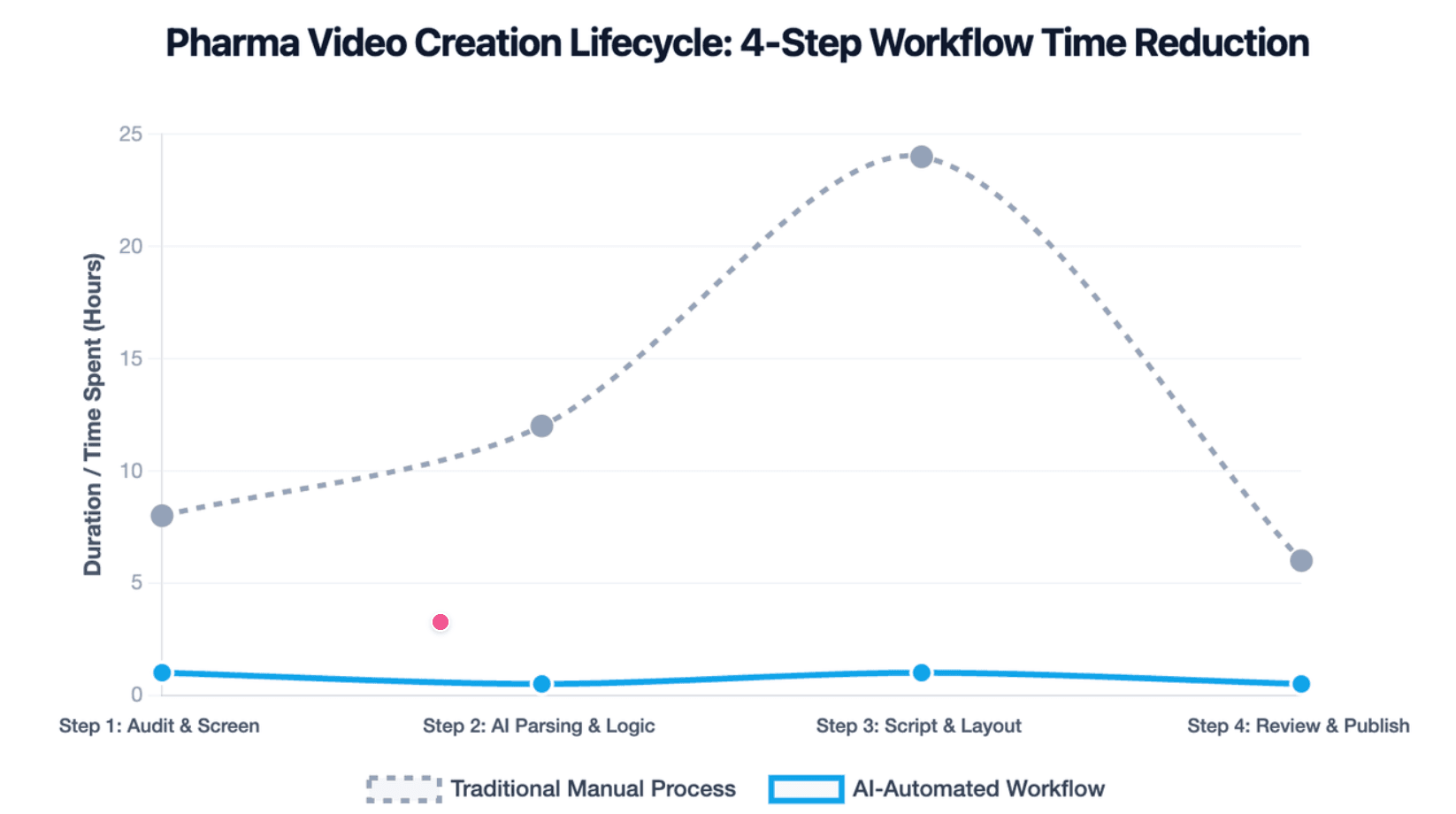
Step 1: Audit Regulatory PDFs, Medical Handbooks, SOPs, and Clinical Protocols for Scripting
The transition begins with a rigorous evaluation of your existing clinical repository. L&D managers can leverage the best AI medical video maker to identify documents that match video learning needs. Focus primarily on protocols prone to human error or those used by international workforces.
Once selected, check the target materials to verify they reflect the latest regulatory updates. This pre-conversion audit ensures your automated workflows build on certified operational foundations.
- Document Screening: Identifies high-priority manuscripts such as safety rules and laboratory guides.
- Content Cleanup: Remediaties broken formatting, unclear sentences, and out-of-date index references.
- Granular Outlining: Separates documents into stand-alone functional topics for easy machine processing.
Step 2: Use AI Parsing to Extract Key Steps, Decision Points, Risks, and Compliance Milestones
Next, feed the approved files into an AI text-processing tool. The algorithm scans the medical context, extracting core criteria, critical control points, and safety warnings. This automated parsing forms the structure of your upcoming audio-visual script.
By letting machine intelligence process long documents, you save your instructional designers days of manual scripting. The software isolates core definitions and highlights priority phrases automatically.
- Entity Extraction: Automatically isolates critical terms like dosage rates and temperature ranges.
- Logic Mapping: Converts raw textual if/then scenarios into clear, sequential scene blueprints.
- Milestone Identification: Highlights required quality checkpoints that need explicit visual focus.
Step 3: Generate Editable Scripts, AI Avatars, Captions, Voiceovers, and Multilingual Video Drafts
Once structured, the platform transforms the parsed points into a complete video storyboard. The system applies Auto Layout engine algorithms to arrange images, matching terms, and backgrounds. Simultaneously, hyper-realistic AI avatars provide clear narration using localized voice cloning.
The platform generates complete closed captions and translations automatically. This allows you to scale a single source document into dozens of target language variants within minutes.
- Auto-Script Compilation: Converts dry technical prose into natural, spoken educational scripts.
- Avatar Integration: Assigns professional virtual avatars to present information cleanly and clearly.
- Multilingual Localization: Translates voiceovers into over 170 dialects with accurate regional accents.
Step 4: Publish Reviewed Videos into LMS, QMS, Training Hubs, or Internal Knowledge Libraries
After getting quality approval, publish the finished files into your corporate infrastructure. Learning operations can seamlessly convert PowerPoint training videos for employees and upload secure video files directly into an existing Learning Management System (LMS) or Quality Management System (QMS). This ensures automated completion tracking across your organization.
Organizing these video SOPs into centralized knowledge bases allows real-time access on the factory floor. Operators can quickly scan a barcode to watch an exact process right before execution.
- SCORM/LMS Integration: Syncs seamlessly with systems like Veeva or SuccessFactors to track employee records.
- Barcode Deployments: Mounts QR links onto laboratory hardware for instant on-the-job guidance.
- Version Control Locking: Archiving old videos automatically when new versions are deployed.
How Does Leadde Fill the Gaps Left by Traditional AI Video Tools?
Many AI video tools are strong at avatars, voiceovers, and fast production. Pharma teams often need more than that.
They need a workflow that starts from existing controlled documents and turns them into structured, editable, multilingual, reviewable learning content.
From Document Upload to Auto Layout, Auto Highlight, Voiceover, and Scene-Based Video Drafts
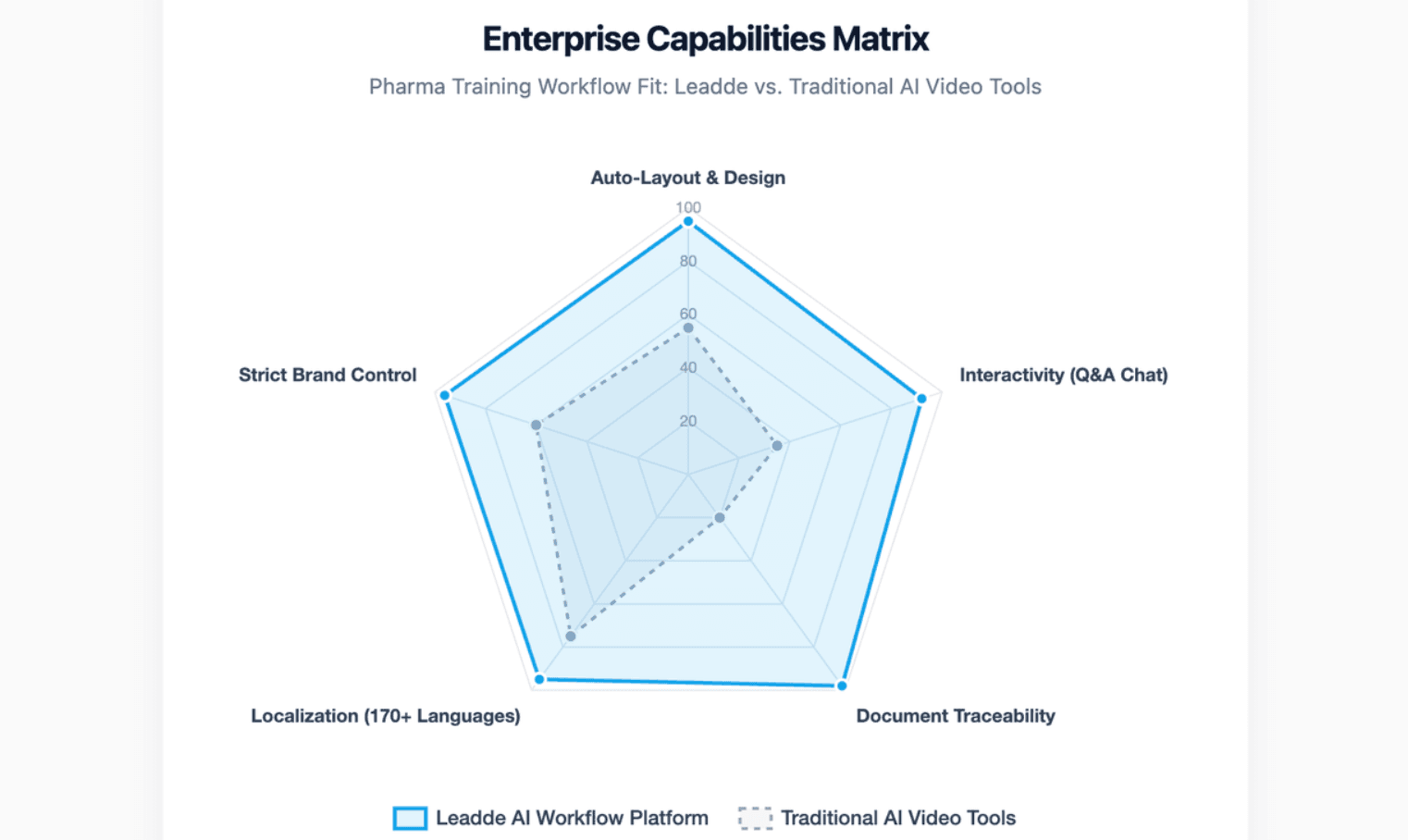
Traditional AI presentation software forces users to manually adjust text boxes and design layouts for every single slide. Leadde changes this workflow with its advanced Auto Layout and Auto Highlight systems. The platform automatically organizes your text, highlights key medical terms, and selects matching visual icons without human effort.
This automation keeps your layout presentation style consistent while maintaining strict corporate branding standards. It handles all positioning work, allowing your training team to focus entirely on content accuracy.
- Intelligent Auto Layout: Instantly configures your text, graphics, and video windows cleanly.
- Dynamic Auto Highlight: Automatically calls out priority safety protocols and metrics on screen.
- Consistent Corporate Branding: Locks colors, logos, and layouts to match your regulatory profile.
From Passive Training Videos to Chat-Enabled Interactive Video Knowledge Libraries
Standard video tools only offer flat, one-way viewing, leaving students unable to clarify confusing regulations. Leadde addresses this limitation by introducing Chat-enabled interactive avatars and direct video chat options. Operators can literally ask the avatar questions during a presentation to get immediate合规 clarifications.
This turns passive training modules into a responsive, real-time corporate knowledge expert. Your personnel can clarify drug-safety workflows instantly, significantly lowering operational compliance risks.
- Two-Way Interactive Chat: Allows viewers to type text questions directly to the presenting avatar.
- Real-Time Compliance Answers: Delivers instant, pre-approved responses based on your loaded PDFs.
- De-risking Lab Operations: Resolves employee confusion immediately on the plant floor before mistakes happen.
From One-Language Training Assets to Multilingual, Localized, and Easier-to-Update Pharma Learning
Scaling traditional media programs across international supply chains is notoriously slow. While platforms like Synthesia cap voice features or require high enterprise add-ons, Leadde provides 170+ languages with accents directly on its Starter Plan. This lets you scale SOP videos for international factories for just $19/month.
Updating content is exceptionally simple. When a policy changes, modify the source text line; Leadde regenerates that specific scene's voice and visuals automatically, protecting your master brand look.
- Affordable Global Reach: Delivers over 170 languages with native accents on a $19/mo Starter tier.
- Scene-Level Updates: Eliminates full-video re-shoots by letting you patch individual text lines.
- Unified Global Assets: Ensures matching training quality across European, Asian, and American manufacturing plants.
Leadde vs. Synthesia vs. HeyGen
The best AI video tool for pharma training depends on the workflow.
For general avatar-led videos, tools such as Synthesia and HeyGen are strong options. For pharma document-to-video conversion, teams should evaluate how well the platform handles controlled documents, review workflows, multilingual updates, and training evidence.
Synthesia describes itself as an AI video platform for business with avatars and voiceovers in 160+ languages, and its features page says it can transform decks, PDFs, and websites into videos with AI. (Synthesia) (Synthesia)
HeyGen emphasizes AI avatars, video translation, lip sync, and support for 175+ languages and dialects. (HeyGen)
Document-to-Video Workflow: Structured Conversion vs. Manual Script Building
Pharma teams should compare tools based on how much document structure they preserve.
| Evaluation Area | Why It Matters for Pharma |
| PDF, Word, and PPT import | Most training starts from existing documents |
| Script editability | Reviewers need to approve exact wording |
| Scene mapping | Teams need traceability to source sections |
| Captions and transcript | Supports accessibility and search |
| Version management | SOP updates require controlled changes |
| Interactive Q&A | Helps learners revisit approved knowledge |
A tool that creates a polished avatar video may still require manual effort if the team must copy, rewrite, map, and review every source section outside the platform.
Pharma Training Fit: Source Traceability, Review Control, Localization, and Update Management
For pharma, the tool choice should not be based only on avatar realism.
The stronger question is:
Can the platform help us manage the lifecycle of regulated training content?
Look for:
- Editable scripts before publishing
- Reviewer workflows
- Version control
- Source document references
- Multilingual review support
- Analytics
- LMS or QMS compatibility
- Easy update workflows after SOP changes
This is where document-to-video platforms can be more useful than generic avatar tools for pharma L&D teams.
Cost and Scalability: Video Minutes, Seat Limits, Editing Time, and Enterprise Training Volume
Pricing and usage limits change often, so teams should verify current official plan details before choosing a platform.
As of the latest official pricing pages available during research, Synthesia lists plan usage in generated video minutes, while HeyGen uses a credit-based model across features and paid plans. (Synthesia) (HeyGen)
For pharma teams, the hidden cost is often not the monthly subscription. It is the time spent on:
- Rewriting documents into scripts
- Rebuilding videos after SOP updates
- Translating and reviewing each version
- Managing reviewer feedback
- Tracking which video matches which SOP version
A platform that reduces these operational steps may produce better ROI than a cheaper tool that creates more manual work.
How Can Pharma Teams Keep AI-Generated Training Videos Audit-Ready, Accurate, and Up to Date?
A pharma training video is only useful if it remains accurate after the source document changes.
The video lifecycle should be connected to document control, review ownership, LMS assignment, and retraining rules.
Link Every Video Scene to SOP Numbers, Versions, Effective Dates, and Review Owners
Every training video should include metadata that connects it back to the approved source.
Recommended metadata:
| Metadata Field | Example |
| Source document | SOP-QA-014 |
| Source version | Version 6.0 |
| Effective date | 2026/4/1 |
| Training owner | QA Training Lead |
| Reviewers | SME, QA, Compliance |
| Target roles | QA reviewers, manufacturing supervisors |
| Retraining trigger | SOP revision or CAPA update |
This helps prevent confusion during audits, inspections, CAPA follow-up, or global rollout.
Track Completion, Quiz Results, Retraining Triggers, and CAPA-Related Evidence
A visual training asset is only as valuable as the compliance data it collects. Your media system must pass employee viewing engagement metrics straight to your centralized learning platform. This monitoring proves that personnel watched instructions completely, rather than simply skipping to the end.
If an operator fails an embedded knowledge quiz, the system should trigger guided retraining workflows automatically. This immediate course correction provides essential evidence for resolving internal CAPA investigations.
- Total Engagement Tracking: Validates that operators watched all critical safety steps.
- Automated Retraining Paths: Locks system access and reassigns video SOP tiers if quiz scores fall below 80%.
- CAPA Audit Evidence: Generates verified data logs proving immediate training remediation after deviations.
Update Only the Affected Scenes When SOPs, PV Rules, or GMP Procedures Change
Pharmaceutical guidelines shift constantly as global safety reports and monitoring metrics change. Using traditional video production forces organizations to scrap entire training projects for minor wording changes. Leadde eliminates this wasted spend through its modular, scene-based design structure.
When a single step in a laboratory workflow changes, you only need to modify that specific scene's text line. The platform adjusts the layout and updates the voiceover automatically, saving your master edits instantly.
- Targeted Content Edits: Lets you update individual phrases without altering surrounding video chapters.
- Instant Audio Updates: Regenerates specific voiceovers immediately via automated text-to-speech.
- Drastically Lowered Costs: Lowers annual video maintenance budgets by over 90%.
Test Videos with Real Learners, Not Only SMEs and Stakeholders
While regulatory reviews ensure absolute accuracy, field validation determines actual operational effectiveness. L&D leads must observe plant operators as they interact with new video SOPs. This observation catches terms or layout transitions that might confuse staff on the floor.
Gathering direct feedback from shop-floor teams helps you continuously optimize production clarity. This on-the-ground assessment guarantees that visual assets actually reduce real-world operational mistakes.
- User Testing Groups: Validates video pacing with junior lab assistants and plant floor operators.
- Friction Analysis: Identifies sections where users pause, rewind, or check terms frequently.
- Continuous Optimization: Refines visual pointers and avatar delivery speed based on user performance data.
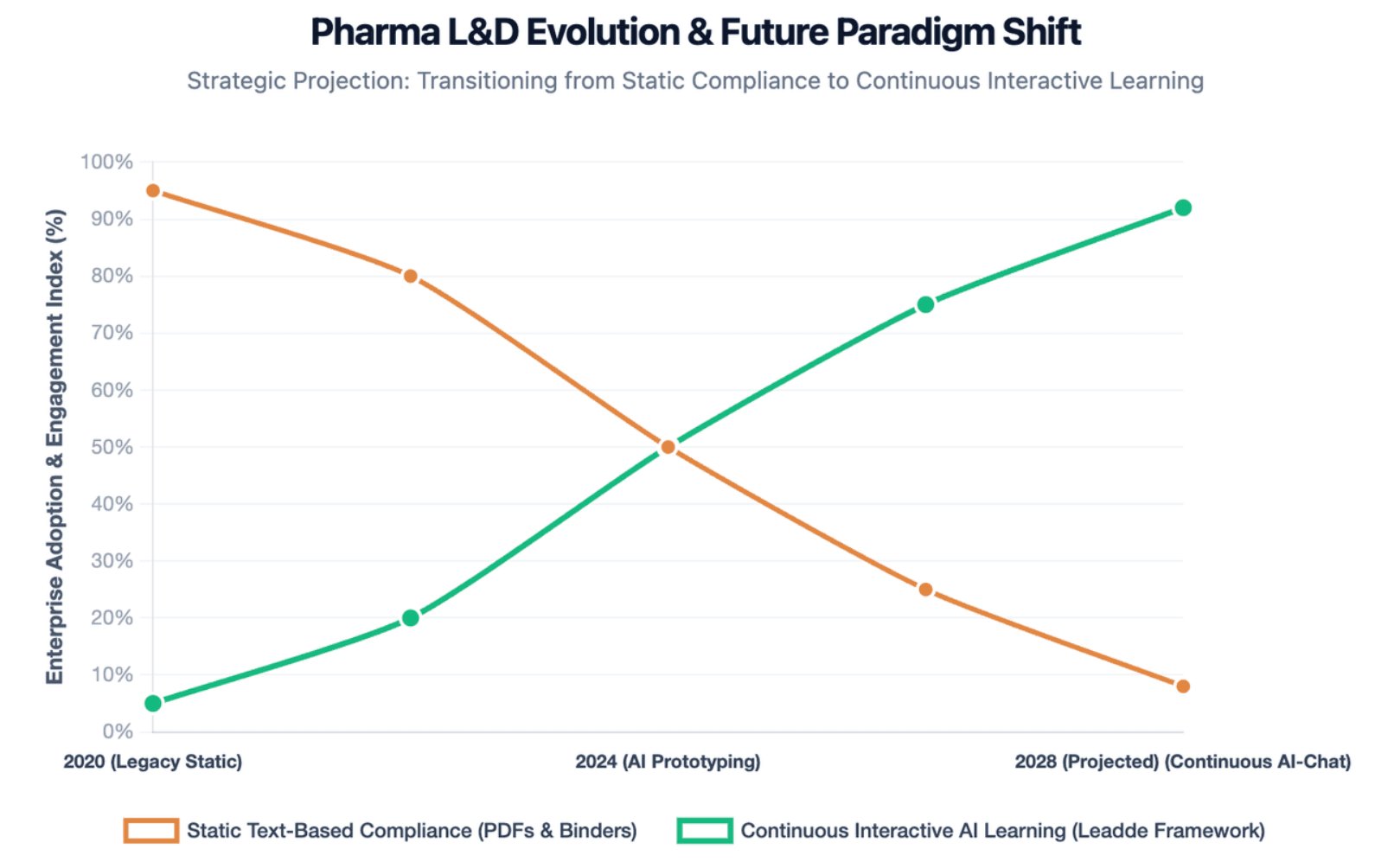
What Is the Future of AI-Driven Knowledge Conversion in Pharmaceutical Education?
The future of pharma training is not simply more videos.
It is the conversion of static document repositories into interactive, searchable, role-based knowledge systems.
From Static Text Repositories to Interactive Video Knowledge Libraries
The pharmaceutical sector is moving away from storing text documents in passive data silos. The modern standard demands Interactive Video Knowledge Libraries that make information instantly searchable and easy to understand. Visual microlearning assets are rapidly replacing dense text manuals across international operations.
By deploying tools like Leadde, life sciences companies convert dead text pages into active, conversational training experts. This format delivers accurate answers the moment employees face on-the-job questions.
- Visual Transformation: Converts flat textual manuals into engaging, multi-language visual guides.
- On-Demand Retrieval: Allows staff to pull up video instructions right at the work bench via mobile links.
- Active Guidance: Replaces boring text reading with dynamic, avatar-led process explanations.
From One-Time Training Completion to Continuous, Searchable, Role-Based Learning Support
Corporate development is shifting away from checking a single box on annual training forms. Modern regulatory demands require continuous, context-aware learning support directly tied to day-to-day employee roles. Teams need immediate access to verified insights without leaving the manufacturing floor.
Using interactive conversational avatars allows operators to query specific SOP steps using simple spoken language. This ongoing verification eliminates errors, protecting your facility’s compliance standing around the clock.
- Role-Based Video Delivery: Serves specific training modules tailored dynamically to individual cleanroom access levels.
- Conversational Verification: Let operators double-check step sequences via real-time avatar chat.
- Zero-Mistake Cultures: Replaces guessing with instant, verified visual instructions right before work begins.
Key Takeaways
Transitioning from traditional documentation to automated AI video workflows is essential for protecting modern operational compliance. Moving your files to automated media pipelines reduces human errors, lowers development friction, and protects global brand consistency.
For managing complex regulatory demands across global production plants, Leadde delivers an ideal combination of strict brand management, flexible scene editing, and conversational interactivity. Implementing automated document-to-video systems keeps your entire workforce inspection-ready every day.
- For Compliance Executives: Visualizing SOPs lowers field deviations and prevents costly regulatory audit errors.
- For Financial Stakeholders: Generates significant value, reducing video production spend by over 80%.
- For Training Operations: Accelerates course creation time by 90% via automated layout mapping.
Conclusion
Pharma teams do not need more static training content—they need a safer way to turn approved knowledge into clear, reviewable, and easy-to-update learning assets. By converting SOPs, regulatory PDFs, clinical protocols, and PV guidelines into short AI-generated video modules, teams can reduce compliance fatigue, support global onboarding, and keep training aligned with changing procedures.
Leadde makes this shift faster by turning documents and text into professional business videos in minutes, with editable scripts, AI avatars, captions, multilingual delivery, and scene-level updates. For pharma L&D, QA, PV, and compliance teams, the future is not just video training—it is an interactive, traceable, and audit-ready knowledge system.