Best AI Medical Video Maker in 2026: Top Tools Compared

The best AI medical video maker in 2026 is a platform that turns approved clinical documents into accurate medical videos from pharmaceutical guidelines, SOPs, and training materials. For healthcare and pharma teams, the right tool should go beyond avatars or generic text-to-video generation by supporting source-grounded document extraction, clinical review workflows, brand control, multilingual medical training videos, interactivity, and scalable video production without increasing medical accuracy risk.
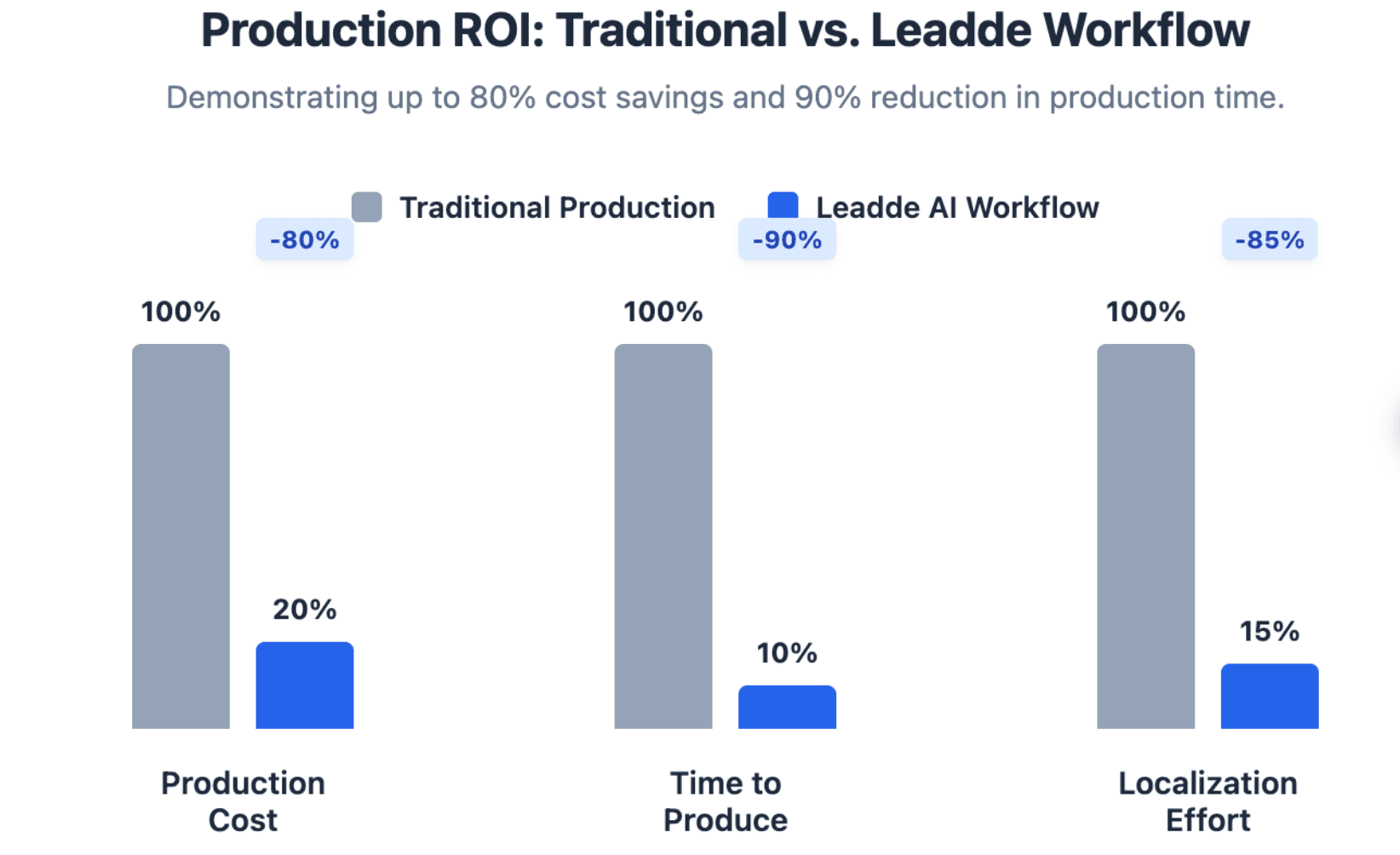
Manual medical video production is slow, expensive, and hard to update across teams and languages. Leadde turns documents and text into professional business videos in minutes, helping healthcare teams maintain branding, streamline reviews, and save up to 80% in production costs and 90% in creation time.
Best AI Medical Video Maker: Which Platform Fits Healthcare and Pharma in 2026?
The best platform depends on the medical use case. A pharma training team, hospital compliance department, patient education team, and medical animation studio do not need the same tool.
For healthcare and pharma, the winning platform should support three priorities:
- Accuracy: content should start from approved sources.
- Reviewability: clinicians, compliance teams, or medical affairs teams should review before publishing.
- Scalability: videos should be easy to update, localize, and reuse.
Best use cases: CME, patient education, compliance training, and pharma product education
AI medical video makers are most useful when the team already has trusted source content but lacks the time or budget to turn it into video.
Common use cases include:
| Use Case | Best-Fit AI Video Workflow |
| Continuing Medical Education (CME) | Source document → structured training video → review → LMS or portal |
| Patient education | Care guide → simple explainer → captions → clinician approval |
| Compliance training | Policy or SOP → avatar-led training → quiz or tracking |
| Pharma product education | Approved product material → branded explainer → medical/legal review |
| Global staff training | Master video → multilingual versions → version control |
The strongest use cases are not “AI invents medical content.” They are AI turns approved medical knowledge into clearer, faster, more scalable video.
Key evaluation criteria: accuracy, clinical review, localization, branding, and scalability
Healthcare and pharma teams should not choose tools only by avatar realism. A realistic avatar cannot fix an inaccurate script.
The best evaluation criteria are:
- Source grounding: Can the tool start from PDFs, SOPs, slide decks, or approved guidelines?
- Script control: Can the team edit every claim before generation?
- Visual control: Can the team adjust layouts, diagrams, highlights, and branding?
- Localization: Can the same content be translated and reviewed across regions?
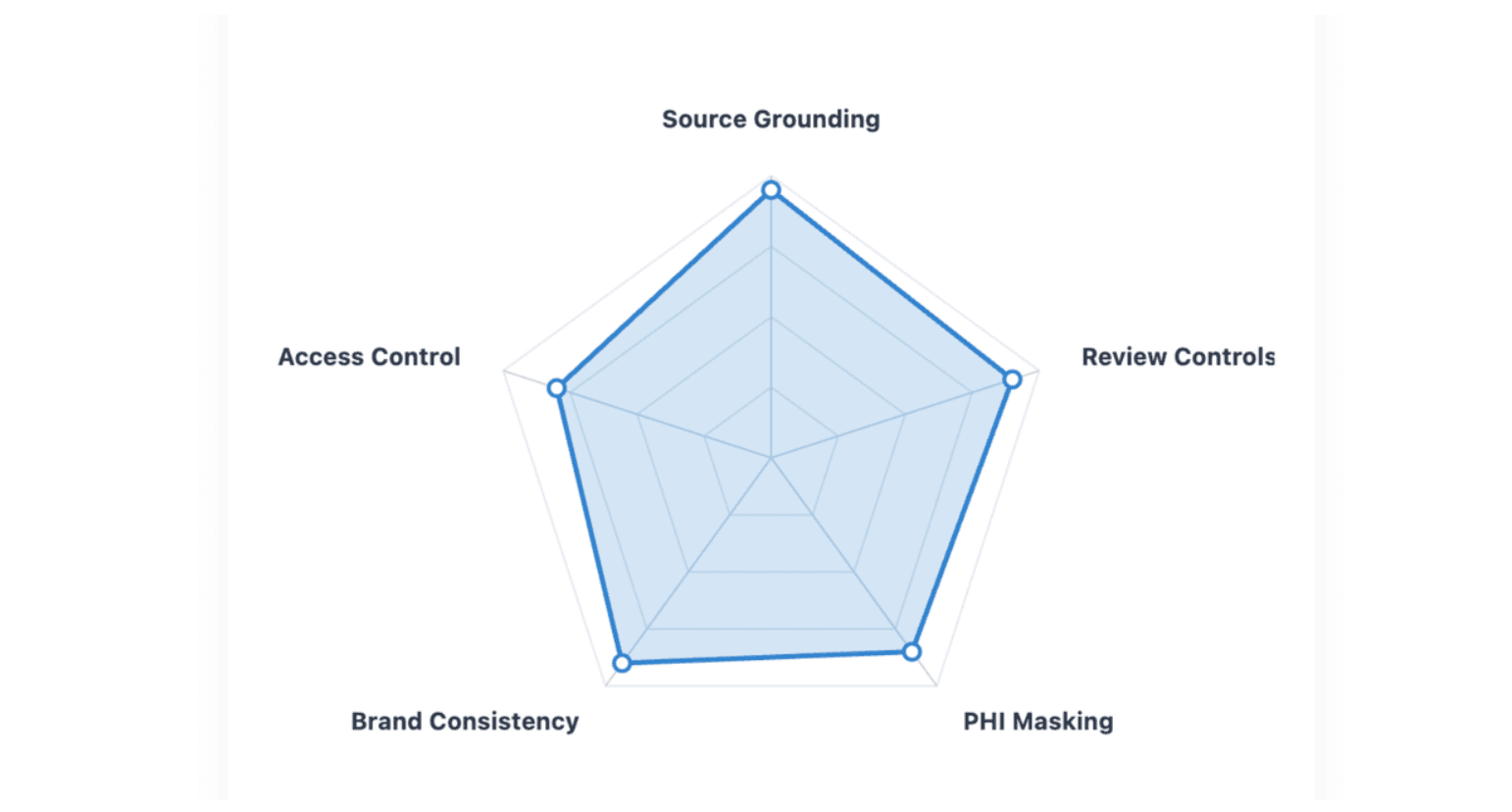
- Compliance readiness: Can the vendor support security, access control, and enterprise review needs?
For medical content, the safest tool is usually the one that gives teams more control, not the one that generates the most dramatic video from a prompt.
Quick comparison: Synthesia, HeyGen, Colossyan, Leadde, and generative video models
As of 2026, available information suggests the clinical video landscape is split between static text-to-video platforms, dynamic documentation engines, and experimental generative diffusion models:
- Synthesia: A rigid, template-driven presentation tool best optimized for baseline internal corporate compliance workflows.
- HeyGen: A robust presenter platform famous for lifelike marketing avatars but limited in complex script layout restructuring.
- Colossyan: A compliance-focused corporate platform that features basic localization tools but suffers from steep user subscription barriers.
- Leadde: A specialized tool designed for automated document-to-video conversion that includes continuous voice cloning and built-in interactive features.
- Generative Models: Cinematic promper tools that yield hyper-detailed biology animations but lack compliance grounding elements.
What Is an AI Medical Video Maker, and How Is It Changing Healthcare Training?
An AI medical video maker is software that helps healthcare, life sciences, and pharma teams create medical education videos with AI. It may use avatars, voiceovers, translation, document parsing, templates, animations, or interactive video features.
The important difference is this: a medical video maker should not simply generate attractive content. It should help teams make accurate, controlled, reviewable medical communication.
From manual video production to source-grounded multimodal AI video generation
Traditional healthcare media production demands extensive production costs, including expensive film studio spaces, medical animation rendering, and specialized voice acting talent. Multimodal AI generation reengineers this framework by treating underlying documents as the primary ground-truth anchor point.
In 2026, healthcare software directly links text, medical lexicons, and synthesized avatars into a unified production workspace. This architecture completely removes manual video recording phases, lowering production lead times down to fractions of an hour.
AI avatars, document-to-video, and medical animation: when each format works best
Different formats solve different problems.
| Format | Best Use | Avoid When |
| AI avatar video | Explaining policies, procedures, conditions, or training topics | You need precise anatomical simulation |
| Document-to-video | Turning SOPs, PDFs, slides, and guidelines into structured video | The source document is not approved |
| Medical animation | Explaining anatomy, physiology, mechanisms of action, or procedures | You lack expert-reviewed visuals |
| Cinematic AI video | Creating concept visuals, B-roll, or visual metaphors | The video could be mistaken for clinical evidence |
For healthcare and pharma, the safest workflow is usually source material first, AI production second, expert review third.
Why prompt-only video generation is risky for YMYL medical content
Prompt-only generation is risky because the model may fill gaps with plausible but incorrect details. In medical content, a small error can change the meaning of a diagnosis, procedure, medication instruction, or safety warning.
Medical video generation remains a difficult research area because medical videos require both visual fidelity and strict medical accuracy; recent research notes that general models often struggle with medical prompts due to limited high-quality medical video datasets. (arXiv)
For this reason, healthcare teams should avoid workflows where AI creates medical explanations from scratch. The better workflow is:
- Start with approved content.
- Generate a draft.
- Review the transcript and visuals.
- Publish only after clinical or compliance approval.
What Makes the Best AI Medical Video Software Safe for Clinical and Pharma Compliance?
The best AI medical video software should support safe production, not just fast production. In healthcare and pharma, speed is useful only when accuracy, control, and review stay intact.
The core question is not, “Can this tool make a video?” The core question is, “Can this tool help us make a video we can safely approve?”
Medical content precision: reducing hallucination with approved source materials
Eliminating factual inaccuracies requires video tools that use advanced retrieval architectures. The system must restrict the text generation scope to the uploaded scientific document context, completely bypassing raw creative generation.
This containment method ensures that specific drug dosages, surgical side-effects, and clinical contraindications are maintained with zero modification. Furthermore, automated text validation ensures that any summarization perfectly mirrors the expert-vetted source material.
Human review, PHI awareness, HIPAA/BAA questions, and publishing controls
Compliance-first medical video creation requires a strict multi-tier operational chain of custody before any content goes live:
- Human-in-the-Loop Review: Software interfaces must provide collaborative environments where medical directors can modify scripts and visuals line-by-line.
- PHI & HIPAA Awareness: Systems must employ deep data masking layers to prevent Protected Health Information (PHI) from polluting model training sets.
- Strict Access Control: The infrastructure must offer distinct editor, reviewer, and final legal sign-off permissions to protect public-facing channels.
Brand identity, CVI consistency, and medical institution trust signals
Healthcare videos must look trustworthy. Weak branding, inconsistent colors, poor layouts, or generic stock visuals can reduce confidence.
For medical institutions and pharma teams, strong visual control matters because videos may appear in:
- Patient portals
- LMS systems
- Hospitals using AI video for staff onboarding
- Sales enablement materials
- Medical affairs education
- Conference training environments
Leadde supports layered PowerPoint import and editing, allowing teams to adjust text, icons, and visual elements instead of rebuilding presentation assets from scratch. This is valuable when teams need to preserve institutional branding, corporate visual identity, and approved visual layouts.
Which AI Video Generators Lead the Healthcare Market in 2026?
The leading tools serve different healthcare needs. No single AI video generator is best for every medical organization.
Synthesia, HeyGen, and Colossyan: strengths and limitations for healthcare teams
Enterprise software choices in 2026 are primarily driven by specific feature availability across legacy multi-national systems:
- Synthesia: Offers strong enterprise security and seamless integration with existing Learning Management Systems (LMS). However, it lacks auto-layout engines, rendering visuals monotonous when processing longer research papers.
- HeyGen: Provides exceptional video translation capabilities alongside clear facial movement rendering for marketing. Yet, it requires substantial manual formatting and breaks down when digesting long medical documentation.
- Colossyan: Features unique integrated tracking fields optimized for institutional learning analytics, but lacks pricing affordability for smaller research laboratories.
Where traditional AI video platforms fall short: static layouts, limited interactivity, and overage risks
Legacy video tools present severe systemic operational challenges for modern agile healthcare teams:
- Static Layout Traps: Visual assets cannot update dynamically with text changes, resulting in monotonous and non-editable media layouts.
- No Interactive Loops: Outputs are locked to standard one-way videos, blocking patients from querying specific symptoms directly within the video stream.
- Overage Financial Burdens: Rigid starter subscription models (such as Synthesia charging $29/month for a mere 10 minutes) trigger massive penalty fees when producing multi-hour CME projects.
When cinematic AI video models help with anatomy, physiology, and medical visuals
Cinematic AI video models can help create visual concepts, motion graphics, and B-roll for medical education. They may be useful for anatomy, physiology, cell behavior, or mechanism-of-action visuals.
However, these tools should be used carefully. For high-risk medical visuals, teams should rely on:
- Expert-reviewed diagrams
- Licensed medical illustrations
- Medical animation specialists
- Clinician-validated scripts
- Clear disclaimers when needed
A cinematic model may create a visually impressive tissue layer, cell process, or organ animation. But visual realism is not the same as medical correctness.
Why Does Leadde Stand Out for AI Medical Content Generation?
Leadde stands out when the medical team’s content already exists in documents. That is common in healthcare and pharma.
Hospitals, clinics, device companies, and pharmaceutical teams already have:
- SOPs
- PDFs
- PowerPoint training decks
- Clinical protocol scripts
- Product education materials
- Compliance policies
- Onboarding documents
- Patient education drafts
Leadde’s value is turning those existing materials into structured, professional, multilingual video assets.
Intelligent document-to-video: preserving healthcare branding with auto layout and key-point highlighting
Leadde converts PowerPoint files, PDFs, Word documents, scripts, and text into structured video presentations. It also automatically generates outlines, scenes, voice-over scripts, and visual layouts.
For medical teams, this helps reduce three production bottlenecks:
- Script bottleneck: Teams do not need to start from a blank page.
- Layout bottleneck: Scenes are structured from source content.
- Branding bottleneck: Existing presentation assets can be reused and edited.
This is especially useful for turning SOP documents into training videos, compliance refreshers, internal product education, and patient education drafts that require medical review before publishing.
Interactive medical learning: video chat, chat-enabled avatars, and guided content exploration
Unlike standard one-way video software, Leadde integrates highly advanced interactivity layers within its core structure:
- Video Chat Integration: Allowing final users to engage in a continuous conversational loop directly with the avatar.
- Chat-Enabled Avatars: Empowers patients to type questions about pharmaceutical side effects and receive source-grounded answers immediately.
- Guided Explorations: Transforms simple lecture materials into deep, multi-directional learning ecosystems.
Scalable localization and review workflows for healthcare documents, SOPs, and training materials
Medical organizations often need the same content in many languages. This is hard with traditional production because each version may require separate scripts, voiceovers, edits, and reviews.
Leadde supports multilingual video workflows across 92 languages, and its translation tools allow teams to generate multilingual drafts inside the editor or from shared video links.
This is valuable for:
- Global pharma training
- Multisite hospital onboarding
- Multilingual patient education
- International compliance programs
- Device training across regions
The strongest localization workflow is not “translate once and publish.” It is translate, review, approve, and keep all versions updated when the source changes.
How Can Medical Teams Create Compliant AI Videos Directly from Clinical Guidelines Using Leadde?
A safe AI medical video workflow should be simple, repeatable, and reviewable. The goal is to turn trusted source material into video without losing control over the message.
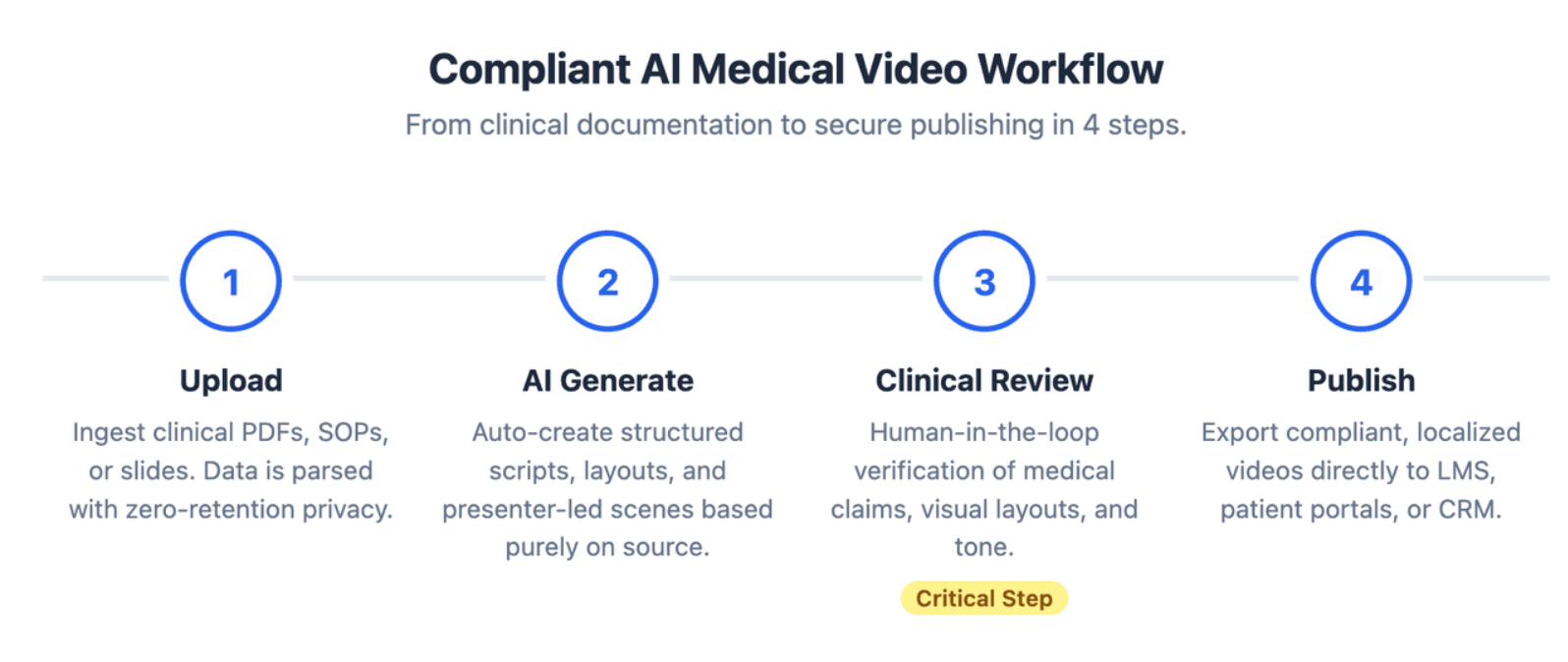
Leadde’s workflow fits this model because teams can upload files or paste text, set language and tone, review generated scripts, select presenters and templates, preview the video, and generate the final version.
Step 1: Upload medical PDFs, SOPs, clinical protocol scripts, or training slides
The compilation process starts inside Leadde's ingestion workspace, which accepts a massive array of file formats. Content teams drag and drop multi-page clinical trials, hospital operation checklists, or PowerPoint decks into the secure interface.
The platform reads the documentation, instantly mapping the contextual hierarchy while isolating core medical definitions and regulatory parameters.
Step 2: Generate structured outlines, layouts, highlights, scripts, and presenter-led scenes
Once file ingestion completes, the automatic engine constructs a comprehensive script blueprint aligned with your branding guidelines.
The software executes auto-layout scripts, assigning custom medical illustrations, structural text bullet points, and speaker notes across scenes. Important terms are auto-highlighted to maintain student focus during difficult regulatory segments.
Step 3: Review, localize, preview, approve, and publish the final medical video
Before publishing, medical teams should review three layers:
- Transcript: every medical claim, instruction, and disclaimer.
- Visuals: diagrams, highlights, presenter scenes, and captions.
- Localization: translated scripts, voiceovers, subtitles, and cultural clarity.
For healthcare and pharma, the final approval should happen before the video is shared with patients, employees, or external stakeholders.
Conclusion
Choose by medical use case, not by generic AI video hype
Organizations must carefully audit their specific communication requirements rather than blindly chasing generic media trends. Teams that produce basic, low-frequency internal company updates can comfortably utilize standard template platforms. However, entities developing complex medical instruction curricula require advanced source-grounded documentation architectures.
Prioritize accuracy, compliance review, brand control, and scalable localization
The selected software system must seamlessly act as an extension of your legal compliance and design teams. Ensure the solution offers perfect data containment to minimize hallucination risks, alongside extensive voice libraries capable of matching regional healthcare demands.
Use Leadde when your team needs source-grounded medical document-to-video workflows
For modern healthcare networks, pharmaceutical corporations, and CME creators requiring true volume, Leadde represents the optimal market choice. By combining an automated document-to-video workflow with an affordable $19/month unlimited video generation plan, it removes financial scaling barriers while maximizing user retention through interactive avatar tools.