
How Are People Making AI Videos So Fast: Tools, Workflows, and Automation

People are making AI videos so fast today because of advances in AI models and streamlined video production workflows. AI video generation tools automate many of the traditionally time-consuming steps, such as scriptwriting, scene creation, voiceover, and editing. By using templates and pre-built assets, creators can quickly produce professional videos, reducing production time from hours to minutes.
Many creators struggle with the time-consuming process of video production, often spending hours or even days to finish a single video. Instead, AI-powered tools like Leadde streamline the entire process, automatically generating scripts, scenes, and voiceovers, so you can create high-quality videos in minutes. This not only saves time but also allows businesses and creators to scale their video production efforts effortlessly.

Why AI Videos Are Being Created So Quickly Today
AI video creation has accelerated dramatically because many steps of traditional video production are now automated. Tasks that once required multiple specialists and software tools can now be handled by a single AI platform.
Instead of writing scripts, filming footage, recording voiceovers, and editing manually, creators can rely on AI to generate these elements automatically.
Automation of Traditional Video Production Tasks
Traditional video production typically involves multiple stages:
- scriptwriting
- filming or sourcing footage
- editing and transitions
- voiceover recording
- exporting the final video
AI video tools automate many of these steps simultaneously. This reduces the need for complex editing workflows and allows creators to generate videos much faster.
Improvements in AI Video Generation Models
Traditional video production typically involves multiple stages:
- scriptwriting
- filming or sourcing footage
- editing and transitions
- voiceover recording
- exporting the final video
AI video tools automate many of these steps simultaneously. This reduces the need for complex editing workflows and allows creators to generate videos much faster.
Integrated AI Video Creation Workflows
Another reason AI videos are produced quickly is that modern tools combine multiple capabilities in a single platform.
Many AI video platforms now include:
- script generation
- scene generation
- voiceover generation
- automatic editing
- instant export
This integrated workflow eliminates the need to switch between different tools during production.
What an AI Video Generator Actually Does
Text-to-Video Generation
Text-to-video generators analyze a written prompt and construct corresponding visual sequences. The AI interprets the context, tone, and subject matter to instantly generate relevant background visuals and animations.
Image-to-Video and Asset-Based Video Creation
Advanced tools can take static assets—like a product photo or a corporate logo—and animate them dynamically. This allows brands to maintain visual consistency without hiring motion graphic designers.
Automatic Scene, Script, and Voiceover Generation
AI video generators can also create the narrative structure of a video automatically.
For example, some platforms generate:
- video scripts
- scene transitions
- voiceover narration
Leadde enables users to convert documents, presentations, and text into structured videos with automatically generated scenes, scripts, and narration, helping teams produce videos faster.
Traditional Video Production vs AI Video Creation
| Process Stage | Traditional Video Production | AI Video Workflow |
|---|---|---|
| Scriptwriting | Manual writing | AI-assisted scripting |
| Filming | Cameras, crew, locations | AI-generated visuals |
| Editing | Manual editing software | Automated editing |
| Voiceover | Recording sessions | AI-generated voice |
| Distribution | Manual formatting | Instant export |
AI reduces multiple steps into a single automated workflow, proving why the modern approach is exponentially faster.
How People Create AI Videos So Fast (Step-by-Step Workflow)
Many creators follow a simple workflow that allows them to generate AI videos quickly.
Step 1 — Start With a Prompt, Idea, or Script
The fastest creators never start with a blank page. They initiate the process using existing materials. Examples include:
- Marketing messages
- Educational topics
- Social media posts
Step 2 — Generate Scripts Automatically
AI tools can transform prompts, documents, or notes into structured video scripts instantly. By feeding a PDF or presentation into the system, the AI extracts key points and formats them for spoken narration.
Step 3 — Generate Video Scenes
AI models generate visual scenes based on text descriptions, images, or templates. The software automatically applies the right pacing, ensuring the visual transitions match the flow of the script perfectly.
Step 4 — Add Voiceover and Sound Automatically
Many platforms include built-in AI voiceovers and background music generation. Creators simply select a voice profile, and the AI generates studio-quality audio with natural breathing and inflections.
Step 5 — Export the Video in Multiple Formats
AI video tools can quickly export videos optimized for various platforms without manual resizing. The system automatically adjusts aspect ratios for:
- YouTube (16:9)
- TikTok (9:16)
- LinkedIn (Square or 16:9)
- Marketing campaigns
The Proven AI Video Creation Framework (Idea → Script → Scene → Voice → Export)
Many fast AI video workflows follow a simple production framework.
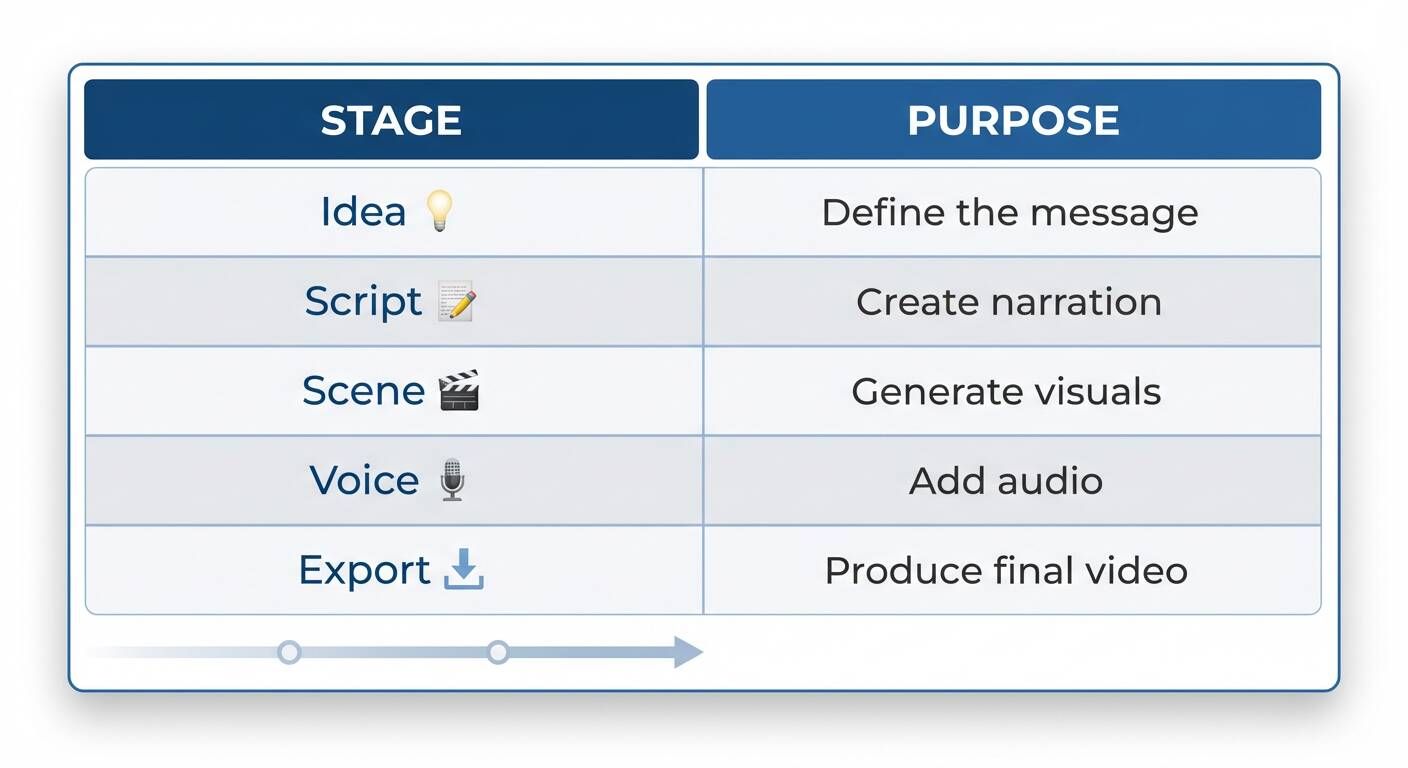
| Stage | Purpose |
|---|---|
| Idea | Define the core message |
| Script | Generate structured narration |
| Scene | Create visuals automatically |
| Voice | Add narration and audio |
| Export | Deliver final video |
This framework explains why AI video creation is significantly faster than traditional workflows. It shifts the human role from "creator" to “director.”
Why Some Creators Produce AI Videos Much Faster Than Others
Using Prompt Templates and Libraries
Speed comes from standardization. Top creators maintain libraries of proven text prompts to instantly generate specific visual styles without trial and error.
Reusing Video Structures and Story Formats
Creators often reuse the same video structure across multiple videos.
For example:
- introduction
- explanation
- conclusion
This approach reduces planning time.
Batch Video Creation and Automation
Some creators generate multiple videos in batches.
Instead of producing one video at a time, they create several variations in a single session.
This approach is common for:
- social media content
- marketing campaigns
- educational series
Minimizing Manual Editing
Experienced creators focus on reusable workflows rather than creating everything from scratch. They trust the AI's automated layout features and avoid getting bogged down in pixel-perfect manual adjustments.
The Most Common AI Video Creation Tools
Text-to-Video Platforms
These tools excel at converting short text prompts into cinematic b-roll or abstract visual clips, perfect for social media backgrounds.
AI Avatar Video Platforms
These platforms utilize hyper-realistic digital humans to deliver spoken content, eliminating the need for on-camera talent or studio rentals.
AI Video Editing Tools
Modern AI tools can generate videos from prompts, scripts, or documents seamlessly.
Leadde enables teams to convert documents, presentations, and text into structured videos with automatically generated scenes, scripts, and narration, helping organizations create business videos faster. With over 200+ avatars and 92 languages, Leadde transforms complex corporate knowledge into engaging videos in minutes.
AI Video Workflows Used by Marketers and Creators
Social Media Video Creation
Creators paste trending topics or blog posts into AI tools to instantly generate 60-second vertical videos, complete with dynamic captions and background music.
Marketing Campaign Videos
Marketers upload campaign briefs, allowing the AI to generate multiple localized video variations for A/B testing across different global markets.
Product Demo and Explainer Videos
By uploading a product manual or presentation deck, companies can automatically generate step-by-step explainer videos featuring an AI presenter.
Outreach and Sales Videos
Sales teams use AI to personalize mass outreach. These workflows demonstrate how AI video generation supports real-world business use cases by addressing prospects by name at scale.
Best Practices for Creating AI Videos Quickly
- Start with a clear message or prompt: The better the input, the faster the output.
- Use reusable templates: Lock in your branding, fonts, and preferred avatars.
- Keep video scripts concise: Shorter scripts process faster and retain higher viewer engagement.
- Automate voiceover and captions: Let the AI handle syncing to save hours of timeline editing.
- Repurpose content into multiple video formats: Turn one core video into snippets for every social channel.
These practices help creators produce videos faster and more consistently.
Common Mistakes That Slow Down AI Video Creation
Starting From Scratch Every Time
Failing to save templates or utilize AI document-to-video features forces you to repeat manual setup tasks for every new project.
Writing Overly Complex Prompts
Feeding the AI contradictory or overly dense instructions often results in confused outputs that require heavy manual corrections.
Editing Too Much Manually
Avoiding these mistakes helps maintain efficient video production workflows. Trust the AI's auto-layout capabilities instead of constantly tweaking minor visual elements.
Frequently Asked Questions About AI Video Creation
How long does it take to make an AI video?
Using modern document-to-video platforms, a professional AI video can be generated in under 5 to 10 minutes, compared to days or weeks for traditional production.
What tools are used to create AI videos?
The market features text-to-video generators, AI avatar platforms, and comprehensive enterprise solutions like Leadde, which specialize in converting business documents into structured videos.
Can AI videos replace traditional video production?
For corporate training, sales outreach, and content marketing, AI videos have largely replaced traditional production due to their 80% cost reduction and rapid scalability.
Conclusion
AI video creation is becoming significantly faster because modern tools automate scripting, visual generation, voiceovers, editing, and formatting. By combining advanced AI models with efficient workflows and reusable templates, creators and businesses can produce professional videos in minutes instead of hours or days.
As AI video technology continues to evolve, automated video production workflows will likely become even faster and more accessible, permanently changing how global content is scaled.