Medical Device Video Production: Process, Cost & Compliance
Medical device video production is the process of turning complex device information into clear product demonstrations, training videos, patient education, clinical content, and sales materials.
It may combine live action, 2D or 3D animation, CAD-based visuals, screen recording, and AI-assisted workflows, while requiring careful medical, regulatory, privacy, and product review before publication.
Producing these videos traditionally takes significant time, budget, and coordination, especially when content must be updated or localized.
Leadde turns approved documents and text into professional business videos in minutes, helping teams reduce production costs by over 80% and content creation time by up to 90%.
Medical Device Video Production: What Is It and Why Do MedTech Companies Need It?
Medical device video production turns technical, clinical, and operational information into visual content that people can understand and use. It may involve live-action filming, screen capture, 2D motion graphics, 3D product animation, CAD models, narration, subtitles, and interactive elements.
Unlike a standard corporate video, a medical device video may communicate product claims, operating instructions, warnings, clinical workflows, or patient information. This creates a greater need for medical accuracy, evidence review, privacy controls, and documented approval.
Medical Device Video vs. General Healthcare Video
General healthcare videos may promote a hospital, introduce a physician, explain a condition, or share a patient story. A medical device video focuses more directly on a physical device, connected application, software platform, diagnostic system, or device-related procedure.
The content often needs to explain:
- What the device is designed to do
- Who should use it
- Where it should be used
- How it should be set up and operated
- Which risks, warnings, or limitations apply
- How the device interacts with software, accessories, or the human body
Medical device videos therefore require close input from product, engineering, clinical, regulatory, legal, quality, and marketing teams. A visually attractive video is not successful if it shows the wrong component, an unsupported benefit, or an unsafe operating step.
| Feature | Medical Device Video | General Healthcare Video |
| Primary Focus | Physical device, software platform, procedure | Hospital, physician, patient story |
| Content Includes | Setup, operation, warnings, interactions | Promotion, condition explanation, wellness |
| Required Approvals | Product, engineering, clinical, regulatory, legal | Marketing, PR |
How Video Supports Product Demos, Training, Patient Education, and Sales
A product demonstration helps buyers and clinicians understand what the device does before they see it in person. A training video can show setup, calibration, operation, cleaning, troubleshooting, or maintenance in a repeatable format.
Patient education videos use simpler language and focus on preparation, expectations, home use, and when to contact a healthcare professional. Sales videos may focus on workflow value, product differentiation, implementation, and approved performance claims.
Video is especially useful when a written explanation cannot clearly show movement, sequence, scale, device positioning, screen behavior, or an internal mechanism. The same approved content can also support websites, sales meetings, conferences, learning portals, distributor training, and customer support.
When Video May Function as Promotional, Training, or Labeling Content
The purpose of a video does not depend only on its title. A video called “education” may still promote a device if it emphasizes product benefits, encourages adoption, or presents claims about safety and performance.
FDA states that device labeling can include written, printed, or graphic materials that accompany a device. It also treats operating and servicing instructions as part of labeling. False or misleading labeling can cause a device to be considered misbranded.
For this reason, teams should decide early whether a video is:
- Promotional content
- General education
- Product labeling
- Training material
- Patient communication
- Internal quality or service content
The classification affects the source documents, reviewers, warnings, evidence, distribution channels, and update controls that the project requires.
What Types of Medical Device Videos and Production Formats Should You Choose?
The right video format depends on what the viewer must understand or do. A realistic live-action video is not always clearer than animation, and detailed 3D animation is not always more effective than a simple diagram.
The best approach is usually the simplest format that can communicate the required information accurately.
Product Demos, Clinical Training, Patient Education, and Surgical Videos
- Product demonstration videos explain the device, its main features, and its place in a clinical or operational workflow. They are useful for product launches, sales presentations, procurement reviews, websites, and trade shows.
- Clinical training videos show professional users how to prepare, operate, clean, maintain, or troubleshoot a device. They should clearly present critical tasks, decision points, warnings, and conditions that require the user to stop.
- Patient education videos should use plain language, calm visuals, and realistic expectations. They may explain preparation, home use, recovery, device care, or what the patient may experience.
- Surgical procedure videos may combine operating-room footage, device-camera feeds, diagrams, narration, and animation. They require careful planning because critical clinical steps may not be repeatable for the camera.
Other useful formats include:
- Medical software walkthroughs
- Distributor training
- Field-service and maintenance videos
- Physician or patient testimonials
- Clinical trial product demonstrations
- Investor and fundraising videos
- Product-launch and conference content
- Internal SOP and compliance training
A separate version is often needed for each major audience. Patients, surgeons, procurement teams, and investors rarely need the same level of detail or language.
Live Action, 2D Animation, 3D CAD Animation, and Screen Recording
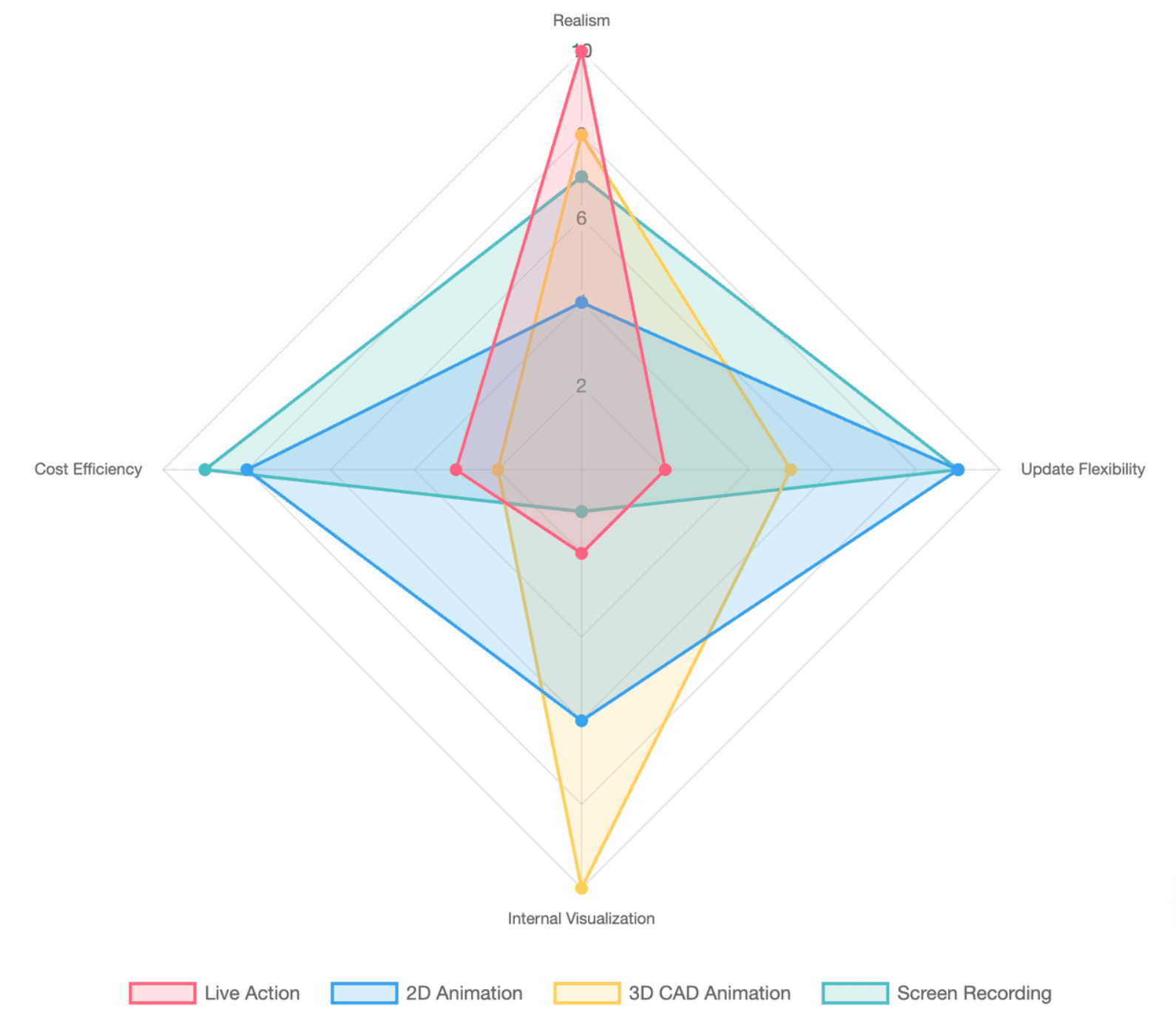
- Live action is effective when viewers need to see a real device, a real hand position, a physical environment, or a complete operating sequence. It creates realism but may require locations, actors, clinical permissions, specialist crews, and multiple takes.
- 2D animation works well for simple workflows, diagrams, user journeys, data, warnings, and patient-friendly explanations. It is usually easier to update than complex live-action or 3D scenes.
- 3D animation is useful when the viewer must see internal parts, fluid paths, tissue interaction, an implanted device, or a mechanism that cannot be filmed. CAD files may provide an accurate geometric starting point, but they normally require cleanup, materials, lighting, movement, and engineering review before they are ready for video.
- Screen recording is the clearest choice for connected applications, dashboards, portals, cloud platforms, and software-controlled medical devices. Demo accounts should contain no real patient information, and every recording should be linked to the correct software version.
- AI presenters and automated scene generation can support document-based training, internal communication, and multilingual content. They should not replace clinical footage or validated animation when precise device handling, anatomy, or procedural movement is essential.
When a Hybrid Video Approach Works Best
A hybrid approach combines formats according to what each one explains best.
For example, a training video may use:
- Live action for physical setup
- Screen recording for software configuration
- 3D animation for an internal mechanism
- 2D graphics for warnings and key steps
- An AI or human presenter for transitions
This avoids forcing one format to perform every task. It also creates reusable modules that can be updated separately.
Hybrid production is particularly valuable for connected devices. The physical product, software interface, clinical workflow, and biological effect may all require different visual methods.
The team should still keep a fixed source of truth. Every format must use the same approved terminology, claims, product version, and operating sequence.
How Does the Medical Device Video Production Process Work?
Medical device video production should begin with information control rather than camera selection. The team must first confirm the audience, intended message, approved claims, source documents, reviewers, and publishing channels.
A structured workflow reduces late changes and makes the final video easier to approve, localize, and update.
From Approved Documents and Product Claims to Script and Storyboard
The project should start with current, approved materials, such as:
- Instructions for use
- Product labeling
- Technical specifications
- Clinical evidence
- Approved claims
- Risk and human-factors documentation
- Software screenshots
- CAD files
- Brand and terminology guides
- Existing training documents
The script should not introduce a clinical benefit simply because it sounds persuasive. Each performance, safety, workflow, or patient claim should be connected to a source and reviewed by the responsible team.
A claims matrix can record:
- The exact claim
- Where it appears
- The evidence supporting it
- Applicable markets
- Required limitations
- The approving reviewer
The storyboard then shows how every claim will appear visually. This matters because an image can create an implied claim even when the narration is technically correct.
Approving the script and storyboard before full production is one of the most effective ways to prevent expensive rework.
Production, Medical Review, Editing, and Final Approval
Production may include filming, screen capture, CAD preparation, animation, voice recording, sound design, and editing. The production team should work from an approved shot list and visual plan.
Review should occur at defined checkpoints:
- Script
- Storyboard
- Device model or capture plan
- Rough cut
- Captions and localized text
- Final master
Medical experts should review clinical accuracy. Engineering should validate components, movement, connections, and product states. Regulatory and legal reviewers should evaluate claims, intended use, qualifications, and risk presentation.
FDA describes training materials as part of the medical device user interface. Human-factors work should help users perceive information, make decisions, and operate the device safely and effectively.
Feedback should be consolidated by one project owner. Without a controlled review process, different departments may make conflicting changes that increase cost and weaken clarity.
Deliverables for Websites, Sales Teams, Training Portals, and Social Media
A complete project often produces more than one video.
Common deliverables include:
- A main product or training video
- Short sales clips
- Social media versions
- Conference loops
- Website embeds
- LMS or training-portal files
- Captioned versions
- Localized voiceovers
- Subtitle files
- Product renders and thumbnails
- Editable source files
Short versions should receive their own claims review. Removing context, warnings, or qualifications from a longer approved video can change the meaning of a claim.
The final delivery package should also contain the approved script, captions, source references, review record, publication date, device version, software version, language, and future update triggers.
How Do You Keep Medical Device Videos Accurate, Compliant, and Safe?
Compliance cannot be added only at the final review. It must guide the script, visual design, filming plan, editing, and distribution strategy from the beginning.
The production agency can organize the review process, but the manufacturer and its qualified reviewers remain responsible for the final medical and regulatory decisions.
FDA, EU MDR, Intended Use, and Evidence-Supported Claims
In the United States, medical device labeling must not be false or misleading. FDA also requires relevant directions and warnings when they are needed for safe use.
Teams should avoid:
- Presenting a cleared device as “FDA approved”
- Showing an unapproved use
- Expanding the intended patient group
- Implying a clinical result that has not been established
- Removing important limitations
- Comparing devices without suitable evidence
- Showing unrealistic before-and-after outcomes
The EU Medical Device Regulation applies similar controls to visual communication. Article 7 prohibits misleading words, names, pictures, and other signs relating to a device’s intended purpose, safety, or performance in labeling, instructions, advertising, and market communication.
Every visual element should therefore be reviewed, not only the written script. Device movement, clinician behavior, anatomical response, patient expressions, data displays, and editing choices can all create implied claims.
Market-specific versions may also be necessary. The same device may have different approved claims, terminology, indications, or regulatory status in different countries.
IFU Alignment, Human Factors, Warnings, and Common Use Errors
Training videos should match the current device model, software version, accessories, and instructions for use. The production team should never rely on an old slide deck when a newer approved source exists.
The video should clearly show:
- Preparation and inspection
- Setup and calibration
- Critical operating steps
- Correct hand positions and connections
- Alarms and system feedback
- Cleaning and maintenance
- Troubleshooting
- Stop conditions
- Warnings and contraindications
FDA explains that human-factors engineering includes device preparation, setup, calibration, operation, cleaning, battery replacement, repair, packaging, labeling, and training materials. Its main goal is to reduce use-related risk and confirm that intended users can operate the device safely and effectively.
A training video may supplement written instructions, but teams should not assume that it automatically replaces the IFU. The required labeling strategy depends on the device, market, and regulatory pathway.
Videos should also address known use errors when doing so helps users avoid harm. However, training should not be used to hide an unsafe interface or a device design that depends on excessive memory.
Patient Consent, HIPAA, Clinical Filming, and Protected Health Information
Clinical filming requires more than a standard appearance release.
Under HHS guidance, healthcare providers generally cannot allow film crews into treatment areas where protected health information is accessible without prior written authorization from every affected individual. Blurring a patient after filming does not solve the problem if the crew was not permitted to access the information in the first place.
The team must check for information in:
- Patient faces and voices
- Wristbands
- Monitors
- Medical records
- Computer screens
- Medication labels
- Whiteboards
- Background conversations
- Room and bed identifiers
HHS also explains that a healthcare provider may need a business associate agreement with a contracted film crew when the crew can access PHI while creating content on the provider’s behalf. Public use of identifiable patient material generally requires suitable patient authorization.
Before filming, the agreement should define:
- What may be recorded
- Who may access raw footage
- Where files will be stored
- How files will be transferred
- Which channels and countries may use the video
- How long the content may be used
- How unused PHI will be returned or destroyed
Hospital policy, state law, research rules, and local privacy requirements may add further controls.
How Much Does Medical Device Video Production Cost, and How Long Does It Take?
There is no universal price for medical device video production. A short screen-recorded tutorial and a surgical video with clinical filming, CAD animation, expert review, and five languages are not comparable projects.
A useful quote should explain the work, deliverables, assumptions, review rounds, usage rights, and update support rather than provide only a price per finished minute.
Key Cost Factors for Live Action, 2D, 3D, CAD, and Clinical Filming
Major cost factors include:
- Script and storyboard development
- Medical and regulatory review
- Number of filming days
- Crew and equipment
- Locations and hospital access
- Actors, clinicians, or hand models
- CAD cleanup
- 2D or 3D complexity
- Anatomical modeling
- Voiceover and sound design
- Captions and accessibility
- Languages and regional versions
- Number of final outputs
- Source-file delivery
- Revision rounds
As of 2026, published agency estimates show how widely budgets can vary. Podymos states that its medical video projects average approximately £10,500 to £31,000, while larger interactive projects may exceed £100,000. Buzzbox Media publishes a broad estimate of $10,000 to $50,000 for professional medical device explainer videos, depending on length, animation, live action, and production quality. These are vendor estimates, not universal market rates.
Per-minute pricing can be misleading because medical review, CAD preparation, filming access, and localization may cost the same whether the final video is two minutes or four minutes.
The lowest quote may also exclude important work, such as medical writing, expert review, product validation, captions, source files, or future updates.
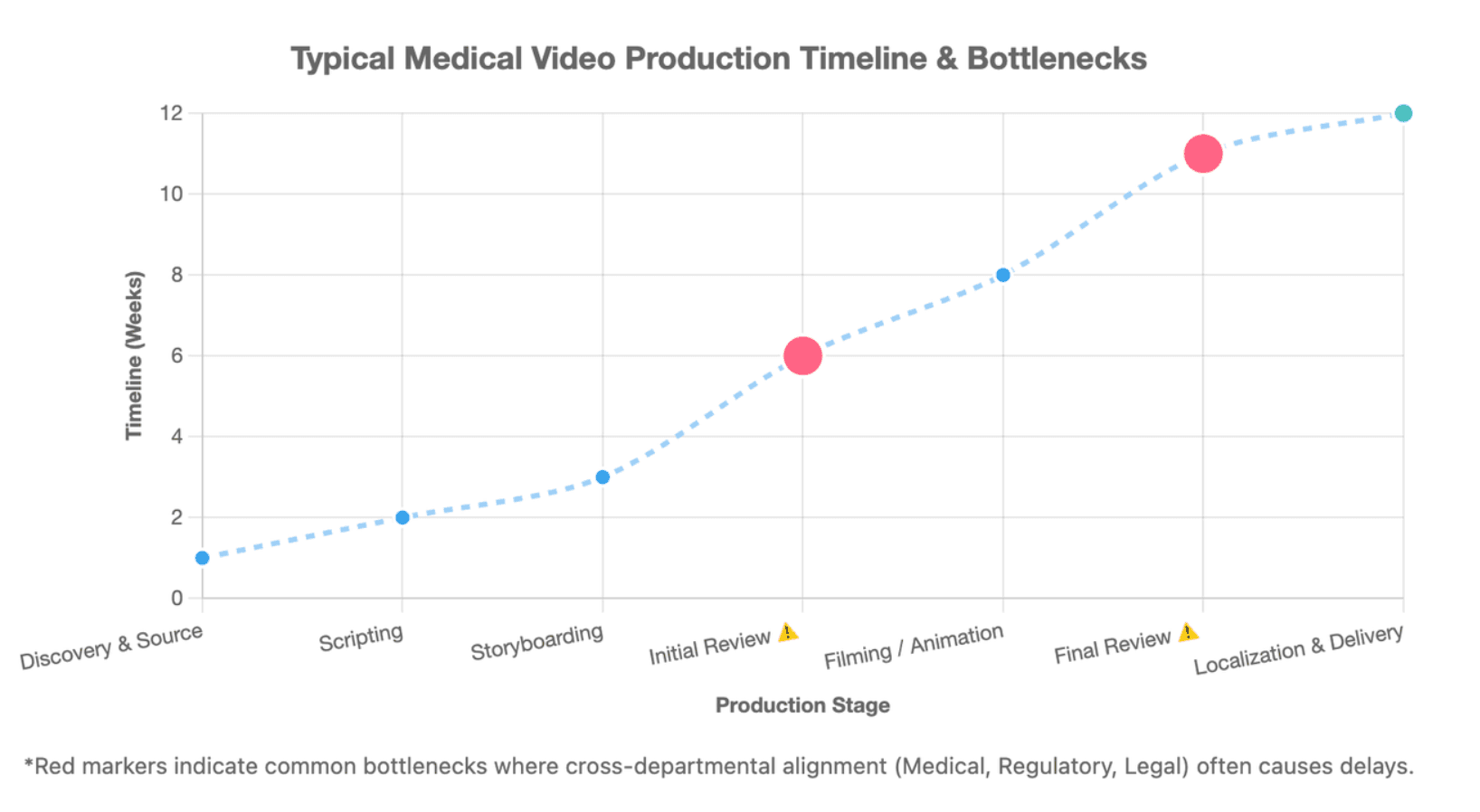
Production Timelines, Review Rounds, and Common Causes of Delay
A simple software walkthrough may be completed faster than a complex 3D medical animation or clinical shoot. The schedule should be based on production stages rather than only final video length.
Common stages include:
- Discovery and source collection
- Script development
- Storyboarding
- Review and approval
- Filming or model preparation
- Animation and editing
- Voiceover
- Captions
- Final review
- Localization and delivery
The most common delays occur when:
- The source documents are outdated
- Approved claims are not available
- Reviewers join late
- CAD files require unexpected cleanup
- Clinical locations are difficult to schedule
- Product or software versions change
- Feedback conflicts across departments
- The script is changed after animation begins
Complex medical projects should reserve real time for clinical, legal, regulatory, engineering, and quality review. A fast production schedule does not remove these approval responsibilities.
How Early Approval and Reusable Assets Reduce Long-Term Costs
Early approval reduces the risk of rebuilding scenes, repeating narration, or reshooting a product.
Teams can control long-term cost by creating reusable assets, including:
- Approved script modules
- Reusable 3D models
- Product B-roll
- Standard warning scenes
- Editable templates
- Voiceover files
- Translations
- Brand libraries
- Screen-recording modules
A modular video is easier to update than one continuous production. When a software screen changes, the team can replace one scene instead of recreating the complete video.
The quote should also define ownership. The manufacturer should know whether it will receive editable project files, cleaned CAD assets, captions, voice tracks, and visual elements required for future revisions.
How Do You Choose a Medical Device Video Partner and Scale Content Efficiently?
The right partner should understand both production quality and medical content control. A strong showreel alone does not prove that a company can manage clinical accuracy, privacy, product claims, or future updates.
The selection process should evaluate the company’s workflow, not only its visual style.
Medical Experience, Review Workflow, Privacy, and Source-File Ownership
Ask the production company to explain:
- Which medical device projects it has completed
- Who writes the script
- How claims are verified
- Who validates the device and anatomy
- When medical and regulatory teams review
- How clinical footage is protected
- How conflicting feedback is managed
- How many revision rounds are included
- Which source files are delivered
- How future updates are handled
The portfolio should match the actual need. A company experienced in hospital interviews may not have the technical skills required for detailed CAD animation. A strong animation studio may not be prepared to film safely in an operating room.
The final agreement should clearly assign responsibilities for:
- Medical accuracy
- Regulatory approval
- Patient authorization
- Product validation
- Data security
- Asset licensing
- Localization
- Publication
- Archiving
Controlled Document-to-Video Production With AI and Human Review
AI can speed up medical device video production when it works from approved source documents and remains inside a controlled review process.
A document-to-video workflow can begin with:
- PowerPoint presentations
- PDFs
- Word files
- SOPs
- Product scripts
- Training text
A platform such as Leadde can convert business documents and text into structured scenes, outlines, narration, and visual layouts. It also supports multilingual drafts, AI presenters, interactive video, analytics, and version-control functions.
Its documented workflow allows users to import content, select language and tone, review an automatically generated outline, choose a template and presenter, edit scene scripts, preview the video, and approve the final generation.
The safest workflow is:
Approved source → AI-generated draft → product and medical review → regulatory review → final production → documented release
AI should assist with structure, narration, scene layout, captions, and translation. It should not become the source of clinical facts.
Generative visuals require extra care. They may create inaccurate anatomy, incorrect device motion, inconsistent components, or unrealistic clinical results. High visual quality does not prove medical accuracy.
Localization, Version Control, Content Repurposing, and Future Updates
Localization is more than direct translation. Medical terminology, claims, instructions, warnings, voice timing, on-screen text, and software interfaces may all need regional review.
A master version should define:
- Approved source language
- Device version
- Software version
- IFU version
- Applicable markets
- Approval date
- Review date
- Content owner
Every localized version should link back to that master. When the source changes, the content owner should be able to identify every affected language and distribution channel.
One approved master project can then create:
- Patient and clinician versions
- Long and short edits
- Website and conference videos
- Sales and training assets
- Multiple languages
- Regional claim variations
- Updated software scenes
This model reduces duplicate work while keeping the scientific core consistent.
What a Successful Medical Device Video Project Looks Like
A successful project does more than produce a polished video. It gives the intended viewer the information needed to understand, evaluate, or use the device correctly.
The final content should be:
- Clear for its intended audience
- Accurate to the product and clinical workflow
- Supported by approved evidence
- Reviewed by the correct experts
- Safe for patients and users
- Accessible and easy to navigate
- Suitable for its publishing channel
- Easy to localize and update
- Connected to the correct device and document version
Performance should be measured according to purpose. A training video may be judged by completion, comprehension, use errors, and support requests. A commercial video may be judged by qualified views, demo requests, sales use, meeting influence, and engagement.
The strongest project is not always the most expensive or visually complex. It is the one that communicates the correct message, passes review efficiently, supports real user needs, and remains manageable after publication.
Conclusion
Successful medical device video production combines clear communication with medical accuracy, regulatory review, patient privacy, and disciplined content management. The best approach starts with approved source documents, selects the simplest suitable production format, and creates reusable video assets that can be reviewed, localized, updated, and distributed across multiple audiences and channels.