Medical Terminology Videos: Complete 2026 Guide
Medical terminology videos are structured learning resources that use narration, visuals, pronunciation guidance, and clinical examples to explain complex healthcare terms.
They help students, healthcare professionals, clinical research teams, and patients understand word roots, anatomy, abbreviations, procedures, and patient-friendly meanings more clearly than text-only definitions.
However, producing clear medical terminology lessons manually is slow, costly, and difficult to update across teams and languages.
[Leadde](- https://leadde.ai/) turns approved documents and text into professional business videos in minutes, helping organizations cut production costs by over 80% and content creation time by 90%.
[ ](- https://leadde.ai/)
Medical Terminology Videos: What Are They and Who Are They For?
Medical terminology videos teach the language used to describe anatomy, diseases, symptoms, tests, treatments, and clinical procedures. A lesson may explain a single term, a family of related word parts, one body system, or an entire medical terminology course.
The strongest videos do more than display a term and its definition. They show how the term is pronounced, how it is built, where it is used, and how its meaning changes in different clinical contexts.
Medical terminology videos vs. general medical education videos
A general medical education video may explain how the heart works, what diabetes is, or how a procedure is performed. A medical terminology video focuses more directly on the language used to describe those subjects.
For example, a general video may explain inflammation. A terminology lesson may break down words such as gastritis, dermatitis, and arthritis to show that the suffix -itis refers to inflammation.
The distinction is important because medical terminology lessons teach a reusable decoding system. The National Library of Medicine’s medical terminology materials organize learning around prefixes, roots, suffixes, diagnostic terms, procedures, and body systems.
Key audiences: students, healthcare staff, clinical researchers, and patients
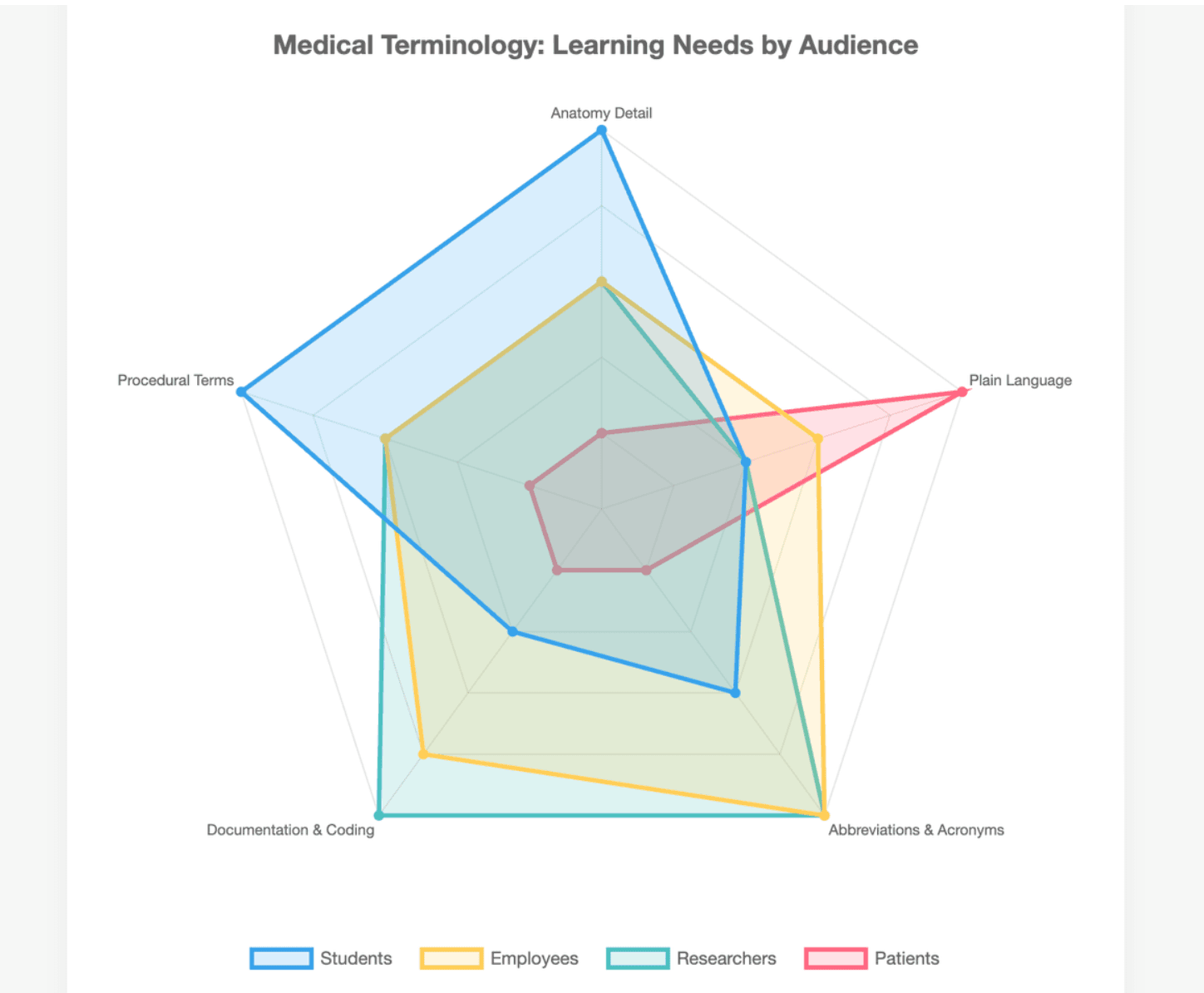
Different audiences require different levels of detail.
| Audience | Main learning need |
| Medical and nursing students | Word construction, anatomy, diseases, procedures, and exams |
| Allied health students | High-frequency terms connected to their future roles |
| Healthcare employees | Workplace vocabulary, documentation, and safe abbreviations |
| Clinical research staff | Diagnoses, anatomy, acronyms, adverse events, and study documents |
| Medical coders | Precise terms connected to documentation and classification |
| Patients and caregivers | Plain-language explanations of unfamiliar medical words |
| Instructors | Structured lessons, examples, activities, and assessments |
A course for nursing students may include detailed anatomy and clinical examples. A patient-facing lesson should use fewer technical details and explain what each term means in practical language.
The main problems terminology videos can solve
Medical terms can be difficult because many are long, unfamiliar, or based on Greek and Latin components. Similar spellings may refer to completely different body structures, while the same abbreviation may have several meanings.
Well-designed videos can help learners:
- See how complex terms are constructed.
- Hear accurate pronunciation.
- Connect terminology with anatomy.
- Compare similar or easily confused words.
- Understand how a term appears in a clinical sentence.
- Review content at their own speed.
- Move from technical language to a plain-language explanation.
Videos are most effective when they form part of a wider learning system. Watching alone may build recognition, but practice questions, recall exercises, and repeated review are usually needed to build usable knowledge.
What Should a Complete Medical Terminology Video Course Cover?
A complete course should begin with common word components and then apply those components to anatomy, body systems, conditions, tests, and treatments.
It should also explain exceptions. Not every medical term can be understood by breaking it into a prefix, root, and suffix. Eponyms, acronyms, medication names, and newer digital health terms may need to be learned as complete expressions.
Word roots, prefixes, suffixes, pronunciation, and spelling
Most beginner courses start with four basic components:
- Prefix: Appears before the root and may describe number, position, time, or condition.
- Word root: Carries the central meaning, often connected to an organ or body structure.
- Suffix: Appears at the end and may identify a condition, symptom, procedure, or specialty.
- Combining vowel: Connects word components and makes a term easier to pronounce.
For example, cardiology can be presented as:
| Component | Meaning |
| cardi | Heart |
| o | Combining vowel |
| -logy | Study of |
| Full meaning | Study of the heart |
A video should also show the complete spelling, syllable breaks, and stressed syllable. Learners should hear the term at both a slow teaching speed and a normal speaking speed.
Plural forms require separate attention because medical language includes forms that do not follow simple English plural rules. A course should compare examples rather than expecting learners to guess.
Anatomy, body systems, diseases, diagnostics, and procedures
After learning basic word components, learners need to apply them to body systems.
A practical course structure may include:
- Anatomical directions, planes, cavities, and regions.
- Cardiovascular and respiratory terminology.
- Musculoskeletal and nervous system terminology.
- Digestive, urinary, and endocrine terminology.
- Reproductive, pediatric, and geriatric terminology.
- Eye, ear, skin, and sensory terminology.
- Microbiology and infectious disease terminology.
- Laboratory, imaging, diagnostic, surgical, and treatment terms.
Each body-system lesson should connect five elements:
Anatomy → Function → Condition → Test → Procedure
The NLM medical terminology course follows a similar body-system approach and includes diagnostic, therapeutic, surgical, and symptomatic terminology.
Abbreviations, clinical language, health literacy, and modern medical terms
A complete course must explain how terminology is used in real communication.
This includes:
- Medical abbreviations and acronyms.
- Formal terms used in records.
- Informal workplace expressions.
- Patient-friendly alternatives.
- Genomics and precision-medicine terms.
- Telemedicine and digital health vocabulary.
- Culturally respectful and non-stigmatizing language.
Stanford’s clinical research training treats roots, anatomy, acronyms, abbreviation use, colloquial language, and health literacy as connected learning goals. This is valuable because knowing what an abbreviation means is not enough; learners must also know when using it may be unsafe or unclear.
Healthcare organizations should use standardized terminology and approved abbreviations. Joint Commission materials also state that the complete term should appear before its abbreviation when it is first used.
How Should Medical Terminology Videos Be Designed for Effective Learning?
Effective design begins with the learning objective, not the animation style. Every scene should help the learner understand, pronounce, remember, or use a term.
A polished video can still fail when it presents too many words, uses unrelated stock images, or reads definitions without adding context.
Short lessons, full courses, and role-based learning paths
Short videos work well when one lesson focuses on a clear concept, such as:
- One common suffix.
- One group of anatomical directions.
- One family of cardiovascular terms.
- One pair of easily confused words.
- One set of approved abbreviations.
Longer courses are useful when learners need a complete sequence. However, the course should still be divided into clear chapters that can be watched independently.
Role-based paths make the course more relevant. A clinical research coordinator may need study-document and adverse-event terms, while a medical assistant may need appointment, examination, and procedure vocabulary.
A reusable course can therefore have one shared foundation and several specialized paths:
| Shared foundation | Specialized path |
| Roots, prefixes, and suffixes | Nursing terminology |
| Anatomical directions | Clinical research terminology |
| Pronunciation principles | Medical coding terminology |
| Common conditions | Patient communication |
| Safe abbreviations | Employee onboarding |
Visual word breakdowns, anatomical context, and clinical examples
Visuals should teach, not decorate.
A useful word-building scene might:
- Display the complete term.
- Separate it into components.
- Color each component consistently.
- Define each part.
- Rebuild the complete meaning.
- Show the related anatomy.
- Use the term in a short clinical sentence.
For example, a video explaining nephrectomy can highlight nephr as kidney and -ectomy as surgical removal. It can then display a labeled kidney illustration and a short sentence showing how the term might appear in a medical record.
The same scene should not introduce several unrelated terms. One main concept per scene keeps the relationship between narration, text, and visuals clear.
Active recall, quizzes, spaced repetition, and interactive practice
Learners need opportunities to retrieve information without seeing the answer.
Useful activities include:
- Pause-and-answer questions.
- Prefix, root, and suffix matching.
- Pronunciation repetition.
- Term-building exercises.
- Clinical mini-cases.
- Easily confused word comparisons.
- Flashcards after each chapter.
- Review questions from earlier lessons.
A weak question only asks learners to recognize the correct definition. A stronger question asks them to interpret a new term, select the correct term for a clinical situation, or explain why a similar option is wrong.
Video chapters can also become spaced-review units. A learner may watch a chapter on Monday, complete a short quiz on Tuesday, and review difficult terms later in the week.
How Do You Create a Medical Terminology Video Step by Step?
Medical terminology video production should follow a controlled process. Starting with an unreviewed script or letting a video tool generate unsupported definitions creates unnecessary risk.
The workflow should keep the source, terminology, script, visuals, pronunciation, and final video connected.
Define the audience, learning objective, and approved medical sources
Begin with three questions:
- Who will watch the video?
- What should they be able to do afterward?
- Which approved sources support the content?
A vague goal such as “teach cardiovascular terminology” is too broad. A stronger objective is:
“After this lesson, nursing students will be able to break down and define five common cardiovascular terms.”
Create a source list before writing. Depending on the subject, sources may include:
- National Library of Medicine resources.
- Government health agencies.
- Professional medical associations.
- Approved textbooks.
- Institutional policies.
- Reviewed clinical training documents.
Create a controlled glossary from those sources. Each record should include the approved term, pronunciation, definition, plain-language explanation, abbreviation, source, reviewer, and review date.
Build the script, pronunciation guide, visuals, and knowledge checks
The script should use short sentences and introduce one main idea at a time.
Each term can follow a repeatable structure:
| Script element | Purpose |
| Direct definition | Gives the answer quickly |
| Word-part breakdown | Shows how the term is constructed |
| Pronunciation | Supports speaking and listening |
| Clinical example | Shows real use |
| Plain-language meaning | Supports patient communication |
| Confusable term | Prevents common mistakes |
| Recall question | Tests learning |
Narration and on-screen text should be written separately. The narrator may explain a concept in full, while the screen displays only the essential term, components, and definition.
Medical visuals should be selected after the script is approved. A visual reviewer should check anatomical position, labels, orientation, and consistency with the narration.
Review, preview, publish, and maintain the lesson
A medical reviewer should examine more than the script. The final review should cover:
- Definitions and word components.
- Pronunciation.
- Spelling.
- Abbreviations.
- Clinical examples.
- Anatomical visuals.
- Patient-friendly explanations.
- Captions and transcripts.
- Translated versions.
- Source and review dates.
Previewing the complete video is essential because errors may appear during production even when the source script is correct. Text can be cut off, captions may contain spelling mistakes, and synthetic voices may mispronounce uncommon terms.
After publication, assign an owner and review date. A lesson should be updated when terminology, institutional policy, accepted abbreviations, or source guidance changes.
How Can AI Improve Medical Terminology Video Production?
AI can reduce repetitive production work, especially when an organization already has approved documents, presentations, or terminology lists.
However, AI should support the workflow rather than act as the final medical authority.
Turning approved documents, presentations, and terminology lists into videos
AI video tools can help convert existing materials into:
- Video outlines.
- Chapter structures.
- Scene-level scripts.
- Narration drafts.
- On-screen summaries.
- Quiz questions.
- Visual suggestions.
- Captions and translations.
The quality of the output depends heavily on the quality of the source document. Teams should remove duplicate definitions, outdated pages, conflicting abbreviations, and irrelevant content before uploading a file.
A source document should also make its hierarchy clear. Headings, approved terms, learning objectives, and reviewer notes help the system create a more accurate first draft.
Creating professional and patient-friendly versions from one source
One approved medical source can support several audience-specific scripts.
A professional version may retain:
- Precise anatomical language.
- Clinical abbreviations.
- Diagnostic and procedural terminology.
- Documentation examples.
- Specialty-specific context.
A patient version may use:
- Everyday words.
- Shorter explanations.
- Fewer abbreviations.
- Clear next steps.
- Visuals connected to practical meaning.
CDC guidance recommends knowing the audience, putting the most important message first, limiting jargon, and replacing difficult medical terms with familiar alternatives when appropriate.
The two versions should come from the same approved definition. Simplification must not change the clinical meaning.
Using Leadde for multilingual drafts, interactive learning, and version control
Leadde can transform PowerPoint files, PDFs, Word documents, scripts, and text into structured video presentations. Its workflow can generate outlines, scenes, narration, and visual layouts from approved business content.
For medical terminology training, a practical Leadde workflow is:
- Upload an approved terminology document.
- Select the audience, language, tone, detail level, and learning objectives.
- Review the automatically generated outline.
- Choose a template, presenter, image source, and video length.
- Edit each scene and narration script.
- Add pronunciation notes and knowledge checks.
- Preview the full video.
- Complete medical and accessibility review.
- Generate and publish the approved version.
Leadde also supports multilingual video workflows, AI presenters, interactive video experiences, analytics, and content version management. These capabilities can help organizations create related lessons from one controlled source while keeping the production process consistent.
Human review remains necessary. Automatic stock-image matching may select a visually related but clinically unhelpful image, while translated drafts may use a technically correct term that is uncommon in the target region.
How Do You Keep Medical Terminology Videos Accurate, Accessible, and Safe?
Accuracy, accessibility, and safety should be treated as production requirements, not optional final checks.
A video that is easy to watch but medically wrong is unsafe. A medically accurate video that many learners cannot access is also incomplete.
Build a verified terminology source of truth
A verified terminology source of truth is a controlled database or glossary used by every script and language version.
Recommended fields include:
| Field | Example purpose |
| Approved term | Prevents inconsistent naming |
| Word-part breakdown | Supports teaching scenes |
| Professional definition | Maintains clinical precision |
| Plain-language explanation | Supports patient content |
| Pronunciation | Guides presenters and synthetic voices |
| Approved abbreviation | Supports safe use |
| Ambiguous or prohibited forms | Prevents communication errors |
| Source | Provides evidence |
| Medical reviewer | Establishes accountability |
| Review date | Supports updates |
| Version status | Identifies current content |
Standardized vocabularies can also support consistency. The NLM’s Unified Medical Language System brings together many health and biomedical vocabularies and standards, although it is more complex than a basic teaching glossary.
The organization’s approved glossary should remain smaller and directly connected to its audience, curriculum, and clinical environment.
Review pronunciation, abbreviations, medical visuals, and changing terminology
Different error types require different reviewers.
- A clinical expert can check meaning and context.
- A language specialist can check pronunciation and translation.
- An accessibility reviewer can check captions and presentation.
- A visual reviewer can check anatomy and labels.
- An instructional designer can check lesson clarity and assessment.
Maintain a pronunciation exception list for terms that synthetic voices repeatedly read incorrectly. Medication names, eponyms, specialist vocabulary, and terms with accepted regional variants often need special attention.
Abbreviations should be checked against the organization’s current policy. Even an approved abbreviation should be introduced with the full term when the audience may not know it.
Changing terminology also requires careful wording. A proposed alternative should not be presented as a universally accepted replacement unless reliable sources confirm that status.
Add accurate captions, transcripts, localization, and expert approval
Captions must match the medical narration exactly. Automatic captions are a starting point, not a finished medical transcript.
W3C guidance explains that captions provide synchronized speech and important non-speech audio information, while transcripts create a text version that can also support people who have difficulty processing audio. W3C specifically warns that automatic captions are not sufficient without accuracy review.
Accessibility checks should include:
- Accurate captions.
- A downloadable or searchable transcript.
- Readable text size.
- Strong color contrast.
- Information that does not rely on color alone.
- Clear narration of essential visual information.
- Keyboard-accessible controls.
- Adjustable playback speed.
- Accessible quiz interactions.
Localization requires more than word-for-word translation. Reviewers should check regional medical terms, abbreviations, drug names, pronunciation, cultural context, and the reading level of the patient explanation.
AHRQ’s PEMAT provides separate criteria for evaluating whether audiovisual patient education materials are understandable and actionable. A strong score does not replace medical fact-checking, so clinical review must remain a separate step.
How Do You Choose and Measure the Right Medical Terminology Video Approach?
There is no single best format for every audience. The right choice depends on what learners must understand, remember, say, or do.
The evaluation plan should be decided before production so that the video can be connected to meaningful learning outcomes.
Match the format to students, employees, patients, or multilingual teams
| Use case | Recommended approach |
| Beginner students | Short lessons with word breakdowns and frequent quizzes |
| Advanced students | Body-system modules with clinical cases |
| Employee onboarding | Role-based videos using institutional terminology |
| Clinical research | Acronym, anatomy, documentation, and health-literacy training |
| Patient education | Plain-language videos with clear actions and teach-back questions |
| Medical coding | Precise terminology connected to documentation examples |
| Multilingual teams | One approved source with clinically reviewed localized versions |
| Exam review | Searchable microlearning clips and spaced-repetition questions |
Animation works well for processes and word construction. A presenter can create a more personal teaching experience. Slides are practical when an organization already has reviewed training materials.
Interactive video is valuable when learners must make decisions, interpret abbreviations, or apply terminology to cases.
Measure quiz performance, retention, terminology errors, and learner confidence
Views and completion rates show whether people watched the lesson, but they do not prove that learning occurred.
Use several measures:
| Metric | What it shows |
| Completion rate | Whether learners finish the video |
| Pre-test vs. post-test | Immediate knowledge improvement |
| Delayed quiz | Longer-term retention |
| Clinical scenario accuracy | Ability to apply terminology |
| Pronunciation check | Ability to say key terms |
| Abbreviation error rate | Communication safety |
| Learner confidence | Perceived readiness |
| Patient teach-back | Actual understanding |
| Search behavior | Terms learners still struggle to find |
| Reviewer feedback | Medical and instructional quality |
Compare results across lessons, roles, and language versions. A translated video may have a strong completion rate but poor quiz results if the localized terms are unfamiliar to the audience.
Learner questions also provide useful evidence. Repeated questions may reveal an unclear explanation, a missing example, or a term that needs its own lesson.
Common mistakes that reduce learning quality and medical credibility
Common production mistakes include:
- Introducing too many terms in one lesson.
- Reading definitions without showing context.
- Using decorative visuals that do not support learning.
- Mispronouncing medical terms.
- Mixing patient and professional language.
- Teaching abbreviations without explaining risk.
- Using AI-generated anatomy without expert review.
- Translating medical language literally.
- Publishing unedited automatic captions.
- Using outdated terminology.
- Failing to record sources and review dates.
- Treating video views as proof of learning.
- Using the same course for every healthcare role.
- Forgetting to update all translated versions after a correction.
The best protection is a controlled workflow in which every term, scene, language version, and correction can be traced back to an approved source.
Conclusion
Effective medical terminology videos combine accurate definitions, clear pronunciation, useful visuals, clinical context, and active practice. The strongest programs adapt each lesson to its audience, use verified medical sources, involve qualified reviewers, and maintain videos as terminology and clinical communication evolve. AI can make production faster and more scalable, but expert oversight remains essential for accuracy, accessibility, localization, and patient safety.