Medical Explainer Videos: Costs, AI, and Best Practices

Medical explainer videos are short educational videos that use animation, motion graphics, live action, voice-over, or AI presenters to make complex healthcare information easier to understand.
They are commonly used for patient education, medical training, pharmaceutical communication, medical-device demonstrations, and public-health campaigns, with effectiveness depending on medical accuracy, clear storytelling, accessible design, and professional review.
Yet turning accurate medical material into clear, engaging video often demands costly scripting, filming, editing, and localization.
Leadde's AI medical education video maker addresses this bottleneck by automatically transforming approved documents and text into professional business videos in minutes, helping teams reduce production costs by up to 80% and content-creation time by up to 90%.
Medical Explainer Videos: What Are They and Why Are They Important?
What Is a Medical Explainer Video?
A medical explainer video is an educational or communication video that uses animation, live action, motion graphics, narration, diagrams, or digital presenters to explain a healthcare topic clearly.
These videos may explain a diagnosis, treatment, medical device, drug mechanism, clinical procedure, care pathway, or public-health message. Unlike general marketing videos, medical explainers must balance clarity, scientific accuracy, patient safety, and regulatory responsibility.
Medical explainer videos are related to—but not identical to—medical animation. Medical animation often focuses on anatomy, molecular activity, surgery, or device behavior. A medical explainer may combine those visuals with storytelling, text, presenters, and practical instructions.
How Do Medical Videos Improve Patient and Healthcare Communication?
Healthcare information often contains unfamiliar terminology, invisible biological processes, and multiple steps. A video can combine spoken explanations with visual demonstrations, allowing viewers to see how a process works instead of relying only on text.
Evidence suggests that animation can improve short-term recall, but results should not be exaggerated. A 2024 systematic review included 15 randomized controlled trials and 2,454 patients; 11 studies reported significant recall improvements, while long-term evidence remained limited.
Medical videos can support communication by:
- Breaking complicated information into smaller scenes
- Showing anatomy, movement, timing, and cause-and-effect relationships
- Giving patients information they can replay after an appointment
- Standardizing explanations across locations and staff members
- Supporting people who find long written materials difficult to process
The CDC recommends developing health materials around a clear main message, everyday language, visual communication, and actionable instructions. Its Clear Communication Index provides research-based criteria for assessing whether public information is understandable.
Who Uses Medical Explainer Videos?
Hospitals and clinics use medical videos to explain appointments, diagnoses, procedures, discharge instructions, rehabilitation, and home care. A replayable video can supplement a clinical conversation, although it should not replace individualized medical advice.
Pharmaceutical, biotechnology, and medical-device companies use them for disease education, mechanism-of-action explanations, device demonstrations, clinical-trial communication, professional training, conferences, and product launches.
Other users include:
- Healthcare professionals: staff education, workflow training, and patient communication
- Public-health organizations: prevention and health-awareness campaigns
- Caregivers: medication, wound-care, mobility, and home-care instructions
- Medical schools: anatomy, procedures, and continuing education
- Healthcare marketers: service explanations and brand communication
- Payers and investors: care-model, technology, and product explanations
The objective, language, evidence level, and call to action should change with the audience. A patient video should prioritize plain language and practical next steps, while an HCP video may require clinical terminology, references, limitations, and more detailed evidence.
| User Category | Common Video Use Cases | Target Audience |
| Hospitals & Clinics | Discharge instructions, procedure prep, diagnoses | Patients, Caregivers |
| Pharma & Biotech | Disease education, mechanism of action (MOA) | HCPs, Patients, Investors |
| Medical Device Cos. | Device demonstrations, surgical training | Surgeons, HCPs, Procurement |
| Public Health Orgs. | Prevention campaigns, health awareness | General Public |
| Medical Schools | Anatomy visualization, continuing education | Students, Medical Staff |
Which Medical Explainer Video Types and Styles Work Best?
Patient Education, Medical Training, Device, and Pharmaceutical Videos
The right format begins with the communication problem rather than the desired animation style.
Patient education videos commonly explain diagnoses, appointments, procedures, recovery, medications, warning signs, and home care. They should focus on one audience and one immediate learning objective.
Medical training videos may cover clinical workflows, equipment operation, safety procedures, compliance, onboarding, or continuing education. These videos often require chapters, demonstrations, knowledge checks, and formal completion records.
Medical-device videos show how a product is assembled, positioned, activated, cleaned, or used. When the device interacts with anatomy, custom 3D visualization may be necessary to explain actions that cannot be filmed safely or clearly.
Pharmaceutical videos may explain a disease state, drug-delivery pathway, clinical-trial design, or mechanism of action. Claims, risks, approved wording, and intended audiences must be reviewed carefully.
Medical videos may also serve public-health campaigns, mental-health education, pediatric care, caregiver instruction, telehealth onboarding, rehabilitation, and healthcare brand communication.
2D Animation vs. 3D Animation vs. Live Action
| Video Style | Best Used For | Key Advantages | Potential Drawbacks |
| 2D Animation | Patient journeys, simplified processes, pediatric content | Easy to update, cost-effective, great for abstract concepts | Lacks anatomical realism and depth |
| 3D Animation | Internal anatomy, surgical movement, molecular activity | Shows what cameras cannot, highly detailed and precise | More expensive, longer production timelines |
| Live Action | Testimonials, clinical environments, physical equipment | Builds high trust and human connection | Privacy/consent hurdles, hard to update later |
A mixed approach is often the most practical:
- Use live action for clinicians, patients, or physical environments
- Use motion graphics for numbers, labels, and workflows
- Use 2D animation for simplified explanations
- Insert custom 3D clips only where anatomical or mechanical depth is essential
The most expensive style is not automatically the clearest. A simple diagram may communicate a basic process more effectively than a photorealistic model filled with unnecessary detail.
What the Best Medical Explainer Video Examples Have in Common
Strong medical explainer videos vary visually, but they usually share several characteristics:
- One clearly defined audience
- One main communication goal
- A direct opening
- A logical sequence
- Visuals that explain rather than decorate
- Accurate and restrained claims
- A clear next step
- A consistent tone appropriate to the subject
Effective videos also match their emotional approach to the medical context. A child preparing for dental treatment may benefit from friendly characters, while a device-training video for surgeons requires precision and minimal distraction.
Metaphor can make invisible experiences such as depression, chronic pain, or fatigue easier to discuss. However, it must not trivialize the condition or replace essential medical information.
Visual quality alone is not proof of educational quality. A polished video can still fail when it contains too much information, incorrect anatomy, unreadable captions, unsupported claims, or no clear action for the viewer.
How Do You Create an Accurate and Effective Medical Explainer Video?
Define the Audience, Goal, and Approved Medical Sources
Begin by defining exactly who will watch the video. “Patients” is too broad when the actual audience may be newly diagnosed adults, parents preparing a child for a procedure, caregivers managing home treatment, or clinicians learning a device.
The production brief should answer:
- Who is the primary audience?
- What do they already know?
- What must they understand or do after watching?
- Where and when will they watch?
- What emotional or practical barriers may affect comprehension?
- Which languages and accessibility formats are required?
Next, assemble an approved source package. Depending on the subject, it may contain clinical guidelines, prescribing information, instructions for use, peer-reviewed studies, product documents, approved claims, diagrams, CAD files, and pronunciation guidance.
Each significant medical claim should be traceable to a source. Draft information, disputed evidence, and promotional language should be separated from approved facts before the script is written.
The video should also state its limits. General education cannot determine whether a specific treatment is appropriate for an individual, and urgent symptoms should direct viewers to qualified care rather than additional marketing content.
Write a Clear Script and Build an Educational Storyboard
A clear medical script does not remove every medical term. It explains necessary terms in familiar language and organizes information in the order the audience needs it.
A practical script structure is:
- State what the video will explain
- Explain why the topic matters
- Show what happens
- Present the required action or decision
- Clarify risks, limits, or warning signs
- Direct the viewer to the appropriate next step
Keep each scene focused on one main idea. Narration, on-screen text, and visuals should support the same meaning instead of competing for attention.
A storyboard should specify:
- What the viewer sees
- What the viewer hears
- Which words remain on screen
- Which source supports the claim
- Which visual details require specialist review
- Which content must be localized or made accessible
Do not assume that a fluent video guarantees understanding. Knowledge questions, pause points, teach-back prompts, or task demonstrations can test whether viewers can apply the information rather than merely recognize it.
Complete Medical Review, Accessibility, and Localization QA
Medical review should happen at several stages, not only after the final render.
A controlled review process includes:
- Source review: verify evidence and approved wording
- Script review: check claims, omissions, risks, and audience suitability
- Storyboard review: check whether the visuals create additional implied claims
- Animation review: verify anatomy, device behavior, timing, and procedure steps
- Caption review: check drug names, terminology, numbers, and units
- Localization review: confirm medical meaning and regional appropriateness
- Final approval: record the approved version, reviewer, and date
Health-product advertising claims must be truthful, not misleading, and supported by appropriate scientific evidence. The FTC also evaluates implied claims created through images and context, not only statements made directly in narration.
Privacy requirements depend on the project and organization. The HIPAA Privacy Rule protects individually identifiable health information handled by covered entities and relevant business associates. Real patient information should not be placed in an unapproved production system merely because the final video will be educational.
Accessibility should be planned from the start. WCAG 2.2 requires captions for prerecorded synchronized media and addresses audio description or media alternatives for important visual information.
Localization also requires more than translation. Medical reviewers should verify terminology, drug names, emergency instructions, care pathways, spoken pronunciation, captions, measurements, and applicable local claims.
How Can AI and Leadde Scale Medical Explainer Video Production Safely?
Turn Approved Documents and Text Into Structured Video Drafts
AI-assisted production is most useful when the organization already has approved source material but needs to convert it into repeatable videos.
A document-to-video workflow can:
- Extract a draft outline from a presentation or document
- Break information into scenes
- Create an initial narration draft
- Match reusable visual assets
- Add an AI presenter or voice
- Generate captions and language versions
- Produce updated versions when source materials change
Leadde’s official product information states that the platform can transform PowerPoint files, PDFs, Word documents, scripts, and text into structured videos. It also supports automated outlines, scenes, narration, multilingual workflows, AI presenters, interactive video, analytics, and version management.
Its documented workflow allows users to upload files or text, select language and tone, review an automatically generated outline, choose templates and presenters, edit the script, preview the result, and generate the video.
For medical use, the safest input is an approved content package rather than an open-ended prompt. The AI should reorganize verified information—not invent the clinical foundation.
When to Use AI Video and When Custom Medical Animation Is Necessary
AI video platforms are well suited to:
- Document-based patient education
- Staff onboarding and recurring training
- SOP and compliance content
- Healthcare service explanations
- Presenter-led educational videos
- Frequently updated content
- Multilingual versions
- Large libraries with a consistent visual structure
Custom specialist animation is more appropriate for:
- Detailed surgical procedures
- Original anatomical models
- Medical-device interaction with tissue
- Molecular mechanisms of action
- Complex biological pathways
- Reviewer-facing technical visualization
- Situations where an inaccurate visual could create safety risks
A hybrid workflow can combine both. A specialist studio can create an approved anatomy, device, or MOA sequence, while a document-to-video platform can package that sequence with narration, presenters, captions, supporting slides, localization, and updated context.
This avoids using expensive custom animation for every scene while preserving specialist quality where it matters most.
Why Human Medical Review Must Remain in the Workflow
AI-generated language may sound confident even when evidence is incomplete, incorrectly interpreted, or missing. Generated visuals can introduce anatomically plausible-looking details that are not medically correct.
OpenAI’s HealthBench evaluates health-related AI through realistic scenarios and physician-defined criteria, illustrating that health AI quality requires domain-specific evaluation rather than a general judgment of fluency.
Human reviewers should retain responsibility for:
- Approving the evidence
- Determining which claims may be used
- Checking risks and contraindications
- Reviewing anatomy and device behavior
- Confirming whether the content crosses into individualized advice
- Approving localized medical language
- Deciding whether an urgent-care instruction is sufficient
- Authorizing publication
Realistic AI-generated or altered content may also require disclosure on publishing platforms. YouTube requires disclosure when realistic synthetic content makes a person appear to say or do something they did not do, changes a real event, or creates a realistic scene that did not occur.
AI can accelerate production, but accountability cannot be automated away.
How Much Do Medical Explainer Videos Cost, and Which Production Option Should You Choose?
Cost, Timeline, and the Factors That Affect Both
Medical explainer video pricing varies widely because the term covers everything from template-based presenter videos to custom molecular animation.
Major cost factors include:
- Video length
- Script development
- Medical complexity
- 2D or 3D production
- Custom anatomy or device modeling
- Number of scenes
- Voice-over
- Accessibility deliverables
- Number of languages
- Medical and regulatory reviews
- Revision rounds
- Source-file ownership
- Delivery formats and shorter versions
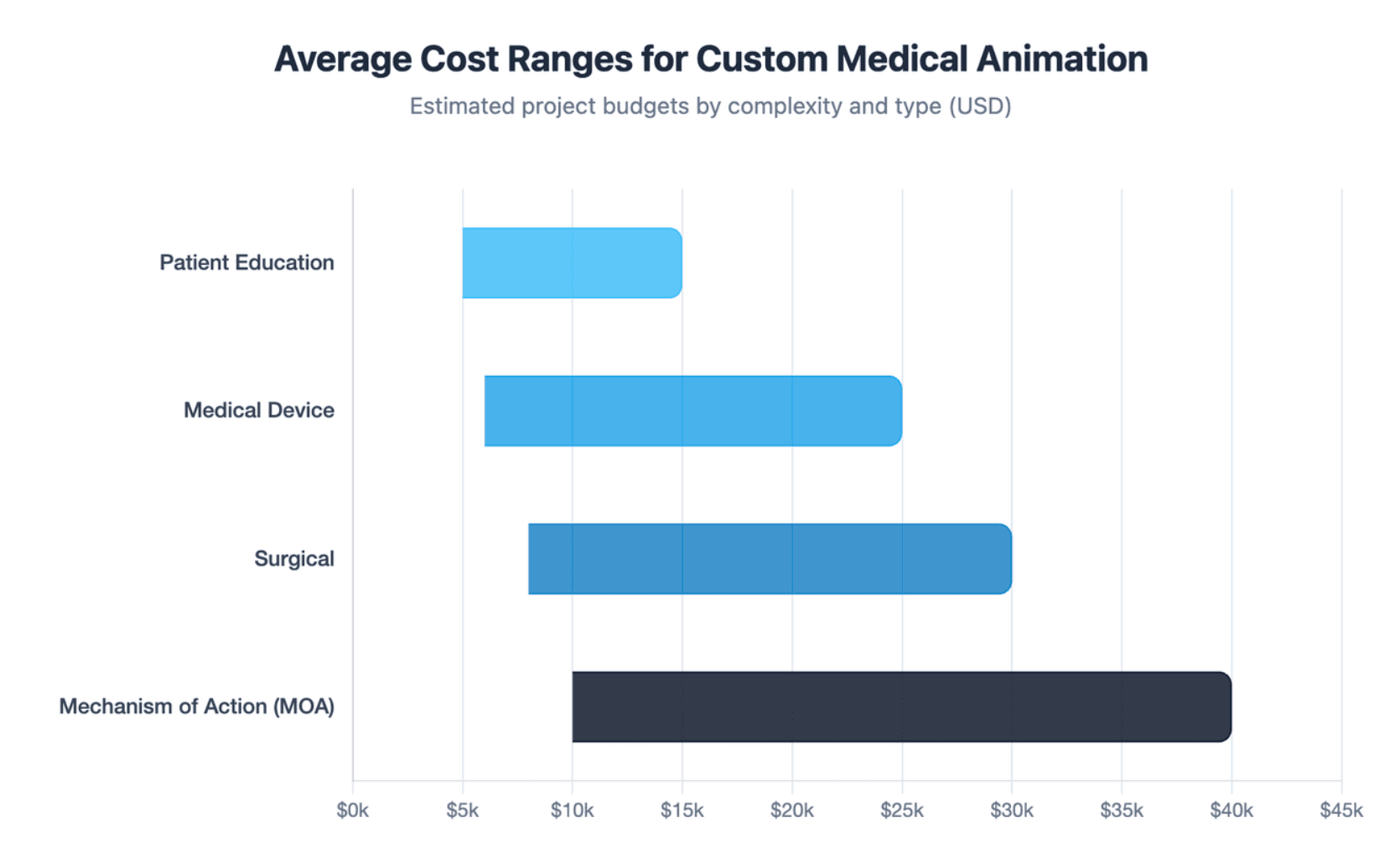
One specialist medical-animation company’s 2026 pricing guide lists approximately $5,000–$15,000 for patient-education animation, $6,000–$25,000 for medical-device visualization, $8,000–$30,000 for surgical animation, and $10,000–$40,000+ for mechanism-of-action animation. These are that supplier’s published ranges, not universal industry prices.
The same specialist states that many custom 3D projects take approximately four to ten weeks, with highly technical or review-heavy projects requiring longer.
AI platforms can shorten the assembly process for document-based content, but organizations should compare total video production cost rather than generation speed alone. Medical review, localization, accessibility, corrections, governance, and future updates remain part of the real budget.
AI Platforms vs. In-House Teams vs. Agencies vs. Medical Animation Studios
An AI video platform is often suitable for repeatable, presenter-led, document-based content. It offers speed, templates, localization, and easier updates but requires controlled sources and human review.
An in-house team offers strong institutional knowledge and control. It works best when the organization produces content frequently and has medical, creative, legal, and technical skills available.
A freelancer may be suitable for a clearly defined, lower-risk project with an approved script and limited visual complexity. Buyers must confirm medical experience, confidentiality practices, and revision capacity.
A general video agency can support strategy, storytelling, filming, animation, and campaigns. It may need external medical reviewers for specialist subjects.
A specialist medical-animation studio is the strongest option for detailed anatomy, devices, procedures, and molecular science. It usually requires a larger budget and a longer production cycle.
A hybrid workflow combines specialist assets with AI-assisted assembly, presenters, localization, and version control. This can be the most efficient model for organizations that need both scientific depth and content scale.
How to Choose the Right Medical Video Production Partner
A strong partner should be able to explain how it protects accuracy—not merely show attractive animation.
Ask prospective providers:
- Who reviews medical claims and visuals?
- Which source materials are required before production?
- How are script, storyboard, and animation approvals separated?
- Does the team understand patient, HCP, and regulatory audiences?
- Can it provide captions, transcripts, and audio-description support?
- How are localized versions medically reviewed?
- How does it handle confidential or patient-related information?
- Are source files and reusable assets included?
- How many revision rounds are included?
- Who owns future updates?
- Does the proposal separate mandatory corrections from creative changes?
- How is AI used and disclosed?
The portfolio should contain work similar to the planned subject. A studio experienced in healthcare branding is not automatically qualified to visualize a novel surgical device, just as a technical 3D studio may not be the best choice for an empathetic caregiver story.
Select the provider according to risk, complexity, audience, review needs, update frequency, and scale, not visual style alone.
How Do You Publish, Measure, and Maintain Medical Explainer Videos?
Medical Video SEO for Google, YouTube, and AI Search
Publish important videos on a dedicated page that contains a clear title, direct summary, transcript, sources, reviewer information, update date, and related questions. Implementing an optimized strategy helps your content rank better, especially when designing an AI video for SEO to capture modern search queries.
Google recommends making videos accessible to crawling and using video structured data to describe them. VideoObject, Clip, and SeekToAction markup can help Google understand video details and key moments, although structured data does not guarantee a search feature.
Useful optimization elements include:
- A descriptive title based on the main question
- A clear opening answer
- A readable transcript
- Chapters aligned with user questions
- A dedicated thumbnail
- Supporting page content
- Original sources
- Medical reviewer credentials
- Publication and review dates
- Multilingual titles, descriptions, and captions
YouTube uses health-source information panels and health-content shelves to help viewers recognize eligible authoritative sources. Medical organizations and licensed professionals should review whether they qualify for these features.
YouTube also restricts harmful medical misinformation that contradicts local health-authority guidance. Educational context does not provide permission to publish dangerous treatment or prevention claims.
Google states that people-first content is especially important for subjects that may affect health or safety, where strong E-E-A-T signals receive greater weight.
Measure Comprehension, Engagement, and Real-World Performance
Views and completion rates indicate exposure, not understanding.
Use separate measurement groups:
Reach and engagement
- Impressions
- Unique viewers
- Watch time
- Completion rate
- Replays
- Chapter use
- Click-through rate
Learning and comprehension
- Pre- and post-video questions
- Recall after a delay
- Teach-back responses
- Correct next-action selection
- Confidence compared with actual scores
Behavior and operations
- Correct device use
- Procedure-preparation completion
- Reduced repeated questions
- Fewer support contacts
- Training assessment scores
- Appointment or service conversion
Quality and safety
- Medical corrections
- Caption errors
- Localization errors
- Viewer misunderstandings
- Complaints
- Outdated-content reports
Research reviews suggest video interventions more consistently improve knowledge than disease severity, healthcare use, or other clinical outcomes. This is why the claim being measured must match what the video can reasonably influence.
Test the material with representative viewers whenever possible. A video that clinicians consider clear may still contain unexplained assumptions, excessive speed, or unfamiliar language for patients.
Keep Medical Videos Accurate With Version Control and Regular Updates
Medical videos should be managed as maintained information assets, not permanent creative files.
Every published video should have:
- A version number
- An approval date
- A named content owner
- A medical reviewer
- A source list
- A scheduled review date
- A record of localized versions
- A replacement or removal process
An immediate review may be required when a guideline, product label, safety warning, device instruction, treatment recommendation, contact pathway, or applicable regulation changes. It is vital to keep healthcare training videos updated to ensure ongoing accuracy and safety compliance across all operational branches.
Modular production makes updates easier. When the introduction, clinical explanation, warning, or call to action exists as a separate module, teams can replace the affected section instead of recreating the full video.
Version control should extend across every channel. Updating the website copy while leaving an outdated video on YouTube, a patient portal, a learning-management system, or a distributor’s page creates inconsistent information.
Platforms such as Leadde include version-management and centralized content capabilities that may support recurring updates, but the organization must still define who monitors medical changes and who approves each revised version.
Conclusion
A trusted medical explainer video combines approved evidence, audience-focused language, purposeful visuals, accessibility, and professional review. AI and document-to-video platforms can improve speed, localization, and scalability, while specialist animation remains essential for complex anatomy, procedures, devices, and mechanisms. Long-term value depends on measuring real understanding and maintaining every version as medical information changes.