Medical Marketing Video: 2026 Strategy, SEO, Compliance & AI Guide
A medical marketing video is a patient-focused video used by healthcare organizations to explain services, educate audiences, build trust, and support appointments or other business goals.
The most effective medical videos combine clear language, verified medical information, the right production format, strong accessibility, and a defined distribution strategy while protecting patient privacy and avoiding unsupported claims.
Yet producing accurate, consistent medical videos at scale can drain time, budgets, and internal resources.
[Leadde](- https://leadde.ai/) solves this by turning approved documents and text into professional business videos in minutes, helping teams cut production costs by over 80% and reduce content creation time by up to 90%.
[ ](- https://leadde.ai/)
Medical Marketing Video: What Is It and Why Does It Matter in 2026?
What Is a Medical Marketing Video?
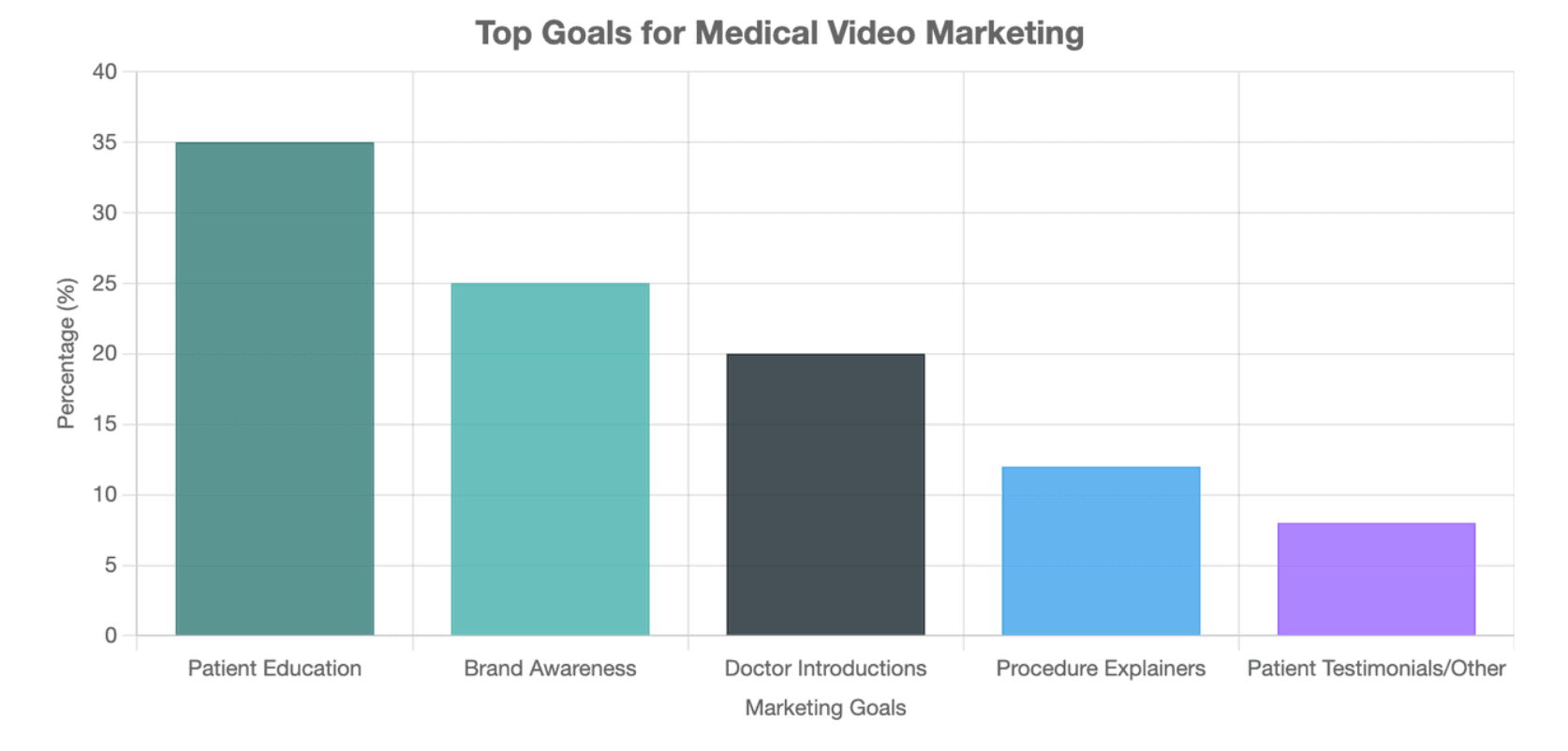
A medical marketing video is a patient-focused or professional-facing video used to explain healthcare services, educate an audience, build trust, support brand awareness, or guide viewers toward an appropriate next step.
It may promote a hospital, clinic, physician, medical device, health platform, treatment service, or public health message. However, not every medical video is an advertisement.
Common goals include:
- Explaining a condition or procedure
- Reducing anxiety before an appointment
- Demonstrating a medical product
- Supporting patient recruitment
- Improving internal training
- Encouraging an appointment or consultation
Medical video marketing differs from general consumer marketing because health information can affect a person’s safety, treatment decisions, privacy, and emotional well-being. Google classifies health-related content as a high-impact YMYL topic and gives particular importance to trust, expertise, authority, and clear authorship.
How Does Video Build Patient Trust and Simplify Medical Information?
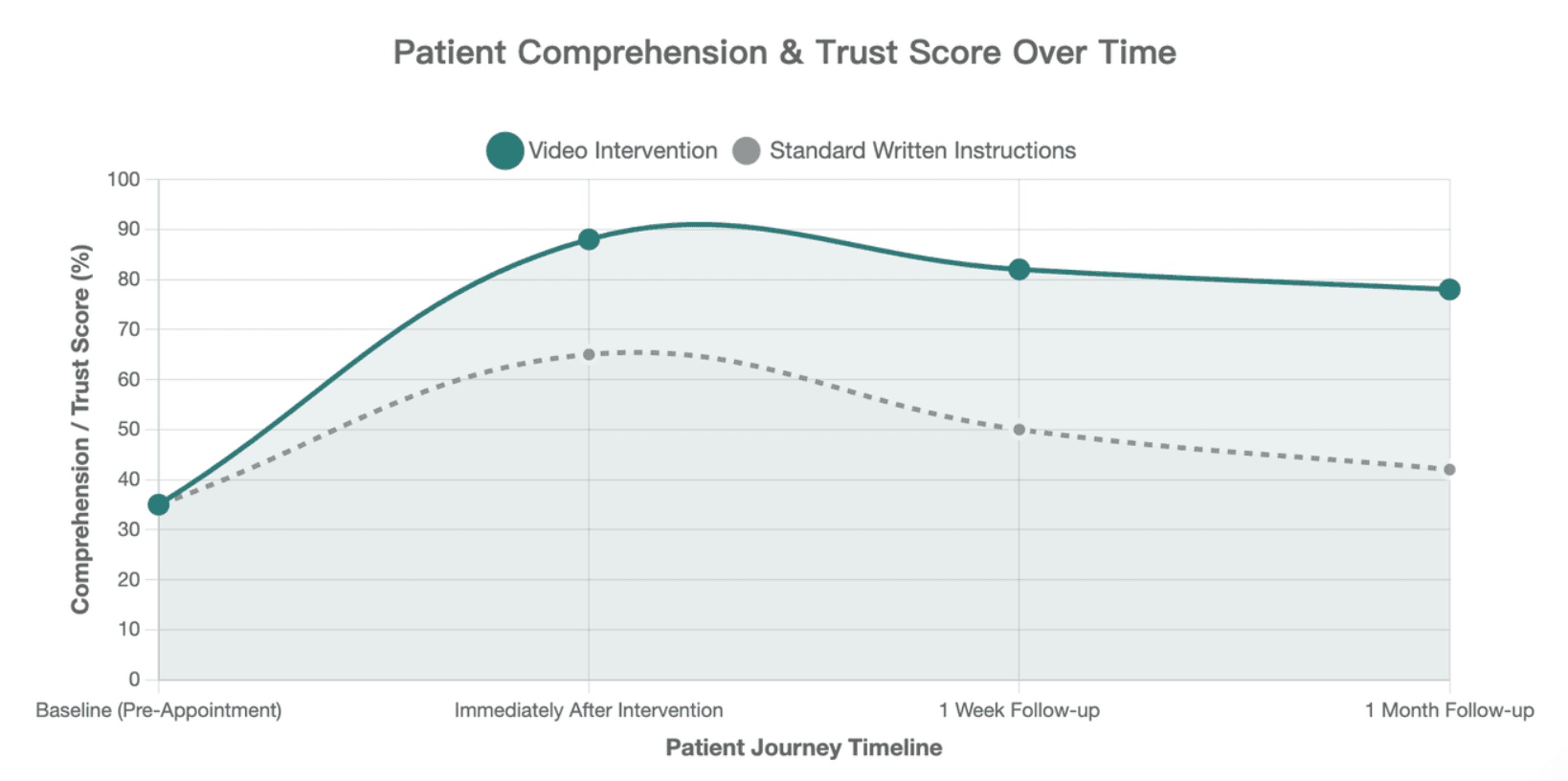
Healthcare decisions often involve unfamiliar terms, complex steps, and emotional stress. Video can combine spoken explanation, diagrams, demonstrations, captions, and human presentation to make information easier to follow.
Recent systematic reviews suggest that video and other visual health interventions can improve health-information comprehension and support patient education, although results still depend on content quality, accessibility, audience needs, and study design.
Trust can also improve when viewers can see and hear the clinician who may provide their care. A doctor-introduction video can show:
- How the doctor explains medical topics
- Whether the communication style feels clear
- What the first appointment may involve
- Which patients or conditions the doctor serves
- What the viewer should do next
The video should not rely on credentials alone. It should combine professional expertise with useful, patient-centered information.
Does Every Healthcare Organization Actually Need More Patient Demand?
Not every medical organization needs the same marketing outcome. A specialist who is already booked for several months may not benefit from generating a larger volume of poorly matched inquiries.
Before creating a campaign, the organization should ask:
- Is the practice accepting new patients?
- Which services have available capacity?
- Are current leads qualified?
- Are patients contacting the wrong department?
- Do staff repeatedly answer the same questions?
- Are no-shows or unprepared visits a larger problem than awareness?
In these cases, video may be more valuable as a qualification and communication tool than as a lead-generation tool. It can explain eligibility, referral requirements, expected timelines, appointment preparation, insurance processes, or available locations before a patient contacts the organization.
The best objective is not always “more views” or “more leads.” It may be better-informed patients, more suitable inquiries, fewer repeated questions, or a smoother care journey.
Which Types of Medical Marketing Videos Work Best?
Patient Education, Procedure Explainers, and FAQ Videos
Patient education videos answer practical questions in clear language. They can explain conditions, tests, preparation steps, treatment options, recovery instructions, and situations in which a patient should seek professional care.
Useful topics include:
- What happens during the first appointment?
- How should a patient prepare for a procedure?
- What are the possible treatment paths?
- What should a patient expect during recovery?
- Which symptoms require urgent attention?
- What questions should the patient ask the clinician?
Procedure explainers are especially useful when the process is hard to understand through text alone. Animation, diagrams, and step-by-step scenes can clarify anatomy and workflows without showing graphic clinical footage.
These videos must avoid turning general education into an individual diagnosis. They should state the intended audience, identify the qualified reviewer, and direct viewers to suitable medical care when individual assessment is required.
Doctor Profiles, Practice Welcome Videos, and Patient Stories
A doctor profile should do more than repeat a résumé. It should help a potential patient understand the doctor’s specialty, approach, communication style, and expectations for the first visit.
A strong profile may answer one focused question, such as:
- What do you wish every patient knew?
- What should patients expect at their first visit?
- What is a common misunderstanding about this condition?
- How do you help patients compare treatment options?
Practice welcome videos can also reduce uncertainty by showing the reception area, care team, facility, consultation process, and practical arrival instructions.
Patient stories provide strong social proof, but they carry greater privacy and advertising risk. In the United States, uses or disclosures of protected health information for marketing generally require valid individual authorization, subject to limited exceptions.
The story must also remain honest. A genuine patient experience cannot be edited into an unsupported promise that every patient will obtain the same medical result.
Brand Campaigns, Medical Product Demos, and Short-Form Social Videos
Healthcare brand campaigns communicate an organization’s purpose, values, community role, or care philosophy. They are useful when patients must understand why the organization is different before evaluating a specific service.
Medical product and device demonstrations are more practical. They may show:
- How a device works
- Who it is intended for
- How professionals use the interface
- Which workflow problem it addresses
- What training or support is available
- What limitations users should understand
Product videos should carefully separate demonstrated functions from medical outcome claims. The FTC requires health-related claims to be truthful, not misleading, and supported by appropriate scientific evidence. Both explicit statements and the overall implied message of the video matter.
Short-form videos work best when each clip addresses one narrow question. A short video can introduce the answer, while a longer article, service page, or full video provides the evidence, limitations, and next steps.
| Video type | Primary purpose | Suitable format |
| Patient explainer | Education | Doctor, animation, or hybrid |
| Provider profile | Trust | Real clinician on camera |
| Practice welcome | Reduce uncertainty | Live action |
| Patient story | Social proof | Authorized live-action interview |
| Device demo | Product education | Screen recording or live demonstration |
| Brand campaign | Awareness | Live action or cinematic storytelling |
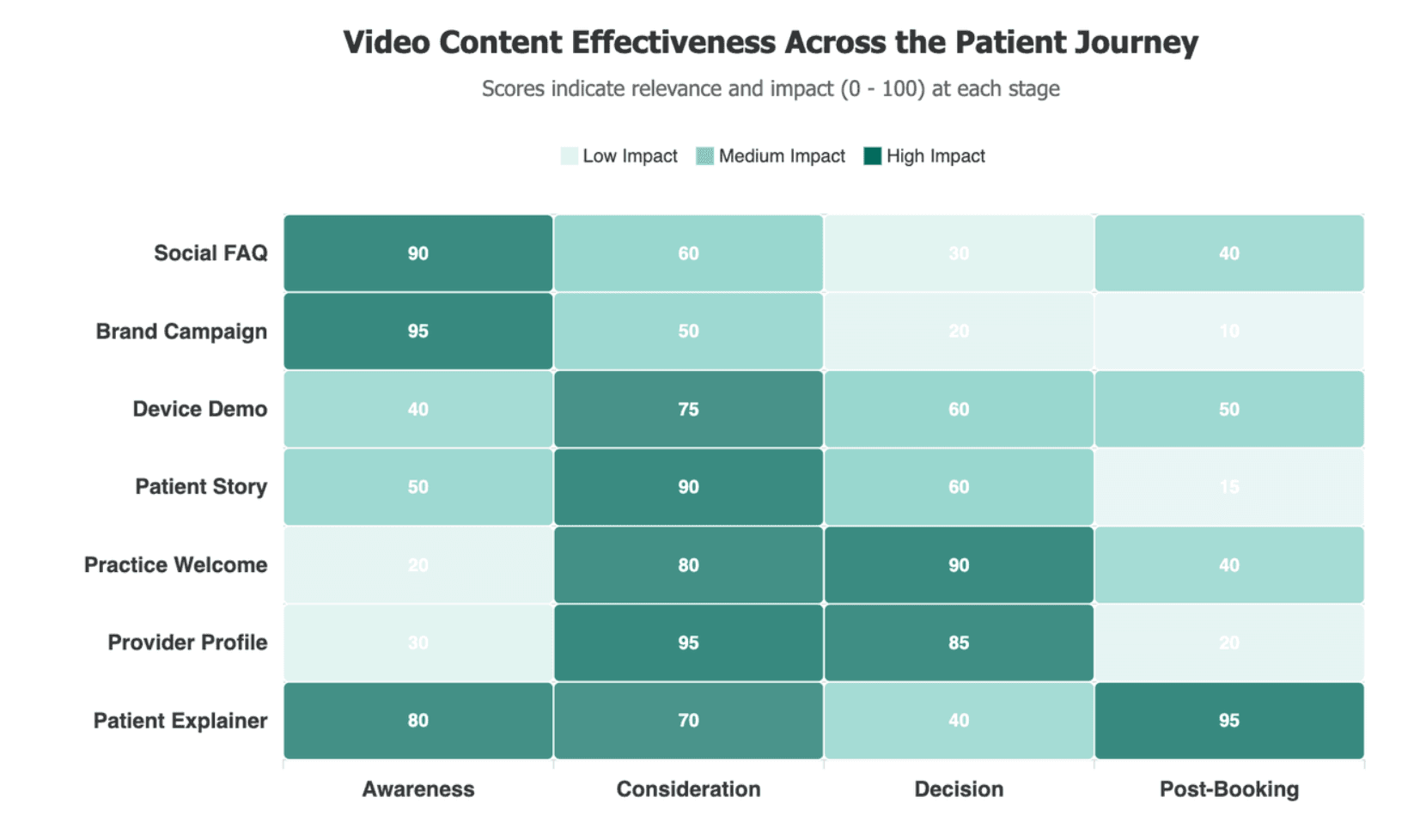
| Social FAQ | Reach and education | Vertical short video |
How Do You Choose the Right Video for the Patient Journey?
Match the Video to Awareness, Consideration, and Appointment Intent
Different patients need different information depending on where they are in the decision process.
At the awareness stage, users may not understand the cause of a symptom or know which type of provider can help. Educational videos, myth-versus-fact clips, and public health content are appropriate.
At the consideration stage, users compare doctors, locations, treatment approaches, and practical details. Provider profiles, facility tours, treatment explainers, and patient stories can reduce uncertainty.
At the decision stage, users need direct operational information:
- How to book
- Whether a referral is needed
- What insurance is accepted
- Which location provides the service
- What to bring
- What happens next
After booking, preparation and recovery videos can support continuity. However, they should complement—not replace—individual instructions from the treating professional.
Choose One Audience, One Patient Question, and One Call to Action
A video becomes confusing when it tries to address patients, caregivers, clinicians, purchasers, and investors at the same time.
Before scripting, define:
- One audience
- One main problem
- One primary question
- One intended action
For example, a video for patients preparing for a colonoscopy should not also serve as a hospital brand commercial, a physician recruitment video, and a medical-device sales presentation.
The call to action should match the viewer’s readiness. Appropriate CTAs may include:
- Read the full patient guide
- Review preparation instructions
- Find a qualified provider
- Request a professional demonstration
- Contact the correct department
- Book an assessment
- Seek urgent medical assistance
A marketing CTA should never imply that watching the video establishes a diagnosis or confirms that the viewer is eligible for a treatment.
Use Real Patient Questions, Search Data, and Community Discussions to Find Topics
The strongest healthcare topics often come from real communication problems rather than creative brainstorming.
Useful topic sources include:
- Questions received by front-desk staff
- Search queries in analytics tools
- Internal site-search terms
- Call-center notes
- Patient surveys
- Comments on existing videos
- Questions submitted during webinars
- Reviews describing uncertainty or friction
- Public discussions on Reddit, Quora, and patient communities
Community questions can reveal language that patients naturally use. However, those discussions should be treated as research input, not as verified medical evidence.
After collecting ideas, rank each topic by:
- Audience demand
- Medical importance
- Business relevance
- Production difficulty
- Regulatory risk
- Update frequency
Google recommends creating people-first content for an existing or intended audience rather than producing content primarily to manipulate rankings.
How Do You Plan and Produce a High-Trust Medical Marketing Video?
Build the Script From Approved Medical Sources
A safe production process should begin with an approved evidence pack, not a blank generative-AI prompt.
Possible source materials include:
- Official clinical guidelines
- Approved product labeling
- Government health resources
- Peer-reviewed research
- Hospital policies
- Patient handouts
- Approved service pages
- Medical-device instructions
- Internal compliance documents
Each important statement should be recorded in a simple claims matrix:
| Script statement | Source | Claim type | Risk level | Reviewer |
| Condition definition | Clinical guideline | Educational | Low | Medical |
| Treatment benefit | Clinical evidence | Efficacy | High | Medical and legal |
| Safety statement | Approved labeling | Safety | High | Regulatory |
| Patient result | Authorized experience | Testimonial | High | Legal |
| Product comparison | Direct evidence | Comparative | Very high | Medical and legal |
Health claims require evidence that matches the actual product, population, outcome, and conditions described in the advertisement. A weak study or unrelated result should not be stretched to support a stronger marketing promise.
Structure the Video Around the Problem, Answer, Evidence, and Next Step
A clear medical video does not need a long corporate introduction. It should provide useful information early.
A practical structure is:
- The patient problem State the question or situation in familiar language.
- The direct answer Give a short, accurate response without making an individual diagnosis.
- The explanation Describe causes, options, steps, or considerations.
- The evidence and limitations Explain what is known, what varies, and what requires professional assessment.
- The next step Direct the viewer to appropriate information, care, or support.
- The source and review information Identify the speaker, medical reviewer, publication date, and relevant sources.
Use short sentences and explain medical terminology when it first appears. A patient should not need professional training to understand the main message.
The script should also make uncertainty visible. Phrases such as “may,” “can,” “for some patients,” and “depends on an individual assessment” are appropriate when they accurately reflect the evidence.
Choose Between Live Action, Animation, Smartphone Video, AI Avatars, and Hybrid Production
The correct production format depends on trust, complexity, speed, budget, and update frequency.
| Script statement | Source | Claim type | Risk level | Reviewer |
| Condition definition | Clinical guideline | Educational | Low | Medical |
| Treatment benefit | Clinical evidence | Efficacy | High | Medical and legal |
| Safety statement | Approved labeling | Safety | High | Regulatory |
| Patient result | Authorized experience | Testimonial | High | Legal |
| Product comparison | Direct evidence | Comparative | Very high | Medical and legal |
| AI avatar | Standardized, multilingual updates | Speed and scale | Requires disclosure and review | |
| Hybrid | Education plus trust | Flexible | More workflow complexity |
AI presenters can support standardized explainers, internal training, multilingual drafts, and frequently updated content. They should not impersonate a real clinician or fabricate a patient experience.
A real doctor is usually the stronger choice when the purpose depends on personal trust, clinical judgment, sensitive reassurance, or the clinician’s individual reputation.
How Can Healthcare Organizations Scale Medical Video Production?
Turn Approved PDFs, PowerPoint Files, Word Documents, and Text Into Videos
Healthcare organizations already own large amounts of approved content, including patient guides, training decks, service descriptions, procedure instructions, policies, and product documentation.
A document-to-video workflow can convert these materials into:
- Patient explainers
- Training videos
- Frequently asked questions
- Product walkthroughs
- Multilingual instructions
- Internal policy updates
- Provider education
Leadde supports the conversion of PowerPoint files, PDFs, Word documents, scripts, and text into structured video presentations. Its workflow can generate outlines, scenes, voice-over scripts, and visual layouts, while allowing the user to edit the content before final generation.
The practical benefit is not simply faster generation. Starting with an approved source can reduce the risk of inventing unsupported medical information.
Create a Source-Controlled Workflow for Script, Medical Review, and Version Updates
Automation should sit inside a controlled approval process.
A suitable workflow is:
Approved source → Generated outline → Script editing → Medical review → Legal or compliance review → Video generation → Caption and visual QA → Publication → Scheduled review
Leadde’s documented workflow allows users to import content, define language, tone, audience, and learning objectives, review the generated outline, choose a template and presenter, edit scenes and scripts, preview the video, and then generate the final version.
For medical use, teams should also retain:
- The source-document version
- The approved script
- Reviewer names
- Approval dates
- Consent records
- Language versions
- Published URLs
- Next review date
- Retirement history
A change to a clinical guideline, drug label, service policy, location, or treatment protocol should trigger a content review.
Repurpose One Video Across Websites, YouTube, Social Media, Ads, and Patient Communication
Scaling does not mean publishing the identical file everywhere. It means creating a reusable source asset and adapting it for each channel.
One approved long-form video can become:
- A website explainer
- A YouTube video
- Several vertical clips
- A provider-profile video
- A paid-ad variation
- An email asset
- A waiting-room video
- A transcript-based article
- A multilingual version
- A patient-preparation resource
Each version needs a different opening, length, framing, and CTA.
For example:
- Website: detailed answer and clear next step
- YouTube: searchable title, chapters, and supporting description
- Short-form social: one question and one concise answer
- Paid advertising: direct problem, eligibility-safe message, and matching landing page
- Email: practical information for an existing patient relationship
Repurposing should preserve the approved medical meaning. Shortening a clip must not remove a limitation or risk statement in a way that changes the overall message.
How Do You Optimize Medical Videos for Search, Distribution, and AI Visibility?
Optimize Titles, Descriptions, Thumbnails, Captions, Transcripts, and Watch Pages
Google recommends creating a dedicated watch page for important videos, making the video prominent, using stable and crawlable URLs, providing suitable thumbnails, and adding relevant supporting text.
A strong watch page should include:
- A clear page title
- The embedded video near the main content
- A concise direct answer
- An accurate HTML transcript
- Speaker and reviewer credentials
- Supporting medical sources
- Publication and review dates
- Relevant internal links
- An appropriate CTA
VideoObject structured data can help Google understand the video, but the markup must reflect visible page content and should be placed on a page where users can actually watch the video. Structured data does not guarantee a rich result.
For large video libraries, a video sitemap can help Google discover video pages and associated metadata.
Connect Videos With Service Pages, Provider Profiles, Local Search, and Paid Campaigns
Video works best when it supports an existing decision page.
Examples include:
- A knee-treatment explainer on the knee-treatment page
- A surgeon introduction on the surgeon’s profile
- A facility tour on a location page
- A software demonstration on a product page
- A preparation video in an appointment-confirmation email
The video, advertisement, and landing page should address the same need. A user who clicks an advertisement for one procedure should not arrive on a generic homepage with no clear path to that service.
Healthcare advertisers must also review current platform rules before launching paid distribution. Google restricts or prohibits some healthcare content, requires certification in certain categories and locations, and applies special rules to healthcare and medicine advertising.
Health is also treated as a sensitive interest category. Advertisers cannot freely use audience data that may reveal conditions, procedures, disabilities, or other sensitive health information for personalized targeting.
Structure Clear Answers, Sources, Reviewer Details, and Chapters for AI Search
No structure can guarantee inclusion in an AI-generated answer. However, clear organization makes the content easier for users and machines to interpret.
Helpful practices include:
- Answer one main question on each page
- Provide a direct answer near the beginning
- Use descriptive H2 and H3 headings
- Define medical terms clearly
- Keep each section focused
- Provide an HTML transcript
- Identify the author, speaker, and medical reviewer
- Cite sources beside the relevant claim
- Show publication and review dates
- Use chapters that map to specific questions
- Include limitations and eligibility conditions
Google specifically recommends making it clear who created content, how it was produced, and why it exists. This is especially important for health-related YMYL content.
A clear answer should not remove necessary nuance merely to sound quotable. Medical content becomes more trustworthy when it explains both the useful conclusion and the boundaries of that conclusion.
What Compliance, Accessibility, and Measurement Rules Should You Follow?
Protect Patient Privacy and Review Medical, Testimonial, and Treatment Claims
Medical marketing videos must be reviewed at both the sentence level and the overall-impression level.
In the United States, covered entities generally need valid authorization to use or disclose protected health information for marketing, subject to limited exceptions. A patient’s decision to discuss a condition publicly does not automatically authorize a healthcare organization to reuse that information in its own marketing.
Before filming, control the environment for possible privacy exposure:
- Patient faces and voices
- Names on doors or screens
- Medical charts
- Appointment schedules
- Computer monitors
- Whiteboards
- Wristbands
- Background conversations
- Diagnostic images
Testimonials must be truthful and not misleading. The FTC warns that an unrepresentative testimonial can mislead viewers when it is not accompanied by information about the results consumers can generally expect. Material connections, including payment or incentives, should also be disclosed.
Prescription-drug promotion can carry additional requirements. FDA rules require major risk information in applicable direct-to-consumer broadcast advertising to be presented in a clear, conspicuous, and neutral manner.
YouTube also prohibits certain harmful medical misinformation that contradicts local health-authority guidance. Educational context may be considered, but a general disclaimer does not protect content that promotes harmful or unsupported treatment claims.
Add Captions, Transcripts, Plain Language, and Multilingual Medical Review
Accessibility should be planned before production rather than added at the end.
WCAG 2.2 requires captions for prerecorded audio in synchronized media, subject to its stated exception. Captions should include both speech and meaningful non-speech audio needed to understand the content.
Videos may also need:
- An accurate transcript
- Speaker identification
- Audio description or a media alternative
- Readable font sizes
- Strong color contrast
- Sufficient display time for text
- Playback controls
- Clear visual hierarchy
- Narration of essential visual information
W3C guidance explains that transcripts and descriptions can make information available to people who cannot access the audio or visual content directly.
Multilingual medical video requires more than direct translation. Each version should be checked for:
- Medical terminology
- Cultural meaning
- Local care pathways
- Local advertising rules
- On-screen text timing
- Subtitle reading speed
- Voice-over accuracy
- Emergency instructions
- Reviewer qualifications
A native-language medical reviewer may be necessary when mistranslation could change a diagnosis, risk, dosage, procedure, or safety instruction.
Measure Qualified Appointments, Patient Understanding, Operational Value, and Content Accuracy
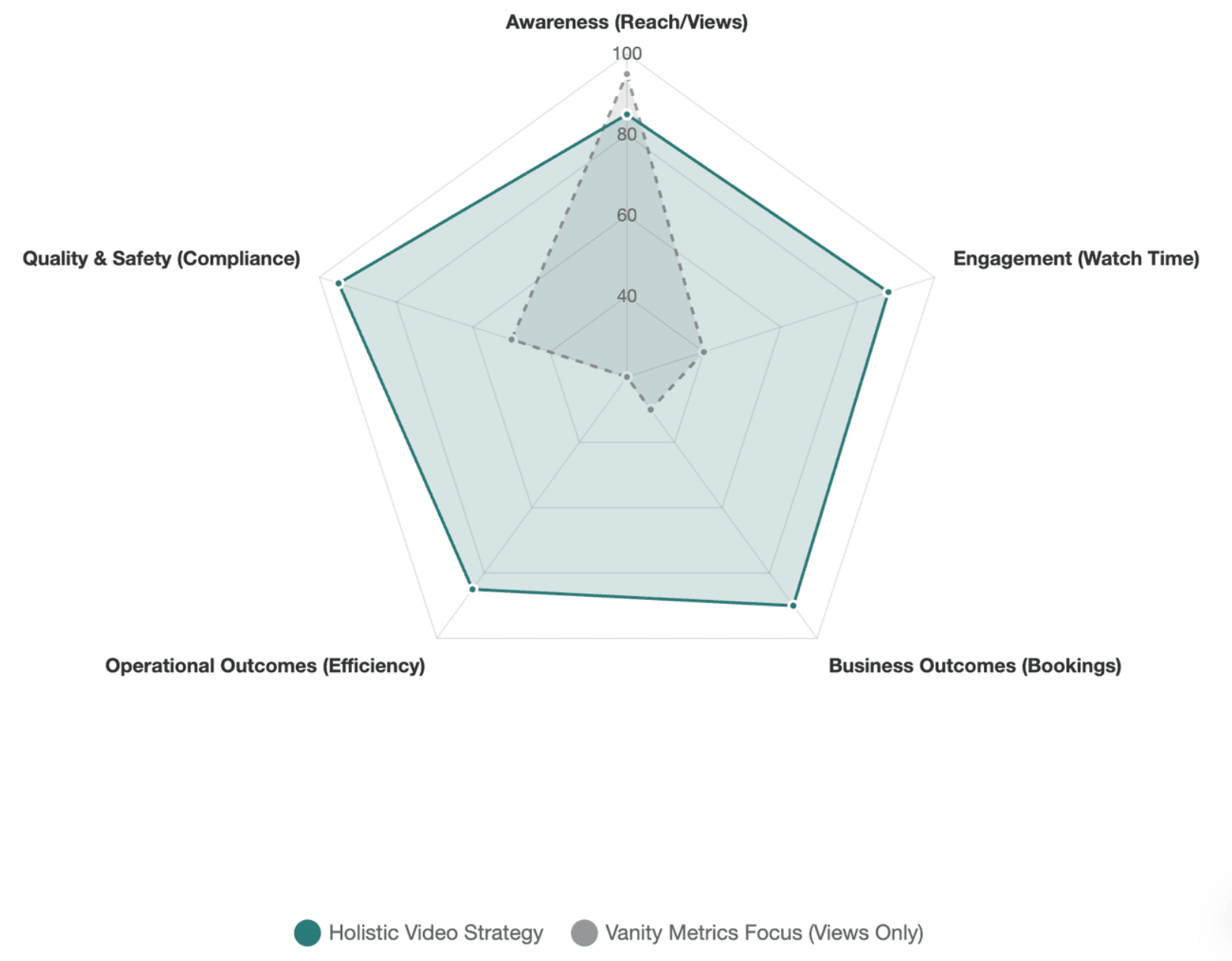
Views and follower counts are not enough to judge a medical video program.
A balanced measurement system should include:
Awareness
- Qualified reach
- Search impressions
- Brand searches
- Relevant watch-page visits
Engagement
- Watch time
- Completion rate
- Chapter usage
- Transcript interaction
- Saves and shares
Business outcomes
- Qualified calls
- Appointment starts
- Completed bookings
- Provider-demo requests
- Cost per qualified action
Patient and operational outcomes
- Understanding of preparation steps
- Reduction in repeated questions
- Better appointment readiness
- Correct routing to services
- Staff time saved
Quality and safety
- Medical corrections
- Expired-source alerts
- Accessibility defects
- Consent issues
- Platform rejections
- Outdated videos removed or updated
Tracking should be designed with privacy in mind. HHS has issued guidance on online tracking technologies used by regulated entities, making it important to review what website and advertising tools collect from health-related pages.
The final measure of success should match the original objective. An educational video may be successful because patients understand a procedure better, even when it produces no immediate appointment.
Conclusion
A successful medical marketing video begins with a real audience need, uses approved medical sources, communicates one clear answer, and selects a format that matches the required level of trust and complexity. Healthcare organizations should combine medical review, privacy protection, accessibility, search optimization, and measurable outcomes while building a production system that can be updated and reused instead of treating every video as a one-time campaign.