AI in Education (2026): 12 Ways Schools Use AI Video, Avatars & Automation
AI in education is transforming how schools teach, create learning materials, and manage everyday tasks. From personalized learning and AI tutors to educational videos, AI avatars, and automated assessments, educators can reduce workloads while creating more accessible learning experiences.
Tools like Leadde enable teachers to turn PDFs, PowerPoint presentations, and existing course materials into structured, multilingual educational videos without traditional filming.
This guide explores 12 practical ways schools use AI in 2026, their benefits and risks, and how educators can integrate AI into teaching without compromising learning quality or independent thinking.
AI in Education: What Is It and How Does It Work?
AI in education refers to the use of artificial intelligence technologies to support teaching, learning, assessment, educational content creation, and school administration. It enables educators to automate repetitive tasks, personalize learning experiences, develop digital resources, and identify learning gaps while maintaining human oversight of important educational decisions.
The Main Types of AI Used in Education
Different AI technologies serve different educational purposes.
| AI Technology | Educational Application |
| Generative AI | Creating lesson plans, educational videos, quizzes, and learning materials |
| Machine Learning | Identifying learning patterns and knowledge gaps |
| Natural Language Processing (NLP) | Language learning, writing feedback, and AI tutoring |
| Adaptive Learning Systems | Adjusting learning difficulty based on student performance |
| Multimodal AI | Processing and generating text, images, audio, and video |
Traditional educational AI primarily analyzes information and recommends learning activities, while generative AI creates new educational content from existing knowledge.
How Is AI Being Used in Education Today?
AI adoption is growing across K–12 schools, universities, online learning platforms, and professional education.
According to RAND's 2025 education report, AI use among American teachers and students has increased rapidly, while school policies and AI training have struggled to keep pace.
This highlights an important distinction: adopting AI tools is not the same as integrating AI effectively into education. Schools also need appropriate teaching strategies, teacher training, and responsible usage guidelines.
What Are the Benefits of AI in Education?
AI can improve educational accessibility, reduce repetitive work, and help teachers deliver learning resources that address different student needs.
Personalized Learning and Student Engagement
AI-powered learning systems can identify knowledge gaps, recommend relevant exercises, and adjust content difficulty based on student performance.
Teachers can also generate simplified explanations, visual learning materials, and additional practice resources for students who need extra support.
However, personalized content alone does not constitute adaptive learning. Effective adaptation requires continuous feedback about student understanding.
Reduced Teacher Workload and Faster Feedback
Teachers can use AI to draft lesson plans, create assessments, summarize materials, and provide preliminary feedback.
A randomized trial published by the Education Endowment Foundation in 2024 found that secondary school teachers using ChatGPT with implementation guidance reduced lesson preparation time by 31%.
The actual efficiency gain, however, depends on the entire workflow, including content preparation, fact-checking, editing, and approval—not just generation speed.
Greater Accessibility and Scalable Learning Resources
AI helps educators produce multilingual videos, subtitles, alternative explanations, and accessible digital learning materials.
Instead of recording the same lesson multiple times, teachers can reuse existing course documents to develop learning resources for different languages, educational levels, and learning environments.
This is particularly valuable for international schools, universities, and online education providers maintaining large course libraries.
12 Real-World Examples of AI in Education
Schools can use AI across the entire educational lifecycle, from lesson preparation and classroom instruction to assessment and administrative management.
AI Tutoring and Adaptive Learning
AI-powered tutoring
AI tutors such as Khanmigo and ChatGPT Study Mode guide students through complex problems using questions, explanations, and step-by-step assistance rather than simply providing answers.
Personalized learning paths
Adaptive learning platforms analyze student performance and recommend exercises based on individual knowledge gaps, helping students progress at their own pace.
Language learning
AI supports pronunciation practice, conversational simulations, grammar correction, and personalized language exercises.
Lesson Planning and Curriculum Development
AI-generated lesson plans
Teachers can use generative AI to develop lesson objectives, classroom activities, discussion questions, and differentiated teaching materials.
Curriculum development
AI helps educators organize course content, identify overlapping topics, and generate supplementary resources aligned with curriculum requirements.
Interactive learning resources
Tools such as NotebookLM can transform existing educational documents into study guides, audio summaries, and video overviews.
AI Educational Videos and Digital Learning Content
- Document-to-video conversion Platforms like Leadde transform PDFs, PowerPoint presentations, and course documents into structured educational videos with AI-generated scripts, narration, and visual scenes.
- AI avatar teachers AI avatars can present course introductions, explain concepts, and deliver standardized learning content without requiring teachers to record every lesson.
- Multilingual educational videos Educators can create localized versions of learning videos to support international students and multilingual classrooms without repeating the entire filming process.
Automated Assessment and School Administration
AI-assisted grading
Platforms such as Gradescope help educators group similar answers and streamline grading while maintaining teacher oversight.
Learning analytics
AI-enabled analytics can help teachers identify learning gaps, monitor progress, and recognize students who may require additional support.
Administrative automation
Schools can use AI to draft announcements, summarize meetings, prepare reports, and organize internal knowledge resources.
| AI Tool | Best For |
| Leadde | Document-to-video and educational video creation |
| ChatGPT | AI tutoring and teaching assistance |
| Khanmigo | Guided student learning |
| NotebookLM | Document-based learning resources |
| Gradescope | AI-assisted grading |
| MagicSchool | Lesson planning and teacher productivity |
How Can Teachers Use AI to Create Better Learning Materials?
One of the most practical applications of generative AI in education is transforming existing knowledge into accessible, reusable learning resources.
Rather than starting every lesson from scratch, educators can build on approved teaching materials to create videos, exercises, and supplementary explanations.
Turning PDFs and Presentations into Educational Videos
Traditional educational video production requires scripting, recording, editing, and localization. These requirements make it difficult for educators to maintain extensive video libraries.
Leadde offers a document-to-video workflow that transforms existing teaching materials into structured, multilingual videos with AI narration and avatars.
For example, a biology teacher could convert a PDF about photosynthesis into a video covering:
- The basic concept of photosynthesis.
- The function of chlorophyll.
- The conversion of light energy.
- The relationship between carbon dioxide, water, and oxygen.
The objective is not simply to make an AI avatar read the textbook aloud, but to organize complex information into a coherent visual explanation.
A Practical AI-Powered Educational Content Workflow
Educators can follow a five-stage workflow to turn AI-generated resources into meaningful learning experiences.
THE AI-TO-LEARNING FRAMEWORK
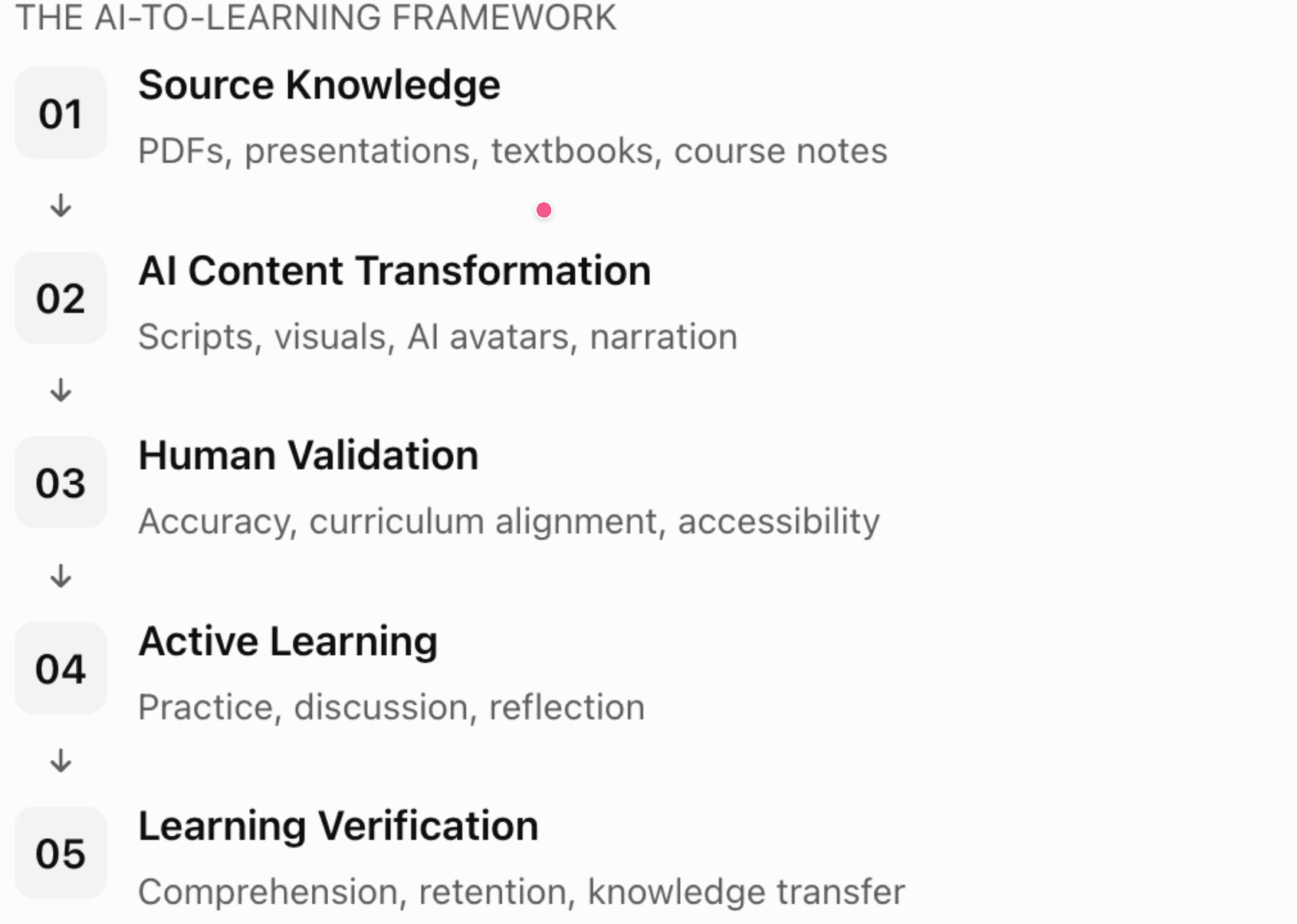
From an instructional design perspective, maintaining a reliable source document also makes future content updates easier. When a curriculum changes, educators can revise the source material and regenerate affected learning resources instead of recording an entire lesson again.
Does AI-Generated Content Actually Improve Learning Outcomes?
A 2025 study published in Computers & Education involving 447 participants found comparable learning outcomes between AI-generated and human-made teaching videos in the experiment, although participants rated human-made videos more positively.
However, the educational value of AI-generated videos depends on content accuracy, instructional design, and active student participation.
The OECD Digital Education Outlook 2026 also emphasizes that completing tasks successfully with generative AI does not automatically produce genuine learning gains.
Educators should therefore evaluate AI-generated learning materials through comprehension tests, delayed recall, and independent problem-solving.
AI creates learning resources. Instructional design turns them into learning experiences.
What Are the Challenges and Risks of AI in Education?
Despite its advantages, artificial intelligence in education introduces challenges that require careful management.
Academic Integrity, Critical Thinking, and AI Dependency
Students may become overly dependent on AI-generated answers, reducing opportunities to practice independent reasoning.
Teachers can address this by incorporating classroom discussions, oral explanations, practical assignments, and assessments that require students to demonstrate understanding without AI assistance.
Content Accuracy, Algorithmic Bias, and Data Privacy
AI-generated educational materials may contain inaccurate information, biased representations, or misleading explanations.
Schools should establish human review procedures, verify content against reliable sources, respect copyright, and avoid uploading sensitive student information to unauthorized AI platforms.
UNESCO's guidance on generative AI in education emphasizes privacy protection, age-appropriate usage, and human oversight.
Digital Inequality and Teacher Readiness
Not every school has equal access to AI tools, reliable internet connectivity, or teacher training.
RAND's 2025 research highlights the growing gap between AI adoption and institutional guidance. Schools must invest in professional development and ensure that technology does not create additional barriers to education.
| Risk | Recommended Solution |
| Academic dishonesty | Redesign assessments |
| AI dependency | Encourage independent problem-solving |
| Inaccurate content | Require teacher verification |
| Data privacy | Use institution-approved tools |
| Digital inequality | Provide alternative learning resources |
| Limited teacher expertise | Offer ongoing AI training |
How Can Educators Use AI Responsibly and Prepare for the Future?
Successful AI integration begins with educational objectives rather than technology adoption.
When Should Teachers Use AI—and When Should They Not?
Different educational tasks require different levels of human involvement.
| AI Participation | Suitable Tasks |
| AI Automation | Transcription, formatting, preliminary subtitles |
| AI-Assisted | Lesson planning, educational videos, preliminary feedback |
| Human-Led | Final grading, emotional support, teaching decisions |
| AI-Restricted | Independent assessments and examinations |
AI should handle repetitive production tasks while educators retain responsibility for teaching quality, student development, and important academic decisions.
A Practical Framework for Implementing AI in Education
Schools can adopt AI through five practical steps:
- Define learning objectives: Identify the educational problem that needs solving.
- Select appropriate tools: Match AI capabilities with actual teaching requirements.
- Pilot and review: Test AI-generated resources before wider deployment.
- Establish policies: Create guidelines for privacy, academic integrity, and teacher oversight.
- Measure outcomes: Evaluate workload, content quality, student comprehension, and independent learning.
This approach reflects Oxford University Press's principle that educational needs should guide technological adoption.
The Future of AI in Education: Human-Centered Learning
The future of education is likely to involve greater collaboration between teachers, students, and multimodal AI systems.
The concept of Education 5.0 emphasizes combining technological innovation with human development, social learning, and lifelong education.
AI-powered educational videos, intelligent tutoring systems, multilingual learning resources, and adaptive platforms will increasingly support this approach.
However, the teacher's role in developing critical thinking, creativity, and meaningful human connections remains essential.
Conclusion
AI in education offers practical opportunities to personalize learning, reduce teacher workloads, and scale educational content. Tools like Leadde make it easier to transform existing teaching materials into structured educational videos, while AI tutors and automation support other learning needs. Ultimately, successful AI integration depends on thoughtful instructional design, responsible implementation, and measurable learning outcomes—not simply the amount of content AI can generate.