Blended Learning Guide (2026): How to Create the Video Component with AI
Blended learning combines online learning with face-to-face instruction, giving learners greater flexibility while maintaining meaningful interaction with instructors. However, creating engaging video content for the online component can be time-consuming and resource-intensive.
With Leadde, educators and training teams can turn teaching materials into AI-powered learning videos from PDFs, presentations, and training documents without traditional filming.
This guide explores blended learning models, benefits, real-world examples, and practical strategies for using AI for training and learning videos.
Blended Learning: What Is It and How Does It Work?
Blended learning is an instructional approach that integrates online learning with face-to-face instruction. Learners acquire knowledge through digital resources, such as videos, readings, and online exercises, while participating in instructor-led discussions, collaborative activities, and hands-on practice to deepen their understanding and develop practical skills.
The Core Components of Blended Learning
An effective blended learning program typically includes four components:
- Self-paced learning: Recorded videos, digital textbooks, and online courses.
- Instructor-led learning: Classroom instruction, workshops, and guided discussions.
- Active learning: Group projects, simulations, and practical exercises.
- Assessment and feedback: Quizzes, assignments, and performance evaluations.
These components should work together toward shared learning objectives rather than operate as separate activities.
Blended Learning vs. Hybrid Learning vs. E-Learning
Although these terms are sometimes used interchangeably, they differ in how learning is organized.
| Learning Method | Delivery Approach | Key Feature |
| Blended Learning | Online and face-to-face | Integrated learning activities |
| Hybrid Learning | Physical and remote participation | Flexible attendance |
| E-Learning | Primarily online | Digital content delivery |
| Traditional Learning | Primarily in-person | Instructor-led instruction |
How Online and Face-to-Face Learning Work Together
In a well-designed blended learning program, online resources introduce foundational knowledge, while classroom sessions focus on applying that knowledge.
For example, employees can watch a safety training video before attending an instructor-led workshop where they practice procedures and receive feedback.
This approach gives instructors more time to address misunderstandings and develop practical skills instead of repeatedly delivering the same information.
What Are the 7 Models of Blended Learning?
The Christensen Institute identifies four main categories of blended learning: Rotation, Flex, A La Carte, and Enriched Virtual. The Rotation category contains four sub-models, resulting in seven commonly recognized models.
Christensen Institute
Rotation Models
| Model | How It Works | Best For |
| Station Rotation | Learners rotate between online activities, group work, and teacher-led instruction. | Classroom learning |
| Lab Rotation | Learners complete digital activities in a dedicated computer lab. | Schools with shared technology |
| Flipped Classroom | Learners study instructional content before class and practice during class. | Education and employee training |
| Individual Rotation | Learners follow customized schedules based on their learning needs. | Differentiated instruction |
| Poor learning continuity | Connect online activities with classroom exercises. | Leadde |
Flex, A La Carte, and Enriched Virtual Models
| Model | How It Works | Best For |
| Flex | Online learning provides the foundation, with instructors offering individual support. | Self-directed learning |
| A La Carte | Learners take independent online courses alongside in-person education. | Specialized subjects |
| Enriched Virtual | Learners complete most coursework remotely with required face-to-face sessions. | Geographically distributed learners |
How to Choose the Right Blended Learning Model
Choose a model based on learning objectives, learner independence, available technology, and instructor resources.
For example, a flipped classroom works well when theoretical knowledge can be delivered through videos, while station rotation is suitable when learners need more frequent instructor guidance.
The best model is the one that solves a specific learning problem, not necessarily the one that uses the most technology.
What Are the Benefits and Challenges of Blended Learning?
Key Benefits of Blended Learning
- Greater flexibility: Learners can access digital resources at their own pace.
- Improved engagement: Different learning activities create opportunities for active participation.
- Personalized learning: Instructors can provide targeted support based on learner performance.
- Cost efficiency: Reusable digital content can reduce repetitive instruction and production workload.
- Scalability: Organizations can distribute standardized learning materials across locations.
Research indicates that blended learning can support positive educational outcomes, although effectiveness depends on instructional design and implementation quality.
Common Challenges and How to Overcome Them
| Challenge | Practical Solution |
| Limited technology access | Provide downloadable materials and transcripts. |
| High instructor workload | Create reusable digital learning resources. |
| Low learner motivation | Establish milestones and regular feedback. |
| Inconsistent content | Standardize content creation and review processes. |
| Poor learning continuity | Connect online activities with classroom exercises. |
Avoiding Learning Overload and Low Engagement
A common instructional design mistake is adding online activities without removing redundant classroom tasks.
Instead of asking learners to watch a video and attend an identical lecture, replace repetitive instruction with self-paced content and reserve classroom time for application.
Use short readiness assessments to identify learners who need additional support before introducing more advanced activities.
Real-World Examples of Blended Learning in Education and Training
Blended Learning in Schools and Higher Education
At Orr Elementary School, fifth-grade teacher Diane Johnson transitioned from a Station Rotation model to a Flex model to provide students with more differentiated learning experiences.
Christensen Institute
In higher education, instructors can similarly use flipped classrooms to deliver theoretical concepts through pre-class lecture videos and dedicate classroom sessions to experiments, problem-solving, and discussions.
Blended Learning in Corporate Training
Deloitte has used blended learning programs combining in-person boot camps, digital learning modules, and peer learning communities to support employee skill development.
An illustrative employee onboarding workflow could include:
| Learning Stage | Activity |
| Before training | Watch AI-generated videos explaining company policies and SOPs. |
| During training | Participate in supervised workplace practice. |
| After training | Review learning materials, complete assessments, and receive feedback. |
This approach connects standardized knowledge delivery with practical competency development.
Blended Learning for Professional Development
A published study of professional development for middle-school mathematics and science teachers examined programs that combined classroom-based sessions with extended online learning.
Sage Journals
Similar approaches can support leadership development, healthcare education, language training, and professional certification.
How to Design and Implement an Effective Blended Learning Program
Define Learning Objectives and Select the Right Tools
Start by identifying what learners should understand or be able to perform after completing the program. Then select learning activities and technologies that support those objectives.
| Tool Category | Purpose | Example |
| Learning Management System | Course delivery and progress tracking | Moodle |
| Virtual Classroom | Live instruction and discussion | Zoom |
| Collaboration Tools | Group learning | Google Workspace |
| Assessment Tools | Knowledge evaluation | Google Forms |
| AI Video Generator | Educational and training video creation | Leadde |
Connect Online Learning with In-Person Practice
The success of blended learning depends on how effectively learners transition between digital instruction and practical activities.
A practical approach is the Learning Handoff Framework, which organizes learning into five connected stages:
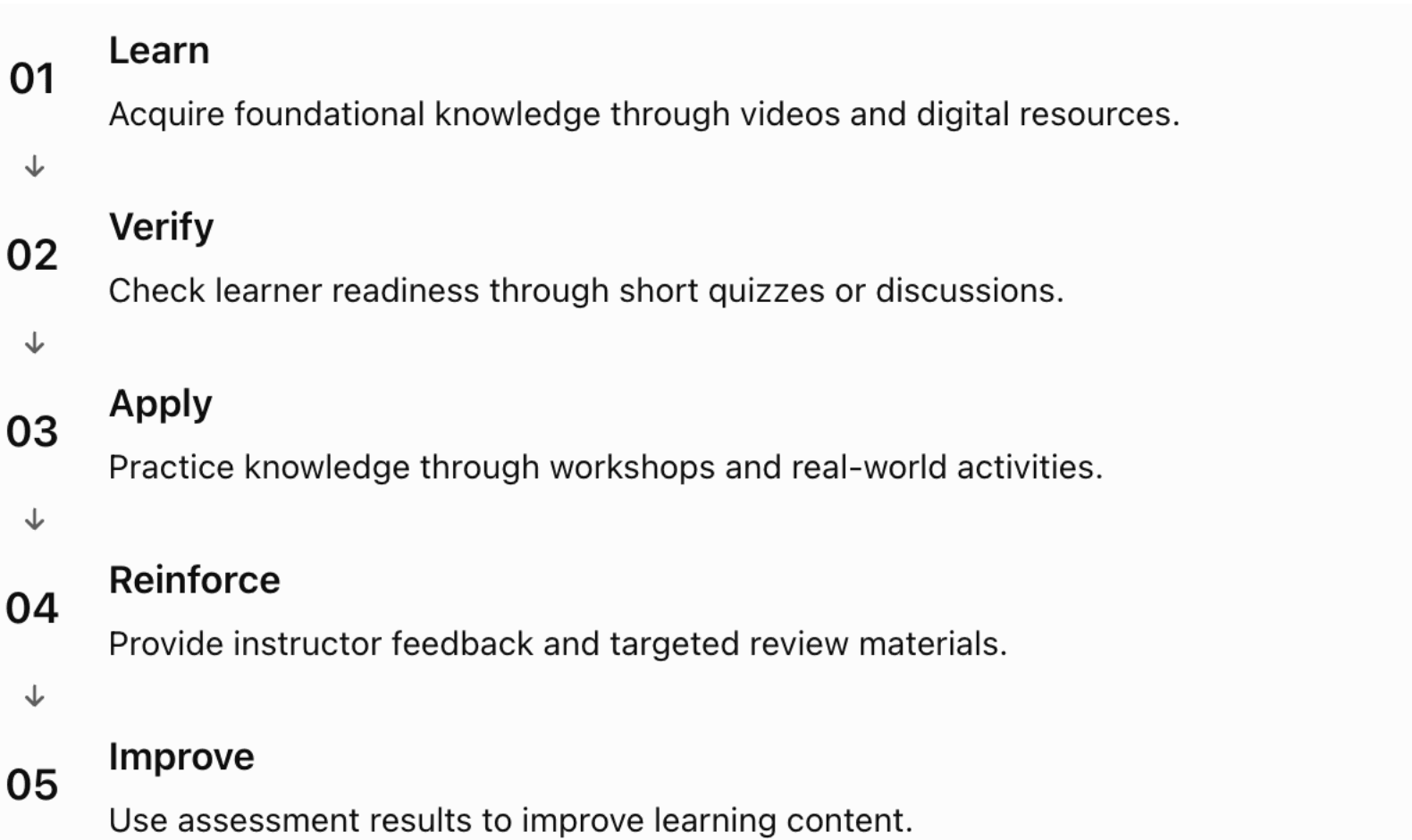
A study on video-based flipped classrooms examined how connecting questions in pre-class videos with classroom reviews can support learning processes and outcomes.
Measure Learning Outcomes and Continuously Improve
Effective evaluation should extend beyond attendance and video completion rates.
Track knowledge retention, skill acquisition, learning transfer, and training costs. For corporate training, evaluate whether employees can apply newly acquired knowledge to their daily responsibilities.
Watching a training video demonstrates participation, not necessarily competency.
How Can AI Videos Improve Blended Learning?
AI video generators help educators and L&D teams create the digital component of blended learning without relying entirely on traditional filming, recording, and editing workflows.
Turn Existing Learning Materials into AI Videos
Many organizations already have valuable knowledge stored in PDFs, PowerPoint presentations, textbooks, and training documents. The challenge is transforming these materials into accessible video lessons.
With Leadde, educators and training teams can follow a document-to-video workflow:
- Upload learning materials: Import PDFs, presentations, or training documents.
- Structure the content: Extract key concepts and organize them into a logical video narrative.
- Generate the video: Create instructional scenes with AI narration or avatars.
- Review and refine: Verify terminology, factual accuracy, and learning objectives.
- Distribute learning resources: Share videos through an LMS or educational platform.
This workflow reduces the need to build every instructional video from scratch.
Use Microlearning and Multilingual Videos to Support Learning
Instead of converting an entire training manual into one long video, divide the material into focused microlearning videos.
For example, an employee safety manual could become separate videos covering preparation, operating procedures, common mistakes, and emergency protocols.
Research by Cynthia Brame emphasizes cognitive load management, learner engagement, and active participation when designing educational videos.
PubMed
Leadde also supports multilingual video generation, helping organizations create localized learning resources for international classrooms and distributed workforces.
When to Use AI Videos and When Human Instruction Matters
Not every learning activity requires a video. Choose the format according to the learning objective.
| Learning Objective | Recommended Format |
| Understand complex concepts | AI explainer video |
| Learn software procedures | Screen-recorded tutorial |
| Review policies | Searchable document |
| Develop communication skills | Instructor-led role-play |
| Master practical skills | Hands-on demonstration |
| Verify competency | Observed assessment |
AI can support script development, narration, and content production, while instructors remain responsible for instructional decisions, subject accuracy, personalized guidance, and competency evaluation.
Keep Learning Content Accurate and Up to Date
Educational videos are long-term learning assets, not one-time deliverables.
When a policy, product feature, or curriculum changes, outdated videos can introduce inconsistencies across learning programs.
Maintain a sustainable learning content lifecycle by:
- Organizing videos into independent knowledge modules.
- Recording the source document and version for each video.
- Reviewing AI-generated content before publishing.
- Updating affected modules when source materials change.
- Checking consistency across language versions.
Leadde helps simplify structured video creation and localization, allowing educators and training teams to focus more on learning design and less on repetitive production work.
Frequently Asked Questions About Blended Learning
Is blended learning more effective than traditional learning?
Blended learning can improve flexibility, engagement, and knowledge retention when digital and face-to-face activities complement each other. However, its effectiveness depends on instructional quality, learner readiness, technology access, and meaningful assessment rather than the delivery format alone.
What are the four main models of blended learning?
The four main models are Rotation, Flex, A La Carte, and Enriched Virtual. The Rotation model includes four subcategories: Station Rotation, Lab Rotation, Flipped Classroom, and Individual Rotation, creating seven commonly recognized blended learning models.
What is the role of a teacher in blended learning?
Teachers design learning activities, guide discussions, provide feedback, address misunderstandings, and assess learner progress. Digital resources can handle repeatable knowledge delivery, allowing teachers to dedicate more time to personalized guidance, collaborative learning, and practical skill development.
Is there an ideal ratio of online to face-to-face learning?
There is no universal ratio. The appropriate balance depends on learning objectives, subject complexity, learner independence, and available resources. Theoretical knowledge may be delivered online, while activities requiring supervision, collaboration, or practical demonstrations often benefit from face-to-face instruction.
Can blended learning be used for employee onboarding?
Yes. Organizations can combine self-paced onboarding videos with instructor-led orientation, workplace mentoring, and practical assessments. AI video generators such as Leadde can help convert company policies, SOPs, and existing training materials into standardized learning videos for new employees.
Conclusion
Blended learning works best when digital content, human instruction, and practical activities serve shared learning objectives. With AI video tools like Leadde, educators and training teams can transform existing knowledge into scalable learning resources while preserving the human interaction essential to effective learning.