What Is an AI Teacher? How AI Teacher Avatars Are Changing Online Learning (2026)
An AI teacher is an artificial intelligence-powered system that explains concepts, delivers lessons, and supports learning. With AI teacher avatars, educators can create virtual instructors that present lessons through natural narration, visual explanations, and multilingual videos.
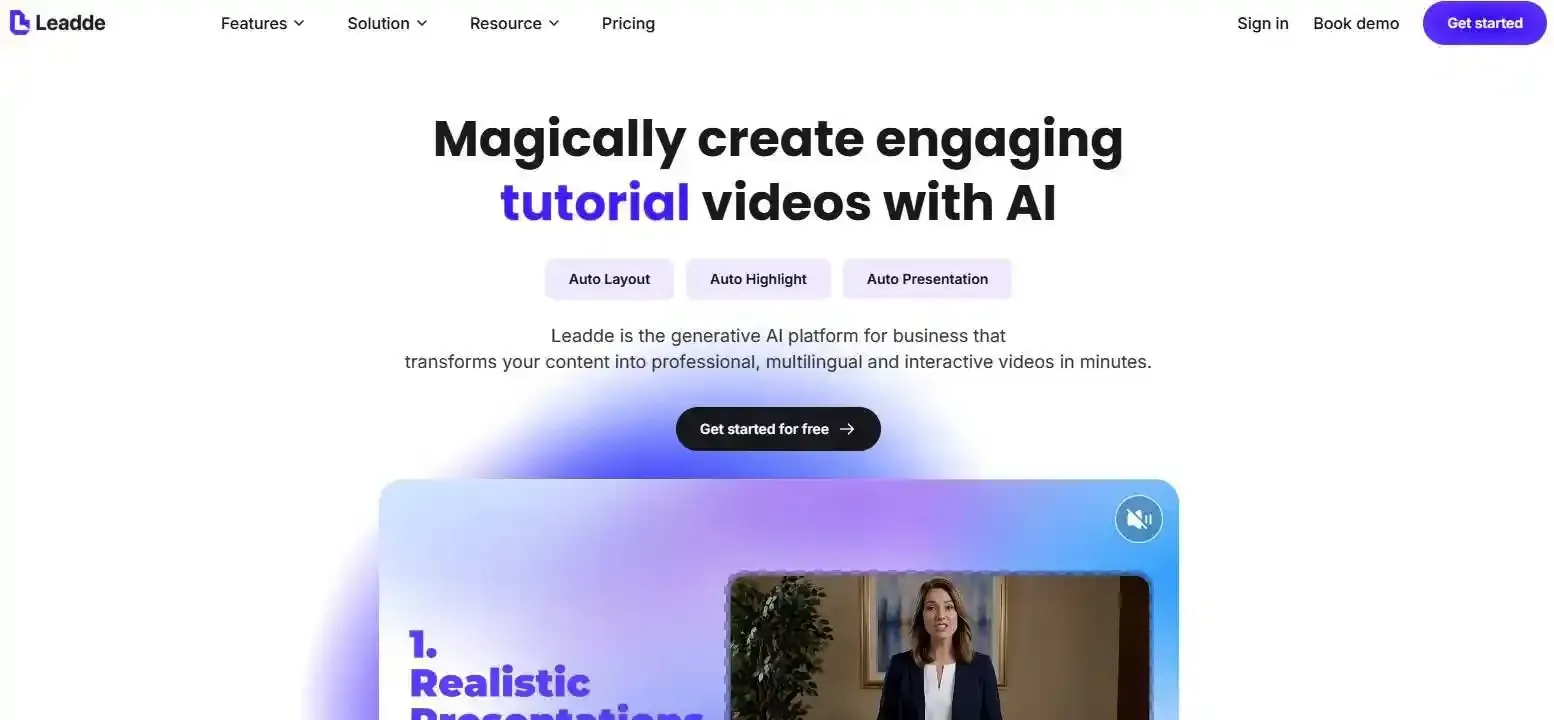
Tools like Leadde take this further by transforming PDFs, PowerPoint presentations, and teaching materials into structured video lessons without traditional filming.
This guide explores how AI teachers work, their benefits and limitations, the best AI teaching tools in 2026, and how to create your own AI teacher avatar for online learning.
AI Teacher: What Is It and How Does It Work?
What Is an AI Teacher?
An AI teacher is a digital system that uses artificial intelligence to explain knowledge, generate educational content, provide learning assistance, or deliver structured lessons. It can take the form of an interactive AI tutor, a virtual teacher avatar, or an automated teaching video designed to support students and educators.
Unlike general-purpose chatbots, effective AI teaching systems are designed around specific learning objectives, instructional methods, and educational content.
How Does an AI Teacher Work?
AI teachers combine several technologies to understand educational materials and deliver knowledge:
- Large language models (LLMs): Understand questions, explain concepts, and generate teaching scripts.
- Multimodal AI: Processes text, images, charts, presentations, and other learning materials.
- AI avatars: Present lessons through computer-generated virtual instructors.
- Text-to-speech technology: Converts teaching scripts into spoken explanations.
- Adaptive learning systems: Adjust instruction according to student performance when supported by the platform.
Not every AI teacher includes all these capabilities. While conversational tutors respond dynamically to students, AI teacher avatars can deliver prepared, structured video lessons.
Types of AI Teachers
| Type | Primary Function | Best For |
| Conversational AI Tutor | Interactive explanations and feedback | Individual learning |
| AI Teaching Assistant | Lesson planning and resource creation | Educators |
| AI Avatar Teacher | Virtual instructor-led lessons | Online courses |
| AI Video Teacher | Structured educational videos | Self-paced learning |
| AI Robot Teacher | Physical classroom interaction | Experimental education |
An important distinction is that personalized content is not the same as adaptive learning. A multilingual AI teaching video can address different learner needs, but it does not necessarily adjust its explanations based on individual student performance.
How Are AI Teachers Used in Education?
Personalized Learning and Student Tutoring
AI tutors help students explore difficult concepts, practice exercises, prepare for examinations, and receive explanations suited to their knowledge level.
For example, instead of revealing a mathematical solution immediately, an AI tutor can provide progressive hints that encourage students to develop independent problem-solving skills.
Lesson Planning and Curriculum Development
AI is increasingly used to develop syllabi, lesson plans, classroom activities, and educational resources.
Anthropic's 2025 Education Report analyzed approximately 74,000 anonymized conversations involving higher education professionals. Curriculum development accounted for 57% of the analyzed conversations, making it the most common identified application.
AI-Powered Educational Videos and Online Courses
AI teacher avatars are changing how educators produce and distribute online learning content.
Teachers can convert existing instructional materials into educational videos for flipped classrooms, university courses, language learning, examination preparation, and employee training.
A university lecturer, for example, could transform a presentation into short video lessons that students review before class, leaving classroom time available for discussion and problem-solving.
With AI video platforms such as Leadde, educators can also create multilingual versions of existing lessons without recording each language separately.
Are AI Teachers Effective? Benefits and Real-World Evidence
Key Benefits of AI Teachers
AI teachers offer several practical advantages for students, educators, and online learning platforms.
- Flexible learning: Students can revisit explanations and lessons at their own pace.
- Reduced teacher workload: AI assists with lesson preparation, scriptwriting, and educational video production.
- Multilingual accessibility: Educational content can be adapted for learners who speak different languages.
- Scalable content production: Schools and businesses can reuse teaching resources across multiple courses.
- Easier content updates: AI-generated lessons can be revised without repeating the entire filming process.
However, generating educational content faster does not automatically improve learning outcomes.
What Does the Research Say About AI Teaching?
Research suggests that AI-generated instruction can support effective learning under appropriate conditions.
A 2025 study published in the British Journal of Educational Technology compared AI-generated instructional videos with human-recorded videos among 76 participants. The AI video group achieved significantly higher knowledge retention scores, although there was no significant difference in knowledge transfer or overall performance.
Wiley Online Library
Meanwhile, Instruction Partners studied 20 AI-powered educational products across 32 classrooms in seven US states, examining how AI affects real instructional experiences. Its research emphasizes purposeful implementation and teacher involvement.
ailearningtour.instructionpartners.org+1
These findings suggest that instructional design matters as much as the AI technology itself.
How to Measure AI Teaching Effectiveness
Educators should evaluate AI teachers using meaningful educational metrics rather than video views or task completion alone.
| Evaluation Metric | What to Measure |
| Knowledge Retention | Can students remember key concepts? |
| Knowledge Transfer | Can students apply knowledge in new situations? |
| Independent Learning | Can students solve problems without AI? |
| Curriculum Alignment | Does the content meet learning objectives? |
| Teacher Time Saved | Does AI reduce total preparation time? |
One frequently overlooked factor is what I call the AI Teacher Review Tax: the time educators spend checking, correcting, and refining AI-generated materials.
Actual time saved = Traditional production time − Total AI production and review time.
Measuring the complete workflow provides a more realistic understanding of AI's value than measuring generation speed alone.
What Are the Best AI Teacher Tools in 2026?
The best AI teacher tool depends on whether you need personalized tutoring, curriculum development, or AI-generated teaching videos.
| AI Teacher Tool | Best For | Key Features |
| Leadde | Educational video creation | Document-to-video, structured lessons, AI avatars, multilingual narration |
| ChatGPT Study Mode | Independent learning | Guided explanations and step-by-step learning |
| Khanmigo | Student tutoring | Interactive learning and teaching assistance |
| MagicSchool | Teachers | Lesson planning and assessment resources |
| NotebookLM | Source-based learning | Document analysis and video overviews |
| HeyGen | Course creators | AI avatar videos and video localization |
| Synthesia | Corporate training | AI presenters and instructional videos |
For interactive student tutoring, ChatGPT Study Mode and Khanmigo are suitable options. For teachers who want to convert existing documents into structured, multilingual video lessons, Leadde offers a dedicated content-to-video workflow.
Rather than choosing an AI teacher based solely on its features, consider your learning objectives, content formats, and required level of student interaction.
How to Create Your Own AI Teacher With AI-Generated Videos
Creating an AI teacher avatar no longer requires cameras, recording studios, or advanced video editing skills. Platforms like Leadde allow educators to transform existing knowledge into virtual instructor-led video lessons.
Turn PDFs and PowerPoints Into Structured Video Lessons
Using Leadde's Document-to-Teaching-Video tool, educators can follow a streamlined workflow:
- Upload teaching materials: Import PDFs, PowerPoint presentations, or course documents.
- Structure the lesson: Organize key concepts into a logical teaching sequence.
- Generate the video: Create teaching scripts, visual scenes, AI avatars, and narration.
- Review and refine: Check explanations, terminology, and instructional pacing.
- Export and distribute: Publish the completed video to an online course or learning management system.
The most important consideration is Source-to-Lesson Fidelity — preserving the accuracy, completeness, and instructional logic of the original teaching materials throughout the conversion process.
Create an AI Avatar Teacher or Visual Learning Experience
Not every educational video needs a virtual presenter. The presentation format should match the learning objective.
| Teaching Scenario | Recommended Video Format |
| Course introduction | AI teacher avatar |
| Language learning | Avatar with pronunciation examples |
| Scientific concepts | Narrated diagrams and animations |
| Mathematics | Step-by-step visual explanations |
| Software tutorials | Screen demonstrations |
| Employee onboarding | Avatar-led instructional videos |
From an instructional design perspective, an AI avatar should support knowledge delivery rather than distract from it. Complex subjects often benefit more from clear visual demonstrations than a continuous talking-head presentation.
Review, Localize, and Deliver Your AI Lessons
Before publishing an AI-generated lesson, educators should verify factual accuracy, pronunciation, visual relevance, and curriculum alignment. Multilingual versions should also be checked for terminology and cultural appropriateness.
For example, a university lecturer could use Leadde to convert an existing presentation into a narrated video lesson, generate additional language versions, and accompany each lesson with independent practice exercises.
Create your first AI teacher video with Leadde.
Can AI Teachers Replace Human Teachers? Risks and Limitations
AI teachers can automate parts of instruction and educational content production, but they cannot fully replace the professional judgment, emotional intelligence, and responsibilities of human educators.
AI Hallucinations and Student Overreliance
AI systems can generate inaccurate explanations, omit important information, or encourage students to rely on automatically generated answers.
A 2025 study published in PNAS found that generative AI without appropriate safeguards could negatively affect students' independent mathematics performance after AI assistance was removed.
Educators should therefore prioritize guided practice, independent assessments, and human-reviewed instructional materials.
Privacy, Cost, and Educational ROI
Schools must consider student data privacy, technology maintenance, licensing costs, and measurable educational outcomes.
In June 2026, Voice of San Diego reported that Altus Schools spent $500,000 on two AI-powered humanoid robots. At the time of reporting, the school had not established whether the investment produced measurable academic improvements.
The case illustrates an important principle: technological sophistication does not automatically translate into educational effectiveness.
Why Human-AI Co-Teaching Works Better Than Full Automation
A practical approach is to delegate repetitive content production tasks to AI while keeping educational decisions under human control.
| Teaching Task | Recommended Responsibility |
| Teaching script generation | AI with human review |
| Educational video production | AI with human review |
| Multilingual content creation | AI with human review |
| Learning objective design | Human teacher |
| Student learning assessment | Human-led, AI-assisted |
| Emotional support | Human teacher |
This collaborative approach allows educators to expand their teaching capacity without sacrificing instructional quality or accountability.
Conclusion
AI teachers and AI teacher avatars are changing online learning by making educational content easier to create, update, and distribute. Platforms like Leadde help educators transform existing knowledge into scalable video lessons. However, the greatest educational value comes from combining AI-powered content production with thoughtful instructional design, human expertise, and active learning.
Frequently Asked Questions
Is there a free AI teacher online?
Yes. Tools such as ChatGPT and MagicSchool offer free access to certain AI learning and teaching features. Some AI video generators also provide free plans or limited video generation credits. Available features, usage limits, and regional restrictions vary by platform.
Can ChatGPT act as an AI teacher?
Yes. ChatGPT can explain concepts, generate practice questions, and guide students through learning activities. Its Study Mode is designed to encourage step-by-step understanding rather than simply providing answers. However, students should verify important information and use ChatGPT alongside reliable educational resources.
Can an AI teacher teach multiple subjects?
AI teachers can support subjects including mathematics, science, languages, history, and professional training. Their effectiveness depends on the accuracy of their knowledge, the quality of instructional materials, and the educational design. Complex or specialized subjects require additional expert review.
Can I turn a PDF into an AI teacher video?
Yes. AI video platforms such as Leadde can transform PDFs, PowerPoint presentations, and educational documents into structured video lessons with AI teacher avatars and narration. Educators can review the generated content before distributing it to students or publishing it on learning platforms.
How much does an AI teacher cost?
AI teacher costs vary depending on the technology. Conversational AI tutors may offer free or subscription-based access, while AI avatar platforms typically charge according to features or video usage. Physical AI teaching robots involve significantly different hardware and maintenance costs.
Are AI teachers safe for students?
AI teachers can support learning responsibly when appropriate privacy protections, age-appropriate safeguards, human supervision, and content verification are in place. Schools should evaluate each platform's data policies and instructional limitations before allowing students to use it independently.
Editorial note: The classroom research is referenced through Instruction Partners' original research because the supplied The 74 article was inaccessible. The proposed teaching workflows and evaluation methods are practical recommendations, not independently verified Leadde performance tests.